THE CLASSIC COLLECTION✦An outlaw’s diary: the CommuneCLASSIC FREE BOOKS
An outlaw’s diary: the Commune
Cécile Tormay
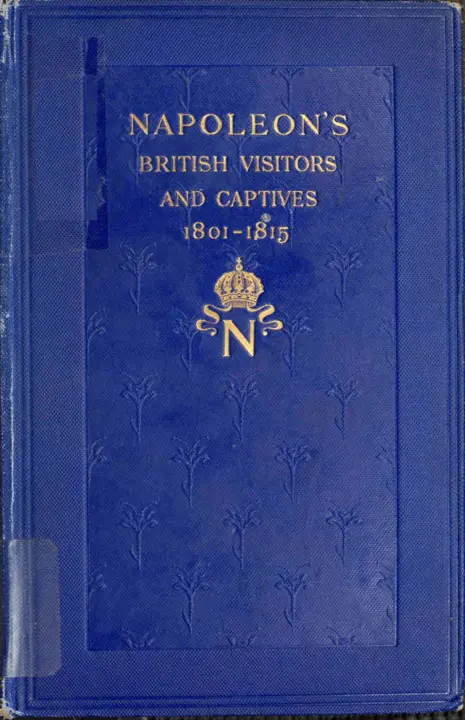
THE CLASSIC COLLECTION · 1904
"Napoleon's British Visitors and Captives, 1801-1815" by John Goldworth Alger is a historical account written in the early 20th century. The book explores the interactions and experiences of British visitors and captives in France during the tumultuous period of Napoleon's rise and reign. Alger delves into the social dynamics, political undertones, and personal stories that emerged as Englishmen navigated their relationships with French citizens amid shifting allegiances and changing circumstances. The opening of the work sets the stage for a comprehensive examination of the vast impact of the French Revolution, highlighting the notable dislocation of individuals across Europe, particularly among the French nobility and other political figures. Alger outlines how the Peace of Amiens in 1802 marked a significant uptick in British travel to France after a decade of hostilities, with numerous English visitors eager to witness the transformative atmosphere of post-revolutionary France. The introductory chapter establishes a backdrop of historical context, emphasizing the social and political exchanges that occurred not only between British visitors and French society but also amidst the hardships faced by those who found themselves unexpectedly detained under Napoleon's regime.
Introduction adapted from the source catalogue; source summaries may be automatically generated.
Free to read · English · 89,397 words · No account needed
MAKE TIME FOR A GOOD BOOK
On by default. Untick to stop anonymous reading totals. Each page counts after 10 seconds in view. How this works.
Anonymous counting is on unless you have switched it off.
Cavan had just returned from Egypt, where he had commanded a division under Abercromby. The Cholmondeleys had been in Paris in 1791, their son and heir being born there. We shall hear presently of their equipages. The Countess (afterwards Marchioness) Conyngham is notorious for her liaison with George IV. Egremont was long a prominent figure in London society, but is more deserving of notice as one of the earliest patrons of Turner the artist. Elgin, of marble fame, was on his way home from the Constantinople embassy. We shall have to speak hereafter of his wife and her paramour Ferguson. Fife, afterwards a distinguished general in the Peninsular War, wounded at Talavera and Cadiz, was great-uncle of the present Duke of Fife. Fitzwilliam had in 1794 been Lord Lieutenant of Ireland, where his three months’ rule was looked back to with regret. Lady Granard, sister of the Earl of Moira, on her honeymoon in 1780 had seen Cardinal York, and had also witnessed a review by Frederic II. Guilford was the son of the Lord North who lost us our American colonies. He stayed seven months, and would have remained longer but for the rupture.
Lady Kenmare (Mary, daughter of Michael Aylmer) was known for her Sunday evening receptions in London, and for a romantic story of her husband’s attachment to her before his first wife’s death, or even before his first marriage. A Gerald Aylmer, who also visited Paris, was probably her kinsman. The Countess of Kingston, who must not be confused with the Duchess of Kingston, the notorious bigamist, was accompanied by two unmarried daughters, probably also by her other daughter, Lady Mount Cashell. One of these daughters had in 1798 been the occasion of a duel in which her brother shot his adversary. Lady Lanesborough, daughter of the Earl of Belvedere, had, as we shall see, found a second and plebeian husband. Lauderdale had witnessed and sympathised with the Revolution, Dr. (father of Sir John) Moore then accompanying him as physician. His Whig opinions had made him lose his seat as a Scottish representative peer in the House of Lords, and his anxiety for the maintenance of peace made Whitworth shut his door to him as one of ‘our rascally countrymen.’[58] His son, moreover, a youth of eighteen, styled himself ‘citizen’ Maitland.[59] Minto, the Gilbert Elliot who, ward of David Hume, was at school with Mirabeau, and was consequently sent over in 1790 to bribe him into keeping France neutral in our threatened quarrel with Spain over Nootka Sound, had been Governor of Corsica. He was one of the earliest visitors, was on his way home from the Vienna Embassy, and was destined to be Viceroy of India. Mount Edgecumbe was an amateur actor and musical composer. His wife,[60] with their young daughter Emma Sophia, afterwards Countess Brownlow and writer of Reminiscences of a Septuagenarian, had previously been to Spa, where she met the Duchess of Gordon, the Conynghams, the Bradfords, Charles and Lady Charlotte Greville, and Dudley and Lady Susan Ryder. She had a serious illness in Paris. Lord Oxford had a great admiration for Napoleon and also for Murat. His wife, who required change of climate, was very handsome, though not rivalling Madame Tallien. Pembroke was the father of Sidney Herbert, the statesman of our time, and in 1806 was Ambassador at Vienna. He stayed three months, and being an excellent observer and a patient listener, his account of Paris was eagerly sought for. Shaftesbury, uncle of the philanthropist of our day, took his wife, a daughter of Sir John Webb, and their daughter. Winchilsea was the father of the fanatical Orangeman who in 1829 fought a duel, on account of Catholic Emancipation, with Wellington, but happily without bloodshed. Viscount Falkland, less fortunate, was killed in a duel in 1809. Viscountess Maynard was the notorious Nancy Parsons whom Lord Maynard had married in 1766, in spite of her antecedents. She had been a widow since 1775, and had been the mistress of the late Duke of Bedford, who, by his will, continued his annuity to her of £2000. Lord Monck, who took over his wife and two daughters, was the grandfather of the Viceroy of Canada. He died shortly after his return, in June 1802. Viscount Strangford was afterwards Ambassador at Lisbon, Stockholm, Constantinople, and St. Petersburg, and translated Camoëns’ Lusiad. Moore, Rogers, and Croker were among his friends.
Your reading position is saved on this browser. Take it to another device with a library code. Reading pages adapt to text, rather than matching a printed edition.
BEHIND THE BOOK
This eBook is for the use of anyone anywhere in the United States and most other parts of the world at no cost and with almost no restrictions whatsoever. You may copy it, give it away or re-use it under the terms of the Project Gutenberg License included with this eBook or online at www.gutenberg.org. If you are not located in the United States, you will have to check the laws of the country where you are located before using this eBook. Read the source licence.
The original source file, including credits and licence, is retained by this library. Request an original-format copy at no charge. Please include the book title and Project Gutenberg identifier #70408.
KEEP YOUR CURIOSITY GOING
Cécile Tormay

Moritz Busch
John L. Ransom
Frances Wright
Cécile Tormay

Mabel Potter Daggett