THE CLASSIC COLLECTION✦An outlaw’s diary: the CommuneCLASSIC FREE BOOKS
An outlaw’s diary: the Commune
Cécile Tormay
THE CLASSIC COLLECTION · 1904
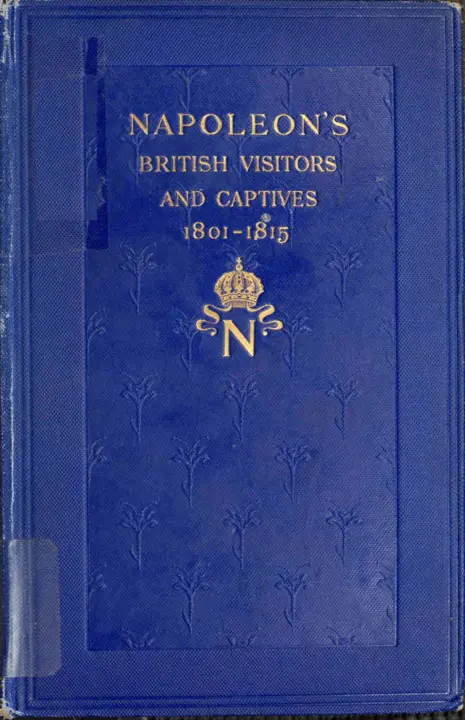
"Napoleon's British Visitors and Captives, 1801-1815" by John Goldworth Alger is a historical account written in the early 20th century. The book explores the interactions and experiences of British visitors and captives in France during the tumultuous period of Napoleon's rise and reign. Alger delves into the social dynamics, political undertones, and personal stories that emerged as Englishmen navigated their relationships with French citizens amid shifting allegiances and changing circumstances. The opening of the work sets the stage for a comprehensive examination of the vast impact of the French Revolution, highlighting the notable dislocation of individuals across Europe, particularly among the French nobility and other political figures. Alger outlines how the Peace of Amiens in 1802 marked a significant uptick in British travel to France after a decade of hostilities, with numerous English visitors eager to witness the transformative atmosphere of post-revolutionary France. The introductory chapter establishes a backdrop of historical context, emphasizing the social and political exchanges that occurred not only between British visitors and French society but also amidst the hardships faced by those who found themselves unexpectedly detained under Napoleon's regime.
Introduction adapted from the source catalogue; source summaries may be automatically generated.
Free to read · English · 89,397 words · No account needed
MAKE TIME FOR A GOOD BOOK
On by default. Untick to stop anonymous reading totals. Each page counts after 10 seconds in view. How this works.
Anonymous counting is on unless you have switched it off.
One Englishman at least was a spectator of Napoleon’s departure from Elba. A Mr. Grattan (probably the father of Thomas Colley Grattan, the traveller and novelist) had landed on the island on the 24th February. On the evening of the 26th he noticed unusual bustle, as though something was about to happen, and at 9 P.M. he saw Napoleon, escorted by General Bertrand, come out in his sister Pauline’s four-horse carriage, enter a boat, and go on board the brig Inconstant. Thereupon the whole flotilla got under way, the soldiers shouting ‘Vive l’Empereur!’ Scarcely believing his eyes, Grattan hired a boat to go alongside the brig, and thence he saw Napoleon in his grey overcoat and round hat pacing the quarter-deck. One of the boatmen, however, cried out that there was an Englishman on board, upon which an officer on the poop of the Inconstant demanded who he was and what he wanted. Grattan had to explain that he had merely come to have a look at the Emperor, whereupon he was told to be off, and he complied with alacrity, expecting every instant to be fired at or arrested.[303]
Up to the 20th March the Moniteur had continued publishing loyal addresses to Louis XVIII., but on the 21st it announced, ‘The King and the Princes left last night. His Majesty the Emperor arrived this evening at eight o’clock in his palace of the Tuileries.’ One of Napoleon’s first inquiries to a lady of his court was whether there were many English in Paris. On being told that nearly all had left he exclaimed, ‘Ah, they recollect what I did before, but those times are past. You do not repeat yourself.’ John Cam Hobhouse, Byron’s friend, afterwards Lord Broughton, tells us this, and he adds that the detentions of 1802 were against French feeling and could not have been repeated in 1815 in defiance of such a feeling. Napoleon, moreover, may have thought there was a chance of his recognition by the allies,[304] and the detention of foreigners would have been a virtual declaration of war. Yet the stampede was obviously prudent, and the principal Englishman who remained did not escape molestation. Francis Henry Egerton, as we have seen, had come over to Paris in 1802, and he had apparently continued to reside uninterruptedly, for he published several works there, both in English and French, between 1812 and 1826. He had hired a house till 1814, but on the restoration of the Bourbons he purchased the mansion of the Noailles family in the rue St. Honoré, and to show his sympathy with the new Government he paid up at once, on the 2nd March 1815, in lieu of by instalments, the stamp duty of 30,000 francs. This seems to have marked him out for Napoleon’s resentment. The house with its contents was requisitioned to serve for a Government office. Egerton resisted, stood a kind of siege, and appealed to the tribunals. He could not, it is obvious, have permanently withstood Napoleon, but he seems to have held his ground until Waterloo arrived and put an end to the affair. He lost no time in securing legal domicile and civic rights, for in default of the latter one alien could not bequeath property to another, such property being forfeit to the French Crown. His support of the Bourbons should have shielded him from further annoyance, but in 1818 he had an unpleasant episode. Workmen who were placing flower-pots on the pillars of the Tuileries gardens found it convenient to fasten ropes to the wall of his back garden in the rue de Rivoli. Egerton drove out in his carriage and required them to desist. An altercation ensued, there were cries of ‘Down with the Englishman!’ and he was dragged out of his carriage to the guardhouse. Though promptly released, he was very punctilious in exacting an apology for this indignity, threatening otherwise to quit France. He was very eccentric in his latter years, if we are to believe that cats and dogs dressed up as human beings sat at his dinner-table, and that he kept rabbits and partridges in his garden in order to have shooting on his own premises. He died as Duke of Bridgewater in 1829, aged seventy-nine, and left £8000 for eight prize treatises which were named after him. The Hôtel St. James, into which his house has been converted, contains the original staircase and other relics of the mansion in which Marie Antoinette welcomed Lafayette and Noailles on their return from America.
Your reading position is saved on this browser. Take it to another device with a library code. Reading pages adapt to text, rather than matching a printed edition.
BEHIND THE BOOK
This eBook is for the use of anyone anywhere in the United States and most other parts of the world at no cost and with almost no restrictions whatsoever. You may copy it, give it away or re-use it under the terms of the Project Gutenberg License included with this eBook or online at www.gutenberg.org. If you are not located in the United States, you will have to check the laws of the country where you are located before using this eBook. Read the source licence.
The original source file, including credits and licence, is retained by this library. Request an original-format copy at no charge. Please include the book title and Project Gutenberg identifier #70408.
KEEP YOUR CURIOSITY GOING
Cécile Tormay

Moritz Busch
John L. Ransom
Frances Wright
Cécile Tormay

Mabel Potter Daggett