THE CLASSIC COLLECTION✦An outlaw’s diary: the CommuneCLASSIC FREE BOOKS
An outlaw’s diary: the Commune
Cécile Tormay
THE CLASSIC COLLECTION · 1904
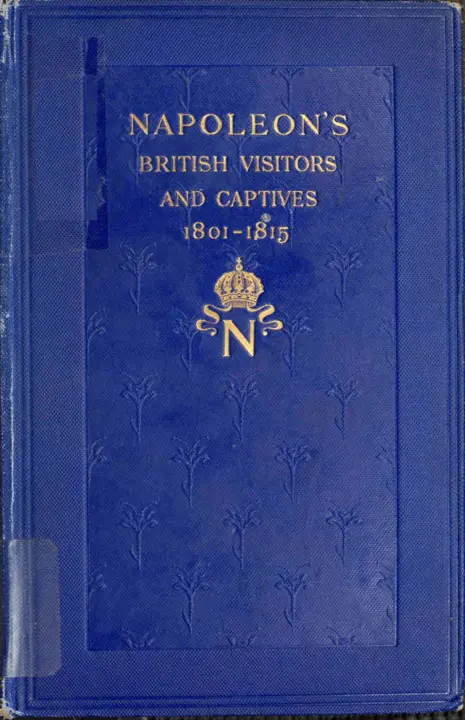
"Napoleon's British Visitors and Captives, 1801-1815" by John Goldworth Alger is a historical account written in the early 20th century. The book explores the interactions and experiences of British visitors and captives in France during the tumultuous period of Napoleon's rise and reign. Alger delves into the social dynamics, political undertones, and personal stories that emerged as Englishmen navigated their relationships with French citizens amid shifting allegiances and changing circumstances. The opening of the work sets the stage for a comprehensive examination of the vast impact of the French Revolution, highlighting the notable dislocation of individuals across Europe, particularly among the French nobility and other political figures. Alger outlines how the Peace of Amiens in 1802 marked a significant uptick in British travel to France after a decade of hostilities, with numerous English visitors eager to witness the transformative atmosphere of post-revolutionary France. The introductory chapter establishes a backdrop of historical context, emphasizing the social and political exchanges that occurred not only between British visitors and French society but also amidst the hardships faced by those who found themselves unexpectedly detained under Napoleon's regime.
Introduction adapted from the source catalogue; source summaries may be automatically generated.
Free to read · English · 89,397 words · No account needed
MAKE TIME FOR A GOOD BOOK
On by default. Untick to stop anonymous reading totals. Each page counts after 10 seconds in view. How this works.
Anonymous counting is on unless you have switched it off.
There was Thelwall, the acquitted Radical of 1794, who had temporarily renounced politics and taken to the cure of stammering. There was Arthur Thistlewood, who, it is said, had visited Paris in 1794, and who soon entered into conspiracies, the last of which, named from Cato Street, resulted in his conviction and execution in 1820. He was decidedly an exception among the visitors, yet the Paris air may have helped to lead him astray, for it was an atmosphere of conspiracy.
There were philosophers and historians such as Sir James Mackintosh, who was anxious to explore the French archives, taking ten copyists with him; but these formidable preparations not unnaturally occasioned obstruction from a suspicious curator, Hauterive,[274] so that Wellington had to urge that no mischief could result from the disclosure of political secrets half a century old. Mackintosh’s son-in-law, Claudius James Rich, the traveller, accompanied him, and the transcripts then made are now in the British Museum. They are limited to the times of the Stuarts.
Archibald Alison, the future historian, accompanied by a fellow Scot and fellow historian, Patrick Fraser Tytler, also went in May 1814, returning by Flanders. It is not clear from their joint narrative whether both or Tytler alone went in the autumn to Aix, staying till the eve of Napoleon’s return.
There were three poets, Rogers, Moore, and Campbell, the last stopping at Rouen to see his brother Daniel, from whom he had parted at Hamburg in 1800. Mrs. Siddons took over her daughter Cecily, who did not continue her mother’s fame, but married a Scottish lawyer, George Combe. Kemble escorted her, with Mrs. Twiss, whose brother-in-law Richard had seen Paris in 1792. There was Mrs. Damer, the artist, of whom we have already heard and shall hear again. There was the more eminent sculptor Chantrey, who made the acquaintance of Canova. There was Curran, who had just resigned his judgeship, and Serjeant Best, not yet a judge. The Duke of Sussex had given Curran an introduction to the future Charles X. Everything he heard intensified his hatred of Napoleon.[275] There were military men like General Ramsay, Bruce, destined to assist in the escape of Lavalette, and Lord Cathcart, who had taken part in the expedition to Copenhagen and was subsequently Ambassador to St. Petersburg. Madame Junot, in whose house Cathcart was quartered, and who speaks highly of his courtesy, had also to receive Lord and Lady Cole, who sent for Eliza Bathurst. She was the handsome daughter of the diplomatist who so mysteriously disappeared. Another military visitor was Colonel William Carmichael Smyth, who had accompanied his father in 1802; but Count Nugent, though born in Ireland, was an Austrian officer. The Navy was represented by Sir Sidney Smith, who was bound for the Congress of Vienna to plead for the reinstatement of Gustavus IV. on the throne of Sweden. He also advocated an international expedition against the piratical Dey of Algiers, of which he would himself have taken the command. Nothing came of either scheme, but he got up a subscription dinner, attended by royal and other celebrities, the proceeds of which were devoted to the redemption of prisoners in Algiers. Science was represented by a Scottish professor, John (afterwards Sir John) Leslie, an Edinburgh Reviewer and eminent mathematician, who formed the habit of paying yearly visits to the Continent. There were philanthropists like Clarkson, who, as on his visit in 1789, was eager to obtain the consent of the new French Government to the abolition of the slave-trade, while Wilberforce and Zachary Macaulay, the historian’s father, were interesting themselves at home in the same cause, the latter sending over, or taking advantage of the presence of, his brother General Macaulay. Clarkson found sympathy from Lafayette, Bishop Grégoire, and Madame de Staël. The antiquary and connoisseur, James Millingen, passed through Paris on his way to or from Florence, as also William Stewart Rose, translator of Ariosto, friend of Ugo Foscolo, Walter Scott, and the Countess of Albany. He was destined to find a wife at Venice. There were painters like Stothard, Wilkie, and Haydon, to the last of whom we are indebted for the liveliest account of Paris, though this, like the rest of his journal, was not published till after his tragical death. He represents Wilkie as constantly exclaiming, ‘What a fool Napoleon was to lose such a country! dear, dear!’ Both Wilkie and Haydon sang ‘God save the King’ in the streets of Rouen, to the amazement or amusement of the townsmen, one of whom said they were English milords. In Paris Wilkie tried to sell his prints, and had frequent disputes at restaurants about change. Another note-taker was Thomas Raikes, brother of the founder of Sunday-schools, but unfortunately his diary does not begin till 1832. A third diarist was Henry Crabb Robinson, to whom street urchins at Dieppe shouted ‘Be off!’ and who in a Rouen theatre heard a line against England applauded. He spent five weeks in Paris without a moment’s ennui, yet left it without a moment’s regret, travelling to Boulogne in company with Copleston, ‘a very sensible, well-informed clergyman,’ just elected Provost of Oriel at Oxford, and destined to be Bishop of Llandaff. Stephen Weston and William Shepherd went doubtless with the intention of again reporting their adventures. William D. Fellowes found material for one of his books, and on another visit in 1817 he visited the old monastery of La Trappe. There were agriculturists like Morris Birkbeck of Wanborough. There were doctors like Hume, chief physician to the army, and Williams the oculist.
Your reading position is saved on this browser. Take it to another device with a library code. Reading pages adapt to text, rather than matching a printed edition.
BEHIND THE BOOK
This eBook is for the use of anyone anywhere in the United States and most other parts of the world at no cost and with almost no restrictions whatsoever. You may copy it, give it away or re-use it under the terms of the Project Gutenberg License included with this eBook or online at www.gutenberg.org. If you are not located in the United States, you will have to check the laws of the country where you are located before using this eBook. Read the source licence.
The original source file, including credits and licence, is retained by this library. Request an original-format copy at no charge. Please include the book title and Project Gutenberg identifier #70408.
KEEP YOUR CURIOSITY GOING
Cécile Tormay

Moritz Busch
John L. Ransom
Frances Wright
Cécile Tormay

Mabel Potter Daggett