READ · DISCOVER · ENJOYClassic literature · Always free
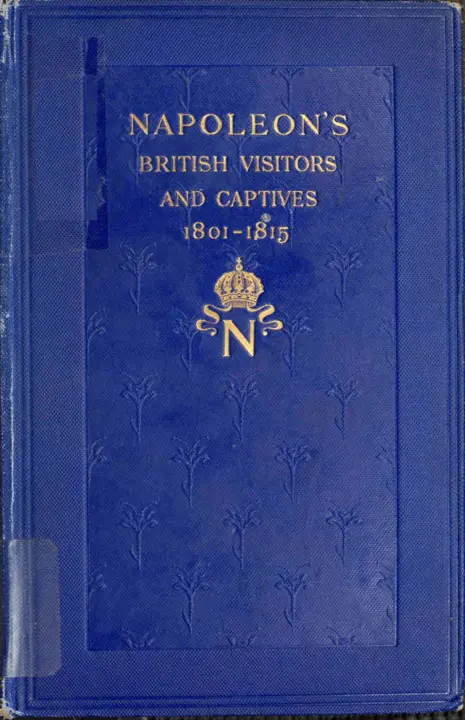
Napoleon’s British visitors and captives, 1801-1815 — digital edition cover

THE CLASSIC COLLECTION · 1904

Napoleon’s British visitors and captives, 1801-1815

"Napoleon's British Visitors and Captives, 1801-1815" by John Goldworth Alger is a historical account written in the early 20th century. The book explores the interactions and experiences of British visitors and captives in France during the tumultuous period of Napoleon's rise and reign. Alger delves into the social dynamics, political undertones, and personal stories that emerged as Englishmen navigated their relationships with French citizens amid shifting allegiances and changing circumstances. The opening of the work sets the stage for a comprehensive examination of the vast impact of the French Revolution, highlighting the notable dislocation of individuals across Europe, particularly among the French nobility and other political figures. Alger outlines how the Peace of Amiens in 1802 marked a significant uptick in British travel to France after a decade of hostilities, with numerous English visitors eager to witness the transformative atmosphere of post-revolutionary France. The introductory chapter establishes a backdrop of historical context, emphasizing the social and political exchanges that occurred not only between British visitors and French society but also amidst the hardships faced by those who found themselves unexpectedly detained under Napoleon's regime.

Introduction adapted from the source catalogue; source summaries may be automatically generated.

Start reading ↓

Free to read · English · 89,397 words · No account needed

MAKE TIME FOR A GOOD BOOK

Napoleon’s British visitors and captives, 1801-1815

On by default. Untick to stop anonymous reading totals. Each page counts after 10 seconds in view. How this works.

Anonymous counting is on unless you have switched it off.

Napoleon’s British visitors and captives, 1801-1815

Stewart Kyd, the ex-radical, and Dr. Barklimore escaped, but the two bankers, Boyd and Benfield, had to undergo the full time of detention. Benfield died in Paris, in straitened circumstances, in 1810. One of his daughters married Grantley Berkeley. According to a police bulletin Benfield was a nullity, whereas Boyd was acquiring a thorough knowledge of French institutions. He arbitrated on a claim against the French Government by Schweizer, Swan’s partner and antagonist, who pronounced him to be a man of great culture and acknowledged probity. He also wrote pamphlets on financial subjects. He was indemnified for French confiscation, and from 1828 to 1830 was M.P. for Lymington. He died in 1837. Another man who made good use of his time was Tuckey, who, captured in 1805, compiled a maritime geography in three volumes. He had previously published an account of a voyage to Botany Bay with a cargo of convicts. He died while exploring the River Congo in 1816.

In several instances besides those already mentioned detention was followed up by actual incarceration. James Smith, the filter-maker, was sent to the Temple in 1804 for talking against the French and extolling the defences of England, to which he had paid frequent visits.[204] Colonel Stack was charged in the same year with espionage. It is even alleged, but this cannot be verified, that he was condemned to be shot as an accomplice of the Due d’Enghien, but was reprieved. What is certain is that he spent three years in Bitche citadel, afterwards remaining a prisoner at Verdun till 1814. Colonel William Edwards, a Jamaica planter, brother I think of Bryan Edwards, M.P., was imprisoned seven years on suspicion of having facilitated escapes. The youngest of his twenty-nine children, born at Bruges in 1800, was Milne Edwards, the eminent French naturalist.

We now come to the liberations and permissions to visit or settle in various towns, for each of which Napoleon’s express sanction was necessary, and we may begin with Lord Yarmouth, since he owed his liberty to negotiations, albeit fruitless, for peace. He had become a prisoner under trying circumstances. He went over to fetch his wife and children just as the rupture had occurred, and he inquired at Calais whether he might safely land. He was answered in the affirmative, yet no sooner had he done so than he, with all his fellow-passengers, was declared a prisoner. Curiously enough, however, he professed to consider the detentions as justified by the embargo in England. He was sent to Verdun, but it was alleged in March 1804 that he had been seen in Paris. Wirion, reproached with laxity on this account, denied, however, that he had gone further afield than Clermont on an affair of gallantry. He had been exempted, indeed, from the twice-a-day roll-call till all exemptions had been abolished, and he had also been allowed to go out shooting; but Wirion urged that permission to go outside the town tended to prevent escapes by rendering them dishonourable, and if such permissions were to be refused the garrison should be strengthened, the walls being so dilapidated that egress was easy.[205] Yarmouth’s mother had been in favour with the Prince of Wales, and he himself had then, as a youth, been admitted to Carlton House. When, therefore, Fox in 1806, on the death of Pitt, became Foreign Secretary, the Prince asked him to intercede with Talleyrand for Yarmouth’s release. Napoleon is said to have imagined that Fox was himself interested in Yarmouth. He consequently not only gave Yarmouth unlimited leave of absence, but suggested that negotiations should be opened through this channel. In August 1805 Yarmouth had already been authorised to quit Verdun for six months and to live near, but not at, Paris. He announced that he chose Versailles, but nevertheless joined his wife in Paris. This contravention was reported by the police, but was winked at for a time.[206] In September, however, he was ordered to repair to Melun. In May 1806 he was allowed, together with Lord Elgin, General Abercromby, and Captain Leveson-Gower, to embark at Morlaix for England. He returned viâ Calais in June with credentials authorising him to negotiate. He was not a novice in diplomacy, for in 1793 he had been sent on a mission to Prussia, charging only his expenses. The police bulletins show how closely all his movements were now watched. They tell us how he went to the Opera, and how he wanted to buy French rentes to the amount of a million francs at one stroke, but could only purchase first 100,000 francs and then 500,000 francs. He called on Quintin Craufurd, Mrs. Sullivan being a friend of Lady Yarmouth, and he was said to be in love with her daughter, the so-called Mademoiselle de Dorset.[207] In case of the success of his mission he was said to intend buying up all the French brandy in the market and selling it at triple price. A man of pleasure and an art connoisseur, Yarmouth could scarcely be much of a diplomatist, and in August Lord Lauderdale was sent to join him. He was believed to feel annoyance at this. Lauderdale, as we have seen, was a follower of Fox and had always advocated peace. At the end of August Yarmouth was recalled, announcing, however, that he should return in January, and hoped then to conclude peace, but Lauderdale had really superseded him. Lauderdale nevertheless had committed a mistake at the outset. He had asked to be presented to Napoleon, and had had to be told that it was not customary for a plenipotentiary of a country still at war to be allowed an audience, yet it was evidently no fault of his if the negotiations proved abortive. According to a French writer who had studied the documents of the French Foreign Office,[208] Yarmouth on the 17th July submitted to Champagny a draft treaty by which England gave up Sicily to Joseph Bonaparte and recognised Napoleon’s conquests in Holland, Germany, and Italy; but Napoleon, instead of closing with so advantageous an offer, awaited the result of his negotiations with Russia. All August was consequently wasted in futile discussions of formalities, and when the Russian negative answer arrived Napoleon gave vent to his exasperation by breaking off the negotiations with England, so that Lauderdale at the beginning of October quitted Paris. The last police bulletin in which he is mentioned absurdly describes him as a spy, who had doubtless sent home information of military movements and of public feeling in Paris.

Your reading position is saved on this browser. Take it to another device with a library code. Reading pages adapt to text, rather than matching a printed edition.

BEHIND THE WORDS

About John Goldworth Alger

John Goldworth Alger (1836–1907). Explore Napoleon’s British visitors and captives, 1801-1815 in this collection. These books span history.

Explore this author’s books →

THE READERS’ VERDICT

How did this story stay with you?

Not rated yet
Your rating for Napoleon’s British visitors and captives, 1801-1815

Be the first to share your verdict.

One rating per browser, which you can change or remove. A necessary browser identifier remembers your vote. How ratings work

A GOOD STORY DESERVES COMPANY

Pass this book along.

A great read is even better when it’s shared.

SEND A LITTLE INSPIRATION

Share this book

BEHIND THE BOOK

Edition & source details.

Title
Napoleon’s British visitors and captives, 1801-1815
Author
John Goldworth Alger
First publication (Open Library catalogue match)
1904
Digital edition publisher
Project Gutenberg
Gutenberg release date
2023-03-29
Language
English
Source edition imprint
$aUnited States :$bJames Pott and Company, $c1904.
Source identifier
Project Gutenberg #70408
Contributors
No additional named contributors in source metadata

Public-domain source & licence

This eBook is for the use of anyone anywhere in the United States and most other parts of the world at no cost and with almost no restrictions whatsoever. You may copy it, give it away or re-use it under the terms of the Project Gutenberg License included with this eBook or online at www.gutenberg.org. If you are not located in the United States, you will have to check the laws of the country where you are located before using this eBook. Read the source licence.

Full source licence and obtaining an original copy

The original source file, including credits and licence, is retained by this library. Request an original-format copy at no charge. Please include the book title and Project Gutenberg identifier #70408.

the full Project Gutenberg License must appear
prominently whenever any copy of a Project Gutenberg work (any work
on which the phrase “Project Gutenberg” appears, or with which the
phrase “Project Gutenberg” is associated) is accessed, displayed,
performed, viewed, copied or distributed:

This eBook is for the use of anyone anywhere in the United States and most
other parts of the world at no cost and with almost no restrictions
whatsoever. You may copy it, give it away or re-use it under the terms
of the Project Gutenberg™ License included with this eBook or online
at www.gutenberg.org. If you
are not located in the United States, you will have to check the laws
of the country where you are located before using this eBook.

1.E.2. If an individual Project Gutenberg electronic work is
derived from texts not protected by U.S. copyright law (does not
contain a notice indicating that it is posted with permission of the
copyright holder), the work can be copied and distributed to anyone in
the United States without paying any fees or charges. If you are
redistributing or providing access to a work with the phrase “Project
Gutenberg” associated with or appearing on the work, you must comply
either with the requirements of paragraphs 1.E.1 through 1.E.7 or
obtain permission for the use of the work and the Project Gutenberg
trademark as set forth in paragraphs 1.E.8 or 1.E.9.

1.E.3. If an individual Project Gutenberg electronic work is posted
with the permission of the copyright holder, your use and distribution
must comply with both paragraphs 1.E.1 through 1.E.7 and any
additional terms imposed by the copyright holder. Additional terms
will be linked to the Project Gutenberg License for all works
posted with the permission of the copyright holder found at the
beginning of this work.

1.E.4. Do not unlink or detach or remove the full Project Gutenberg
License terms from this work, or any files containing a part of this
work or any other work associated with Project Gutenberg.

1.E.5. Do not copy, display, perform, distribute or redistribute this
electronic work, or any part of this electronic work, without
prominently displaying the sentence set forth in paragraph 1.E.1 with
active links or immediate access to the full terms of the Project
Gutenberg License.

1.E.6. You may convert to and distribute this work in any binary,
compressed, marked up, nonproprietary or proprietary form, including
any word processing or hypertext form. However, if you provide access
to or distribute copies of a Project Gutenberg work in a format
other than “Plain Vanilla ASCII” or other format used in the official
version posted on the official Project Gutenberg website
(www.gutenberg.org), you must, at no additional cost, fee or expense
to the user, provide a copy, a means of exporting a copy, or a means
of obtaining a copy upon request, of the work in its original “Plain
Vanilla ASCII” or other form. Any alternate format must include the
full Project Gutenberg License as specified in paragraph 1.E.1.

1.E.7. Do not charge a fee for access to, viewing, displaying,
performing, copying or distributing any Project Gutenberg works
unless you comply with paragraph 1.E.8 or 1.E.9.

1.E.8. You may charge a reasonable fee for copies of or providing
access to or distributing Project Gutenberg electronic works
provided that:

• You pay a royalty fee of 20% of the gross profits you derive from
the use of Project Gutenberg works calculated using the method
you already use to calculate your applicable taxes. The fee is owed
to the owner of the Project Gutenberg trademark, but he has
agreed to donate royalties under this paragraph to the Project
Gutenberg Literary Archive Foundation. Royalty payments must be paid
within 60 days following each date on which you prepare (or are
legally required to prepare) your periodic tax returns. Royalty
payments should be clearly marked as such and sent to the Project
Gutenberg Literary Archive Foundation at the address specified in
Section 4, “Information about donations to the Project Gutenberg
Literary Archive Foundation.”

• You provide a full refund of any money paid by a user who notifies
you in writing (or by e-mail) within 30 days of receipt that s/he
does not agree to the terms of the full Project Gutenberg™
License. You must require such a user to return or destroy all
copies of the works possessed in a physical medium and discontinue
all use of and all access to other copies of Project Gutenberg™
works.

• You provide, in accordance with paragraph 1.F.3, a full refund of
any money paid for a work or a replacement copy, if a defect in the
electronic work is discovered and reported to you within 90 days of
receipt of the work.

• You comply with all other terms of this agreement for free
distribution of Project Gutenberg™ works.


1.E.9. If you wish to charge a fee or distribute a Project
Gutenberg™ electronic work or group of works on different terms than
are set forth in this agreement, you must obtain permission in writing
from the Project Gutenberg Literary Archive Foundation, the manager of
the Project Gutenberg™ trademark. Contact the Foundation as set
forth in Section 3 below.

1.F.

1.F.1. Project Gutenberg volunteers and employees expend considerable
effort to identify, do copyright research on, transcribe and proofread
works not protected by U.S. copyright law in creating the Project
Gutenberg™ collection. Despite these efforts, Project Gutenberg™
electronic works, and the medium on which they may be stored, may
contain “Defects,” such as, but not limited to, incomplete, inaccurate
or corrupt data, transcription errors, a copyright or other
intellectual property infringement, a defective or damaged disk or
other medium, a computer virus, or computer codes that damage or
cannot be read by your equipment.

1.F.2. LIMITED WARRANTY, DISCLAIMER OF DAMAGES - Except for the “Right
of Replacement or Refund” described in paragraph 1.F.3, the Project
Gutenberg Literary Archive Foundation, the owner of the Project
Gutenberg™ trademark, and any other party distributing a Project
Gutenberg™ electronic work under this agreement, disclaim all
liability to you for damages, costs and expenses, including legal
fees. YOU AGREE THAT YOU HAVE NO REMEDIES FOR NEGLIGENCE, STRICT
LIABILITY, BREACH OF WARRANTY OR BREACH OF CONTRACT EXCEPT THOSE
PROVIDED IN PARAGRAPH 1.F.3. YOU AGREE THAT THE FOUNDATION, THE
TRADEMARK OWNER, AND ANY DISTRIBUTOR UNDER THIS AGREEMENT WILL NOT BE
LIABLE TO YOU FOR ACTUAL, DIRECT, INDIRECT, CONSEQUENTIAL, PUNITIVE OR
INCIDENTAL DAMAGES EVEN IF YOU GIVE NOTICE OF THE POSSIBILITY OF SUCH
DAMAGE.

1.F.3. LIMITED RIGHT OF REPLACEMENT OR REFUND - If you discover a
defect in this electronic work within 90 days of receiving it, you can
receive a refund of the money (if any) you paid for it by sending a
written explanation to the person you received the work from. If you
received the work on a physical medium, you must return the medium
with your written explanation. The person or entity that provided you
with the defective work may elect to provide a replacement copy in
lieu of a refund. If you received the work electronically, the person
or entity providing it to you may choose to give you a second
opportunity to receive the work electronically in lieu of a refund. If
the second copy is also defective, you may demand a refund in writing
without further opportunities to fix the problem.

1.F.4. Except for the limited right of replacement or refund set forth
in paragraph 1.F.3, this work is provided to you ‘AS-IS’, WITH NO
OTHER WARRANTIES OF ANY KIND, EXPRESS OR IMPLIED, INCLUDING BUT NOT
LIMITED TO WARRANTIES OF MERCHANTABILITY OR FITNESS FOR ANY PURPOSE.

1.F.5. Some states do not allow disclaimers of certain implied
warranties or the exclusion or limitation of certain types of
damages. If any disclaimer or limitation set forth in this agreement
violates the law of the state applicable to this agreement, the
agreement shall be interpreted to make the maximum disclaimer or
limitation permitted by the applicable state law. The invalidity or
unenforceability of any provision of this agreement shall not void the
remaining provisions.

1.F.6. INDEMNITY - You agree to indemnify and hold the Foundation, the
trademark owner, any agent or employee of the Foundation, anyone
providing copies of Project Gutenberg™ electronic works in
accordance with this agreement, and any volunteers associated with the
production, promotion and distribution of Project Gutenberg™
electronic works, harmless from all liability, costs and expenses,
including legal fees, that arise directly or indirectly from any of
the following which you do or cause to occur: (a) distribution of this
or any Project Gutenberg work, (b) alteration, modification, or
additions or deletions to any Project Gutenberg work, and (c) any
Defect you cause.

Section 2. Information about the Mission of Project Gutenberg

Project Gutenberg is synonymous with the free distribution of
electronic works in formats readable by the widest variety of
computers including obsolete, old, middle-aged and new computers. It
exists because of the efforts of hundreds of volunteers and donations
from people in all walks of life.

Volunteers and financial support to provide volunteers with the
assistance they need are critical to reaching Project Gutenberg’s
goals and ensuring that the Project Gutenberg collection will
remain freely available for generations to come. In 2001, the Project
Gutenberg Literary Archive Foundation was created to provide a secure
and permanent future for Project Gutenberg and future
generations. To learn more about the Project Gutenberg Literary
Archive Foundation and how your efforts and donations can help, see
Sections 3 and 4 and the Foundation information page at www.gutenberg.org.

Section 3. Information about the Project Gutenberg Literary Archive Foundation

The Project Gutenberg Literary Archive Foundation is a non-profit
501(c)(3) educational corporation organized under the laws of the
state of Mississippi and granted tax exempt status by the Internal
Revenue Service. The Foundation’s EIN or federal tax identification
number is 64-6221541. Contributions to the Project Gutenberg Literary
Archive Foundation are tax deductible to the full extent permitted by
U.S. federal laws and your state’s laws.

The Foundation’s business office is located at 41 Watchung Plaza #516,
Montclair NJ 07042, USA, +1 (862) 621-9288. Email contact links and up
to date contact information can be found at the Foundation’s website
and official page at www.gutenberg.org/contact

Section 4. Information about Donations to the Project Gutenberg
Literary Archive Foundation

Project Gutenberg™ depends upon and cannot survive without widespread
public support and donations to carry out its mission of
increasing the number of public domain and licensed works that can be
freely distributed in machine-readable form accessible by the widest
array of equipment including outdated equipment. Many small donations
($1 to $5,000) are particularly important to maintaining tax exempt
status with the IRS.

The Foundation is committed to complying with the laws regulating
charities and charitable donations in all 50 states of the United
States. Compliance requirements are not uniform and it takes a
considerable effort, much paperwork and many fees to meet and keep up
with these requirements. We do not solicit donations in locations
where we have not received written confirmation of compliance. To SEND
DONATIONS or determine the status of compliance for any particular state
visit www.gutenberg.org/donate.

While we cannot and do not solicit contributions from states where we
have not met the solicitation requirements, we know of no prohibition
against accepting unsolicited donations from donors in such states who
approach us with offers to donate.

International donations are gratefully accepted, but we cannot make
any statements concerning tax treatment of donations received from
outside the United States. U.S. laws alone swamp our small staff.

Please check the Project Gutenberg web pages for current donation
methods and addresses. Donations are accepted in a number of other
ways including checks, online payments and credit card donations. To
donate, please visit: www.gutenberg.org/donate.

Section 5. General Information About Project Gutenberg electronic works

Professor Michael S. Hart was the originator of the Project
Gutenberg concept of a library of electronic works that could be
freely shared with anyone. For forty years, he produced and
distributed Project Gutenberg eBooks with only a loose network of
volunteer support.

Project Gutenberg eBooks are often created from several printed
editions, all of which are confirmed as not protected by copyright in
the U.S. unless a copyright notice is included. Thus, we do not
necessarily keep eBooks in compliance with any particular paper
edition.

Most people start at our website which has the main PG search
facility: www.gutenberg.org.

This website includes information about Project Gutenberg,
including how to make donations to the Project Gutenberg Literary
Archive Foundation, how to help produce our new eBooks, and how to
subscribe to our email newsletter to hear about new eBooks.


KEEP YOUR CURIOSITY GOING

Your next chapter awaits.