
Dead letters
Maurice Baring
THE CLASSIC COLLECTION · 1919
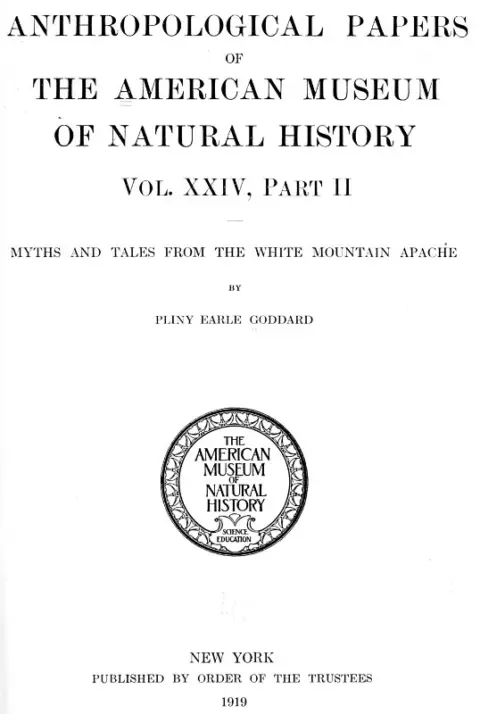
"Myths and Tales from the White Mountain Apache" by Pliny Earle Goddard is a collection of folkloric narratives written in the early 20th century. The book provides free translations of the myths and tales as recorded in the dialect of the White Mountain Apache, exploring themes of creation, ancestry, and the interplay between humans and nature. The collection likely serves to preserve and share the rich cultural heritage and mythology of the Apache people, reflecting their worldview and traditions. At the start of the text, the introduction presents the motivation behind the collection, emphasizing that the narratives were recorded to capture the stories of the White Mountain Apache, specifically during a study in the Southwest. The opening myth narrates the unique creation story involving a maiden who becomes pregnant after receiving the Sun's breath. This tale introduces the boys born from her, setting them on a journey to discover their father, the Sun. As they traverse dangerous terrains and encounter various characters, including the Raven and Eagle, the story intertwines elements of myth and adventure, establishing a foundation for the rich tapestry of tales that follow in the book.
Introduction adapted from the source catalogue; source summaries may be automatically generated.
Free to read · English · 24,075 words · No account needed
MAKE TIME FOR A GOOD BOOK
On by default. Untick to stop anonymous reading totals. Each page counts after 10 seconds in view. How this works.
Anonymous counting is on unless you have switched it off.
When Coyote was dead his wife gave the daughter to the man described by Coyote and he married her. It was Coyote himself, who married his own daughter. He had her hunt his lice. On the back of his head was a large wart. He told her that the lice always stay on this side, indicating a portion of his head remote from the wart. While she was looking for his lice, her husband fell asleep. Wondering why he always spoke as he did, she looked on the back of his head. There was a wart there. She slipped his head off her lap while he was asleep and going to her mother told her that the man was her father; that he had a wart on the back of his head. She picked up a large stone and was about to strike him on the crown of his head when he saw her shadow. He jumped, ran out, and trotted off toward the east. Whenever he came where there were camps people reviled him as the man who had his own daughter for his wife. They heard him saying “ci, ci, ci.” They referred to him as the scabby one and hit him. He cried “wai” and turned from human form into a coyote.
Coyote was driving some mules. He smothered five of the mules. He wondered what smothered them. “Hurry,” he said, “skin their throats. This place will be called Coyote Springs,” he said.
When coyotes were people they all drank whiskey and ran about everywhere shouting. When they became coyotes, they barked.
Footnote 69:
Told by the father of Frank Crockett.
Footnote 70:
This incident is generally known over western North America. Professor Boas has discussed its distribution.
FRANCISCAN FATHERS, THE. An Ethnologic Dictionary of the Navaho Language. St. Michaels, Arizona, 1910.
GODDARD, PLINY EARLE, (a) Jicarilla Apache Texts (Anthropological Papers, American Museum of Natural History, vol. VIII. New York, 1911.)
(b) The Beaver Indians (Anthropological Papers, American Museum of Natural History, vol. X, part IV. New York, 1916.)
KROEBER, A. L. Gros Ventre Myths and Tales (Anthropological Papers, American Museum of Natural History, vol. I, part III. New York, 1907.)
MATTHEWS, WASHINGTON. Navaho Legends (Memoirs, American Folk-Lore Society, vol. V. New York, 1897.)
RUSSELL, FRANK. Myths of the Jicarilla Apache (Journal of American Folk-Lore, vol. XI, 1898.)
VOTH, H. R. The Traditions of the Hopi (Publication 96, Anthropological Series, Field Columbian Museum, vol. VIII. Chicago, 1905.)
WISSLER, CLARK, AND DUVALL, D. C. Blackfoot Mythology (Anthropological Papers, American Museum of Natural History, vol. II, part I. New York, 1908.)
1. Silently corrected typographical errors. 2. Retained anachronistic and non-standard spellings as printed. 3. Enclosed italics font in underscores.
Your reading position is saved on this browser. Take it to another device with a library code. Reading pages adapt to text, rather than matching a printed edition.
BEHIND THE BOOK
This eBook is for the use of anyone anywhere in the United States and most other parts of the world at no cost and with almost no restrictions whatsoever. You may copy it, give it away or re-use it under the terms of the Project Gutenberg License included with this eBook or online at www.gutenberg.org. If you are not located in the United States, you will have to check the laws of the country where you are located before using this eBook. Read the source licence.
The original source file, including credits and licence, is retained by this library. Request an original-format copy at no charge. Please include the book title and Project Gutenberg identifier #53113.
KEEP YOUR CURIOSITY GOING
Maurice Baring
Francis Greenleaf Allinson & Anne C. E. (Anne Crosby Emery) Allinson
Stuart Dodgson Collingwood
Percy Keese Fitzhugh
Mary Macleod & Edmund Spenser

Cooke Don-Carlos