THE CLASSIC COLLECTION✦An outlaw’s diary: the CommuneCLASSIC FREE BOOKS
An outlaw’s diary: the Commune
Cécile Tormay
THE CLASSIC COLLECTION · 1833
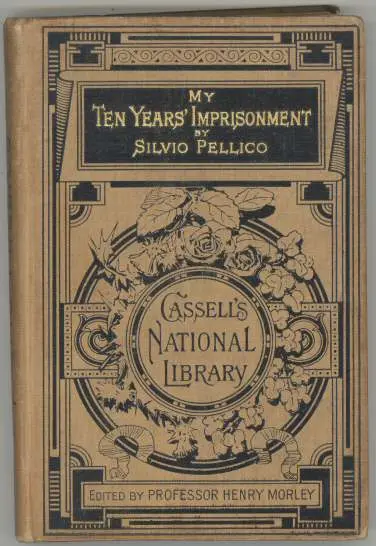
"My Ten Years' Imprisonment" by Silvio Pellico is a historical account written in the early 19th century. The work recounts Pellico's experiences during ten years of imprisonment under the Austrian government, detailing his struggles, thoughts, and reflections on liberty, faith, and the human condition. The book serves as both a personal memoir and a broader commentary on the sociopolitical issues of Italy during this tumultuous period. The opening of the book sets the stage for Pellico's arrest and detention in a Milanese prison. He begins his narrative on the day of his arrest, reflecting on the abrupt shift from a life of freedom to confinement and the heavy emotions tied to thoughts of his family and loved ones. Pellico describes his initial experiences in prison, including the loneliness and despair he feels, as well as his encounters with jailers and fellow prisoners. Throughout these early chapters, he grapples with his circumstances through philosophical reflections and an exploration of his faith, revealing a man determined to retain his humanity amidst suffering. His thoughts often drift to his parents and siblings, creating a poignant backdrop to his narrative.
Introduction adapted from the source catalogue; source summaries may be automatically generated.
Free to read · English · 65,091 words · No account needed
MAKE TIME FOR A GOOD BOOK
On by default. Untick to stop anonymous reading totals. Each page counts after 10 seconds in view. How this works.
Anonymous counting is on unless you have switched it off.
{9} The learning of Ugo Foscolo, and the reputation he acquired by his Hymn upon the Tombs, his Last Letters of Jecopo Ortis, his Treatises upon Dante, Petrarch, Boccaccio, &c, are well-known in this country, where he spent a considerable portion of his life, and died in the year 1827.
{10} The Cavalier Vincenzo Monti stands at the head of the modern poets of Italy. His stanzas on the Death of Uge Basville obtained for him the title of Dante Redivivo. His works, both in verse and prose, are numerous, and generally acknowledged to be noble models in their several styles. His tragedy of Aristodemo, takes the lead among the most admirable specimens of the Italian drama. He died at Milan in the year 1829.
{11} Monsignor Lodovico di Breme, son of the Marquis of the same name, a Piedmontese, an intimate friend of the celebrated Madame de Staël, of Mons. Sismondi, &c, and a man of elevated sentiments, brilliant spirit, high cultivation, and accomplishments.
{12} Don Pietro Borsieri, son of a judge of the Court of Appeal at Milan, of which, previous to his receiving sentence of death, he was one of the state secretaries. He is the author of several little works and literary essays, all written with singular energy and chasteness of language.
{13} La Signora Angiola.
{14} “Venezianina adolescente sbirra?”
{15} Tremerello, or the little trembler.
{16} Per capire che le lucciole non erano lanterne.
“To know that glowworms are not lanterns.”
{17} Buzzolai, a kind of small loaf.
{18} Odoardo Briche, a young man of truly animated genius, and the most amiable disposition. He was the son of Mons. Briche, member of the Constituent Assembly in France, who for thirty years past, had selected Milan as his adopted country.
{19} Respecting Pietro Borsieri, Lodovico di Breme, and Count Porro, mention has already been made. The Count Federico Confalonieri, of an illustrious family of Milan, a man of immense intellect, and the firmest courage, was also the most zealous promoter of popular institutions in Lombardy. The Austrian Government, becoming aware of the aversion entertained by the Count for the foreign yoke which pressed so heavily upon his country, had him seized and handed over to the special commissions, which sat in the years 1822 and 1823. By these he was condemned to the severest of all punishments—imprisonment for life, in the fortress of Spielberg, where, during six months of each weary year, he is compelled by the excess of his sufferings to lie stretched upon a wretched pallet, more dead than alive.
{20} The Count Camillo Laderchi, a member of one of the most
distinguished families of Faenza, and formerly prefect in the ex-kingdom
of Italy.
Your reading position is saved on this browser. Take it to another device with a library code. Reading pages adapt to text, rather than matching a printed edition.
BEHIND THE BOOK
This eBook is for the use of anyone anywhere in the United States and most other parts of the world at no cost and with almost no restrictions whatsoever. You may copy it, give it away or re-use it under the terms of the Project Gutenberg License included with this eBook or online at www.gutenberg.org. If you are not located in the United States, you will have to check the laws of the country where you are located before using this eBook. Read the source licence.
The original source file, including credits and licence, is retained by this library. Request an original-format copy at no charge. Please include the book title and Project Gutenberg identifier #2792.
KEEP YOUR CURIOSITY GOING
Cécile Tormay

Moritz Busch
John L. Ransom
Frances Wright
Cécile Tormay

Mabel Potter Daggett