THE CLASSIC COLLECTION✦An outlaw’s diary: the CommuneCLASSIC FREE BOOKS
An outlaw’s diary: the Commune
Cécile Tormay
THE CLASSIC COLLECTION · 1833
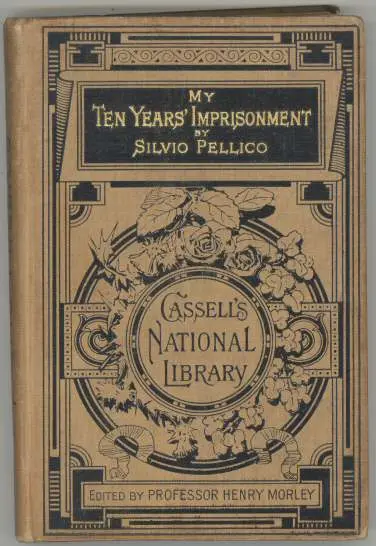
"My Ten Years' Imprisonment" by Silvio Pellico is a historical account written in the early 19th century. The work recounts Pellico's experiences during ten years of imprisonment under the Austrian government, detailing his struggles, thoughts, and reflections on liberty, faith, and the human condition. The book serves as both a personal memoir and a broader commentary on the sociopolitical issues of Italy during this tumultuous period. The opening of the book sets the stage for Pellico's arrest and detention in a Milanese prison. He begins his narrative on the day of his arrest, reflecting on the abrupt shift from a life of freedom to confinement and the heavy emotions tied to thoughts of his family and loved ones. Pellico describes his initial experiences in prison, including the loneliness and despair he feels, as well as his encounters with jailers and fellow prisoners. Throughout these early chapters, he grapples with his circumstances through philosophical reflections and an exploration of his faith, revealing a man determined to retain his humanity amidst suffering. His thoughts often drift to his parents and siblings, creating a poignant backdrop to his narrative.
Introduction adapted from the source catalogue; source summaries may be automatically generated.
Free to read · English · 65,091 words · No account needed
MAKE TIME FOR A GOOD BOOK
On by default. Untick to stop anonymous reading totals. Each page counts after 10 seconds in view. How this works.
Anonymous counting is on unless you have switched it off.
STILL, in this deplorable condition, he continued to compose verses, he sang, and he conversed; and all this he did to encourage me, by disguising from me a part of what he suffered. He lost his powers of digestion, he could not sleep, was reduced to a skeleton, and very frequently swooned away. Yet the moment he was restored he rallied his spirits, and, smiling, bade me be not afraid. It is indescribable what he suffered during many months. At length a consultation was to be held; the head physician was called in, approved of all his colleague had done, and, without expressing a decisive opinion, took his leave. A few minutes after, the superintendent entered, and addressing Maroncelli,
“The head physician did not venture to express his real opinion in your presence; he feared you would not have fortitude to bear so terrible an announcement. I have assured him, however, that you are possessed of courage.”
“I hope,” replied Maroncelli, “that I have given some proof of it in bearing this dreadful torture without howling out. Is there anything he would propose?”
“Yes, sir, the amputation of the limb: only perceiving how much your constitution is broken down, he hesitates to advise you. Weak as you are, could you support the operation? will you run the risk—”
“Of dying? and shall I not equally die if I go on, without ending this
diabolical torture?”
“We will send off an account, then, direct to Vienna, soliciting permission, and the moment it comes you shall have your leg cut off.”
“What! does it require a permit for this?”
“Assuredly, sir,” was the reply.
In about a week a courier arrived from Vienna with the expected news.
My sick friend was carried from his dungeon into a larger room, for permission to have his leg cut off had just arrived. He begged me to follow him: “I may die under the knife, and I should wish, in that case, to expire in your arms.” I promised, and was permitted to accompany him. The sacrament was first administered to the unhappy prisoner, and we then quietly awaited the arrival of the surgeons. Maroncelli filled up the interval by singing a hymn. At length they came; one was an able surgeon, to superintend the operation, from Vienna; but it was the privilege of our ordinary prison apothecary, and he would not yield to the man of science, who must be contented to look on. The patient was placed on the side of a couch; with his leg down, while I supported him in my arms. It was to be cut above the knee; first, an incision was made, the depth of an inch—then through the muscles—and the blood flowed in torrents: the arteries were next taken up with ligatures, one by one. Next came the saw. This lasted some time, but Maroncelli never uttered a cry. When he saw them carrying his leg away, he cast on it one melancholy look, then turning towards the surgeon, he said, “You have freed me from an enemy, and I have no money to give you.” He saw a rose, in a glass, placed in a window: “May I beg of you to bring me hither that flower?” I brought it to him; and he then offered it to the surgeon with an indescribable air of good-nature: “See, I have nothing else to give you in token of my gratitude.” He took it as it was meant, and even wiped away a tear.
Your reading position is saved on this browser. Take it to another device with a library code. Reading pages adapt to text, rather than matching a printed edition.
BEHIND THE BOOK
This eBook is for the use of anyone anywhere in the United States and most other parts of the world at no cost and with almost no restrictions whatsoever. You may copy it, give it away or re-use it under the terms of the Project Gutenberg License included with this eBook or online at www.gutenberg.org. If you are not located in the United States, you will have to check the laws of the country where you are located before using this eBook. Read the source licence.
The original source file, including credits and licence, is retained by this library. Request an original-format copy at no charge. Please include the book title and Project Gutenberg identifier #2792.
KEEP YOUR CURIOSITY GOING
Cécile Tormay

Moritz Busch
John L. Ransom
Frances Wright
Cécile Tormay

Mabel Potter Daggett