THE CLASSIC COLLECTION✦The old English dramatistsCLASSIC FREE BOOKS
The old English dramatists
James Russell Lowell

THE CLASSIC COLLECTION · 1899
"My Study Windows" by James Russell Lowell is a collection of essays written in the late 19th century. The work draws from the author's reflections and experiences over a span of years, presenting a range of topics that encompass nature, literature, and personal musings. It hints at a thoughtful exploration of the beauty of the natural world, alongside cultural commentary, making it appealing for readers interested in nuanced observations about life and the environment. The opening of the book sets the stage with a prefatory note where Lowell introduces the collection, explaining that the essays included were composed over the last fifteen years. He expresses his intention to compile these writings as a means of 'shutting them between two covers' to make space for new thoughts. The initial essay, "My Garden Acquaintance," begins with the author reminiscing about the joy he found in reading Gilbert White's "Natural History of Selborne," drawing parallels between White's observations of nature and his own experiences. Lowell invokes a vivid portrayal of his garden and its inhabitants, offering insights into the interplay between humanity and nature, which will be a recurring theme throughout the collection.
Introduction adapted from the source catalogue; source summaries may be automatically generated.
Free to read · English · 137,668 words · No account needed
MAKE TIME FOR A GOOD BOOK
On by default. Untick to stop anonymous reading totals. Each page counts after 10 seconds in view. How this works.
Anonymous counting is on unless you have switched it off.
Till within a year or two we have been as distant and obscure to the eyes of Europe as Ecuador to our own. Every day brings us nearer, enables us to see the Old World more clearly, and by inevitable comparison to judge ourselves with some closer approach to our real value. This has its advantage so long as our culture is, as for a long time it must be, European; for we shall be little better than apes and parrots till we are forced to measure our muscle with the trained and practised champions of that elder civilization. We have at length established our claim to the noblesse of the sword, the first step still of every nation that would make its entry into the best society of history. To maintain ourselves there, we must achieve an equality in the more exclusive circle of culture, and to that end must submit ourselves to the European standard of intellectual weights and measures--That we have made the hitherto biggest gun might excite apprehension (were there a dearth of iron), but can never exact respect. That our pianos and patent reapers have won medals does but confirm us in our mechanic and material measure of merit. We must contribute something more than mere contrivances for the saving of labor, which we have been only too ready to misapply in the domain of thought and the higher kinds of invention. In those Olympic games where nations contend for truly immortal wreaths, it may well be questioned whether a mowing-machine would stand much chance in the chariot-races,--whether a piano, though made by a chevalier, could compete successfully for the prize of music.
We shall have to be content for a good while yet with our provincialism, and must strive to make the best of it. In it lies the germ of nationality, and that is, after all, the prime condition of all thorough-bred greatness of character. To this choicest fruit of a healthy life, well rooted in native soil, and drawing prosperous juices thence, nationality gives the keenest flavor. Mr. Lincoln was an original man, and in so far a great man; yet it was the Americanism of his every thought, word, and act which not only made his influence equally at home in East and West, but drew the eyes of the outside world, and was the pedestal that lifted him where he could be seen by them. Lincoln showed that native force may transcend local boundaries, but the growth of such nationality is hindered and hampered by our division into so many half-independent communities, each with its objects of county ambition, and its public men great to the borders of their district. In this way our standard of greatness is insensibly debased. To receive any national appointment, a man must have gone through precisely the worst training for it; he must have so far narrowed and belittled himself with State politics as to be acceptable at home. In this way a man may become chairman of the Committee on Foreign Affairs, because he knows how to pack a caucus in Catawampus County, or be sent ambassador to Barataria, because he has drunk bad whiskey with every voter in Wildcat City. Should we ever attain to a conscious nationality, it will have the advantage of lessening the number of our great men, and widening our appreciation to the larger scale of the two or three that are left,--if there should be so many. Meanwhile we offer a premium to the production of great men in a small way, by inviting each State to set up the statues of two of its immortals in the Capitol. What a niggardly percentage! Already we are embarrassed, not to find the two, but to choose among the crowd of candidates. Well, seventy-odd heroes in about as many years is pretty well for a young nation. We do not envy most of them their eternal martyrdom in marble, their pillory of indiscrimination. We fancy even native tourists pausing before the greater part of the effigies, and, after reading the names, asking desperately, “Who was he?” Nay, if they should say, “Who the devil was he?” it were a pardonable invocation, for none so fit as the Prince of Darkness to act as cicerone among such palpable obscurities. We recall the court-yard of the Uffizj at Florence. That also is not free of parish celebrities; but Dante, Galileo, Michael Angelo, Macchiavelli,--shall the inventor of the sewing-machine, even with the button-holing improvement, let us say, match with these, or with far lesser than these? Perhaps he was more practically useful than any one of these, or all of them together, but the soul is sensible of a sad difference somewhere. These also were citizens of a provincial capital; so were the greater part of Plutarch’s heroes. Did they have a better chance than we moderns,--than we Americans? At any rate they have the start of us, and we must confess that
Your reading position is saved on this browser. Take it to another device with a library code. Reading pages adapt to text, rather than matching a printed edition.
James Russell Lowell
James Russell Lowell

James Russell Lowell
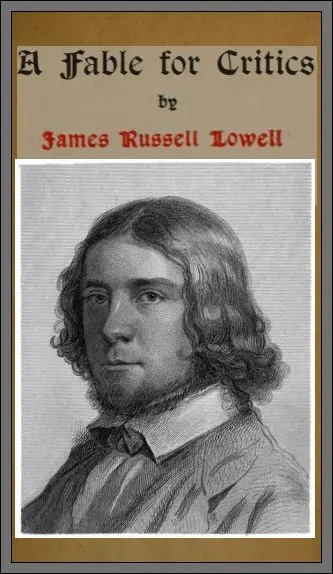
James Russell Lowell
BEHIND THE BOOK
This eBook is for the use of anyone anywhere in the United States and most other parts of the world at no cost and with almost no restrictions whatsoever. You may copy it, give it away or re-use it under the terms of the Project Gutenberg License included with this eBook or online at www.gutenberg.org. If you are not located in the United States, you will have to check the laws of the country where you are located before using this eBook. Read the source licence.
The original source file, including credits and licence, is retained by this library. Request an original-format copy at no charge. Please include the book title and Project Gutenberg identifier #73710.
KEEP YOUR CURIOSITY GOING

David Patterson (Spirit) Hatch

David Patterson (Spirit) Hatch

David Patterson (Spirit) Hatch

Ralph Waldo Emerson

Maurice Baring

Oscar Wilde & James McNeill Whistler