THE CLASSIC COLLECTION✦The old English dramatistsCLASSIC FREE BOOKS
The old English dramatists
James Russell Lowell

THE CLASSIC COLLECTION · 1899
"My Study Windows" by James Russell Lowell is a collection of essays written in the late 19th century. The work draws from the author's reflections and experiences over a span of years, presenting a range of topics that encompass nature, literature, and personal musings. It hints at a thoughtful exploration of the beauty of the natural world, alongside cultural commentary, making it appealing for readers interested in nuanced observations about life and the environment. The opening of the book sets the stage with a prefatory note where Lowell introduces the collection, explaining that the essays included were composed over the last fifteen years. He expresses his intention to compile these writings as a means of 'shutting them between two covers' to make space for new thoughts. The initial essay, "My Garden Acquaintance," begins with the author reminiscing about the joy he found in reading Gilbert White's "Natural History of Selborne," drawing parallels between White's observations of nature and his own experiences. Lowell invokes a vivid portrayal of his garden and its inhabitants, offering insights into the interplay between humanity and nature, which will be a recurring theme throughout the collection.
Introduction adapted from the source catalogue; source summaries may be automatically generated.
Free to read · English · 137,668 words · No account needed
MAKE TIME FOR A GOOD BOOK
On by default. Untick to stop anonymous reading totals. Each page counts after 10 seconds in view. How this works.
Anonymous counting is on unless you have switched it off.
but all the while he has the splendid centuries of Greece and Rome behind him, and can begin his poem with invoking a goddess from whom legend derived the planter of his race. His eyes looked out on a landscape saturated with glorious recollections; he had seen Cæsar, and heard Cicero. But who shall conjure with Saugus or Cato Four Corners,--with Israel Putnam or Return Jonathan Meigs? We have been transplanted, and for us the long hierarchical succession of history is broken. The Past has not laid its venerable hands upon us in consecration, conveying to us that mysterious influence whose force is in its continuity. We are to Europe as the Church of England to her of Rome. The latter old lady may be the Scarlet Woman, or the Beast with ten horns, if you will, but hers are all the heirlooms, hers that vast spiritual estate of tradition, nowhere yet everywhere, whose revenues are none the less fruitful for being levied on the imagination. We may claim that England’s history is also ours, but it is a de jure, and not a de facto property that we have in it,--something that may be proved indeed, yet is a merely intellectual satisfaction, and does not savor of the realty. Have we not seen the mockery crown and sceptre of the exiled Stuarts in St. Peter’s? the medal struck so lately as 1784 with its legend, HEN IX MAG BRIT ET HIB REX, whose contractions but faintly typify the scantness of the fact?
As the novelist complains that our society wants that sharp contrast of character and costume which comes of caste, so in the narrative of our historians we miss what may be called background and perspective, as if the events and the actors in them failed of that cumulative interest which only a long historical entail can give. Relatively, the crusade of Sir William Pepperell was of more consequence than that of St. Louis, and yet forgive us, injured shade of the second American baronet, if we find the narrative of Joinville more interesting than your despatches to Governor Shirley. Relatively, the insurrection of that Daniel whose Irish patronymic Shea was euphonized into Shays, as a set-off for the debasing of French chaise into shay, was more dangerous than that of Charles Edward; but for some reason or other (as vice sometimes has the advantage of virtue) the latter is more enticing to the imagination, and the least authentic relic of it in song or story has a relish denied to the painful industry of Minot. Our events seem to fall short of that colossal proportion which befits the monumental style. Look grave as we will, there is something ludicrous in Counsellor Keane’s pig being the pivot of a revolution. We are of yesterday, and it is to no purpose that our political augurs divine from the flight of our eagles that to-morrow shall be ours, and flatter us with an all-hail hereafter. Things do really gain in greatness by being acted on a great and cosmopolitan stage, because there is inspiration in the thronged audience, and the nearer match that puts men on their mettle. Webster was more largely endowed by nature than Fox, and Fisher Ames not much below Burke as a talker; but what a difference in the intellectual training, in the literary culture and associations, in the whole social outfit, of the men who were their antagonists and companions! It should seem that, if it be collision with other minds and with events that strikes or draws the fire from a man, then the quality of those might have something to do with the quality of the fire,--whether it shall be culinary or electric. We have never known the varied stimulus, the inexorable criticism, the many-sided opportunity of a great metropolis, the inspiring reinforcement of an undivided national consciousness. In everything but trade we have missed the invigoration of foreign rivalry. We may prove that we are this and that and the other,--our Fourth-of-July orators have proved it time and again,--the census has proved it; but the Muses are women, and have no great fancy for statistics, though easily silenced by them. We are great, we are rich, we are all kinds of good things; but did it never occur to you that somehow we are not interesting, except as a phenomenon? It may safely be affirmed that for one cultivated man in this country who studies American, there are fifty who study European history, ancient or modern.
Your reading position is saved on this browser. Take it to another device with a library code. Reading pages adapt to text, rather than matching a printed edition.
James Russell Lowell
James Russell Lowell

James Russell Lowell
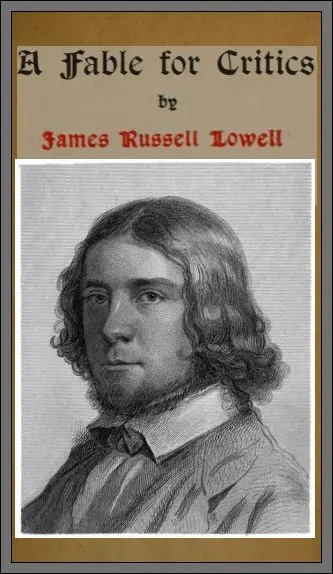
James Russell Lowell
BEHIND THE BOOK
This eBook is for the use of anyone anywhere in the United States and most other parts of the world at no cost and with almost no restrictions whatsoever. You may copy it, give it away or re-use it under the terms of the Project Gutenberg License included with this eBook or online at www.gutenberg.org. If you are not located in the United States, you will have to check the laws of the country where you are located before using this eBook. Read the source licence.
The original source file, including credits and licence, is retained by this library. Request an original-format copy at no charge. Please include the book title and Project Gutenberg identifier #73710.
KEEP YOUR CURIOSITY GOING

David Patterson (Spirit) Hatch

David Patterson (Spirit) Hatch

David Patterson (Spirit) Hatch

Ralph Waldo Emerson

Maurice Baring

Oscar Wilde & James McNeill Whistler