THE CLASSIC COLLECTION✦The old English dramatistsCLASSIC FREE BOOKS
The old English dramatists
James Russell Lowell

THE CLASSIC COLLECTION · 1899
"My Study Windows" by James Russell Lowell is a collection of essays written in the late 19th century. The work draws from the author's reflections and experiences over a span of years, presenting a range of topics that encompass nature, literature, and personal musings. It hints at a thoughtful exploration of the beauty of the natural world, alongside cultural commentary, making it appealing for readers interested in nuanced observations about life and the environment. The opening of the book sets the stage with a prefatory note where Lowell introduces the collection, explaining that the essays included were composed over the last fifteen years. He expresses his intention to compile these writings as a means of 'shutting them between two covers' to make space for new thoughts. The initial essay, "My Garden Acquaintance," begins with the author reminiscing about the joy he found in reading Gilbert White's "Natural History of Selborne," drawing parallels between White's observations of nature and his own experiences. Lowell invokes a vivid portrayal of his garden and its inhabitants, offering insights into the interplay between humanity and nature, which will be a recurring theme throughout the collection.
Introduction adapted from the source catalogue; source summaries may be automatically generated.
Free to read · English · 137,668 words · No account needed
MAKE TIME FOR A GOOD BOOK
On by default. Untick to stop anonymous reading totals. Each page counts after 10 seconds in view. How this works.
Anonymous counting is on unless you have switched it off.
“The obligation wherein we all stood bound Cannot be concealed [cancelled] without great reproach.”
“The realm, not they,
Must be regarded. Be [we] strong and bold,
We are the people’s factors.”
“Shall not be o’erburdened [overburdened] in our reign
“A merry heart
And a good stomach to [a] feast are all.”
“Have her meat serv’d up by bawds and ruffians” [dele “up.”]
“Brother or father
In [a] dishonest suit, shall be to me.”
“What’s she in Rome your greatness cannot awe. Or your rich purse purchase? Promises and threats.” [dele the second “your.”]
“Through clouds of envy and disast [rous] change.”
“The Devil drives, ’tis [it is] full time to go.”
He has overlooked some strange blunders. What is the meaning of
“Laugh at your misery, as foredeeming you
An idle meteor, which drawn forth, the earth
Would soon be lost i’ the air”?
We hardly need say that it should be
“An idle meteor, which, drawn forth the earth,
Would,” &c.
“Forwardness” for frowardness,” (Vol. II. p. 87,) “tennis-balls struck and banded” for “bandied,” (Ib. p. 275,) may be errors of the press; but
“Come, I’ll love you wisely:
That’s jealousy,”
has crept in by editorial oversight for “wisely, that ’s jealously.” So
have
“Ay, the great emperor of [or] the mighty Cham”;
and
“This wit [with] taking long journeys”;
and
“Virginius, thou dost but supply my place, I thine: Fortune hath lift me [thee] to my chair, And thrown me headlong to thy pleading bar”;
and
“I’ll pour my soul into my daughter’s belly, [body,] And with my soldier’s tears embalm her wounds.”
We suggest that the change of an a to an r would make sense of the following: “Come, my little punk, with thy two compositors, to this unlawful painting-house,” [printing-house,] which Mr. Hazlitt awkwardly endeavors to explain by this note on the word compositors,--“i. e. (conjecturally), making up the composition of the picture “! Our readers can decide for themselves;--the passage occurs Vol. I. p. 214.
We think Mr. Hazlitt’s notes are, in the main, good; but we should like to know his authority for saying that pench means “the hole in a bench by which it was taken up,”--that “descant” means “look askant on,”--and that “I wis” is equivalent to “I surmise, imagine,” which it surely is not in the passage to which his note is appended. On page 9, Vol. I., we read in the text,
“To whom, my lord, bends thus your awe,”
Your reading position is saved on this browser. Take it to another device with a library code. Reading pages adapt to text, rather than matching a printed edition.
James Russell Lowell
James Russell Lowell

James Russell Lowell
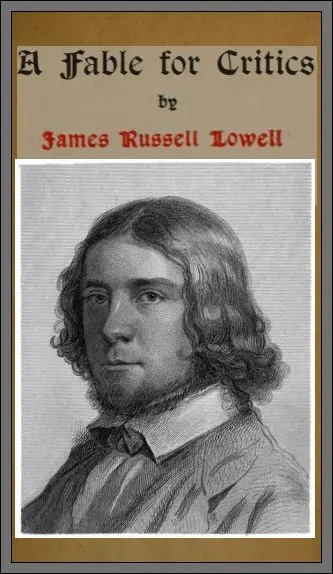
James Russell Lowell
BEHIND THE BOOK
This eBook is for the use of anyone anywhere in the United States and most other parts of the world at no cost and with almost no restrictions whatsoever. You may copy it, give it away or re-use it under the terms of the Project Gutenberg License included with this eBook or online at www.gutenberg.org. If you are not located in the United States, you will have to check the laws of the country where you are located before using this eBook. Read the source licence.
The original source file, including credits and licence, is retained by this library. Request an original-format copy at no charge. Please include the book title and Project Gutenberg identifier #73710.
KEEP YOUR CURIOSITY GOING

David Patterson (Spirit) Hatch

David Patterson (Spirit) Hatch

David Patterson (Spirit) Hatch

Ralph Waldo Emerson

Maurice Baring

Oscar Wilde & James McNeill Whistler