THE CLASSIC COLLECTION✦The old English dramatistsCLASSIC FREE BOOKS
The old English dramatists
James Russell Lowell

THE CLASSIC COLLECTION · 1899
"My Study Windows" by James Russell Lowell is a collection of essays written in the late 19th century. The work draws from the author's reflections and experiences over a span of years, presenting a range of topics that encompass nature, literature, and personal musings. It hints at a thoughtful exploration of the beauty of the natural world, alongside cultural commentary, making it appealing for readers interested in nuanced observations about life and the environment. The opening of the book sets the stage with a prefatory note where Lowell introduces the collection, explaining that the essays included were composed over the last fifteen years. He expresses his intention to compile these writings as a means of 'shutting them between two covers' to make space for new thoughts. The initial essay, "My Garden Acquaintance," begins with the author reminiscing about the joy he found in reading Gilbert White's "Natural History of Selborne," drawing parallels between White's observations of nature and his own experiences. Lowell invokes a vivid portrayal of his garden and its inhabitants, offering insights into the interplay between humanity and nature, which will be a recurring theme throughout the collection.
Introduction adapted from the source catalogue; source summaries may be automatically generated.
Free to read · English · 137,668 words · No account needed
MAKE TIME FOR A GOOD BOOK
On by default. Untick to stop anonymous reading totals. Each page counts after 10 seconds in view. How this works.
Anonymous counting is on unless you have switched it off.
“Oh, if there be another world i’ th’ moon, As some fantastics dream, I could wish all men, The whole race of them, for their inconstancy, Sent thither to people that!”
(Old Chaucer was yet slier. After saying that Lamech was the first
faithless lover, he adds,--
“And he invented tents, unless men lie,”--
implying that he was the prototype of nomadic men.)
“Virtue is ever sowing of her seeds:
In the trenches, for the soldier; in the wakeful study,
For the scholar; in the furrows of the sea,
For men of our profession [merchants]; all of which
Arise and spring up honor.”
(“Of all which,” Mr. Hazlitt prints it.)
“Poor Jolenta! should she hear of this,
She would not after the report keep fresh
So long as flowers on graves.”
“For sin and shame are ever tied together With Gordian knots of such a strong thread spun, They cannot without violence be undone.”
“One whose mind
Appears more like a ceremonious chapel
Full of sweet music, than a thronging presence.”
“What is death?
The safest trench i’ th’ world to keep man free
From Fortune’s gunshot.”
“It has ever been my opinion
That there are none love perfectly indeed,
But those that hang or drown themselves for love,”
says Julio, anticipating Butler’s
“But he that drowns, or blows out ’s brains,
The Devil’s in him, if he feigns.”
He also anticipated La Rochefoucauld and Byron in their apophthegm concerning woman’s last love. In “The Devil’s Law-Case,” Leonora says,--
“For, as we love our youngest children best,
So the last fruit of our affection,
Wherever we bestow it, is most strong,
Most violent, most unresistible;
Since ’t is, indeed, our latest harvest-home,
Last merriment ’fore winter.”
In editing Webster, Mr. Hazlitt had the advantage (except in a single doubtful play) of a predecessor in the Rev. Alexander Dyce, beyond all question the best living scholar of the literature of the times of Elizabeth and James I. If he give no proof of remarkable fitness for his task, he seems, at least, to have been diligent and painstaking. His notes are short and to the point, and--which we consider a great merit--at the foot of the page. If he had added a glossarial index, we should have been still better pleased. Mr. Hazlitt seems to have read over the text with some care, and he has had the good sense to modernize the orthography, or, as he says, has “observed the existing standard of spelling throughout.” Yet--for what reason we cannot imagine--he prints “I” for “ay,” taking the pains to explain it every time in a note, and retains “banquerout” and “coram” apparently for the sake of telling us that they mean “bankrupt” and “quorum.” He does not seem to have a quick ear for scansion, which would sometimes have assisted him to the true reading. We give an example or two:--
Your reading position is saved on this browser. Take it to another device with a library code. Reading pages adapt to text, rather than matching a printed edition.
James Russell Lowell
James Russell Lowell

James Russell Lowell
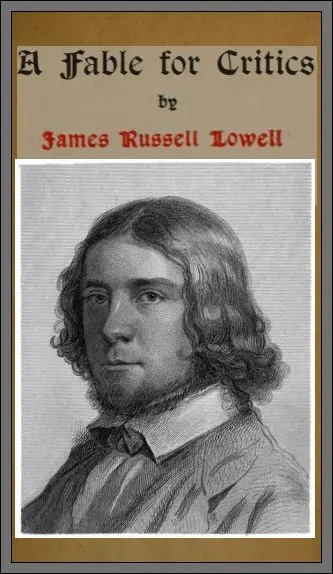
James Russell Lowell
BEHIND THE BOOK
This eBook is for the use of anyone anywhere in the United States and most other parts of the world at no cost and with almost no restrictions whatsoever. You may copy it, give it away or re-use it under the terms of the Project Gutenberg License included with this eBook or online at www.gutenberg.org. If you are not located in the United States, you will have to check the laws of the country where you are located before using this eBook. Read the source licence.
The original source file, including credits and licence, is retained by this library. Request an original-format copy at no charge. Please include the book title and Project Gutenberg identifier #73710.
KEEP YOUR CURIOSITY GOING

David Patterson (Spirit) Hatch

David Patterson (Spirit) Hatch

David Patterson (Spirit) Hatch

Ralph Waldo Emerson

Maurice Baring

Oscar Wilde & James McNeill Whistler