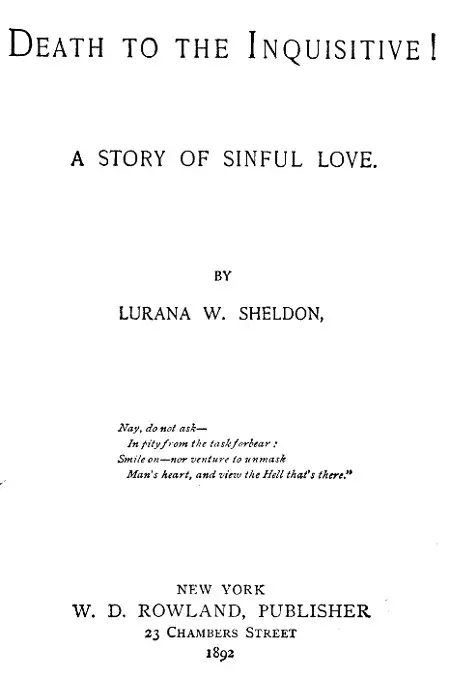
Death to the Inquisitive! A story of sinful love
Lurana Sheldon
THE CLASSIC COLLECTION · 1900
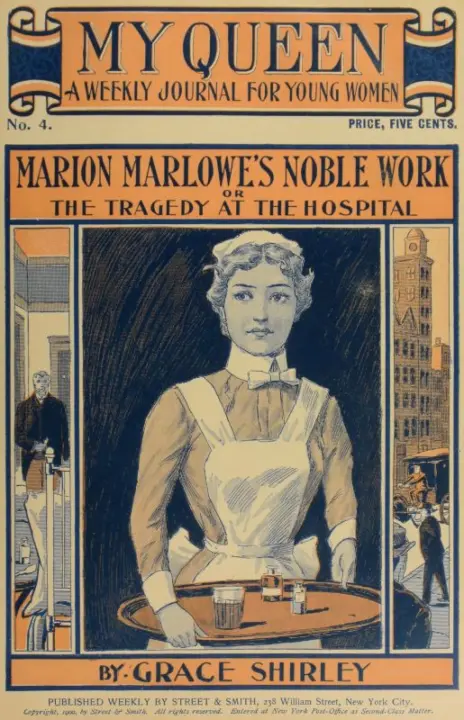
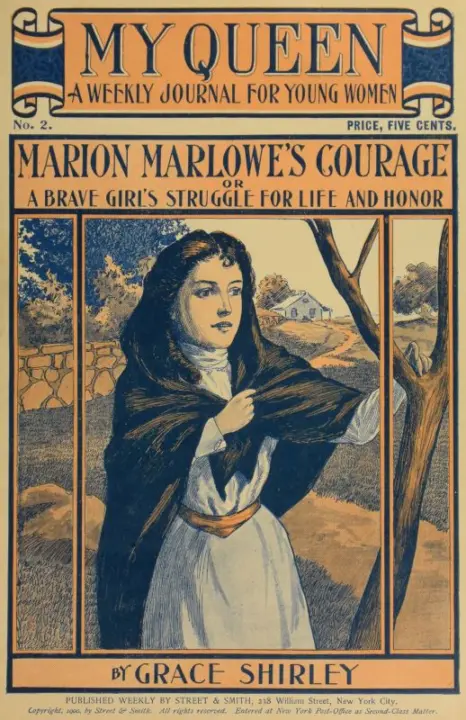
"My Queen: A Weekly Journal for Young Women. Issue 4, October 20, 1900" by Sheldon is a fictional publication written during the late 19th century. The journal appears to be aimed at young women, featuring stories that touch on issues of personal growth, romance, and social challenges faced by women at the time. The opening portion introduces the journal's serialized story, "Marion Marlowe’s Noble Work; or, The Tragedy at the Hospital," suggesting a blend of drama and lessons on character as young women navigate the complexities of life. At the start of the journal, we meet Dr. Reginald Brookes, a recent medical graduate, and his friends as they discuss their future placements in the medical field. Brookes expresses his intention to work at a penitentiary hospital to be near his love interest, Marion Marlowe, who is a dedicated nurse at Charity Hospital. The narrative quickly shifts between the lives of these characters, revealing their struggles with love, ambition, and societal expectations. Marion is portrayed as a strong yet vulnerable character who faces trials related to her work in healthcare, illustrating her role as a protector, especially of her sister Dollie. Through various interactions, the story highlights themes of sacrifice, moral lessons, and the growth of the female characters within a world of adversity.
Introduction adapted from the source catalogue; source summaries may be automatically generated.
Free to read · English · 22,557 words · No account needed
MAKE TIME FOR A GOOD BOOK
On by default. Untick to stop anonymous reading totals. Each page counts after 10 seconds in view. How this works.
Anonymous counting is on unless you have switched it off.
Augustus Atherton, attorney-at-law, was seated in his office looking
over some papers.
Suddenly he tapped a bell upon his desk and his office-boy entered.
“Tell Sands to bring me a copy of Halstead’s testimony, Bob,” he said, shortly, “and tell him to hurry; I want it this minute!”
“Mr. Sands is out to lunch, sir, won’t be back for half an hour,” said the boy, respectfully, “but Miss Marlowe has the copy; shall I tell her to bring it?”
“Yes, at once,” said the lawyer, wheeling around in his chair.
In less than a minute his “typewriter girl” entered the office.
“Here is the paper, sir,” said a sweet, low voice.
Mr. Atherton looked up and then stared a little. It was the first time he had really taken a good look at the new copyist.
The young girl who stood before him was very beautiful. She had a sweet, oval face, lighted by violet eyes, and her rippling golden hair shone like threads of sunshine.
Her figure was plump, but exceedingly graceful, and every curve was enhanced by the charming simplicity of her garments.
“Oh, thank you!” he said politely, as she laid the papers upon the desk, and at the same time he looked admiringly at her small white hand and taper fingers.
“You copy very neatly and accurately, Miss Marlowe,” he said quickly, as she was about to turn respectfully and leave him.
“Thank you, sir,” said the beautiful girl, blushing. “I am very glad, indeed, that I please you. It is my first position and I am naturally a little nervous.”
“You have never worked in an office before, then,” said the old lawyer, glancing her over critically. “Well, you are doing nicely, and Sands tells me you are very rapid.”
“I do manage the typewriter very easily, sir,” said the young girl, smiling, “and I am studying very hard. I shall soon be a stenographer.”
“Then I’ll have you in here where I can dictate to you,” said the
lawyer, quickly.
“By Jove! What a treat that will be after two years of Miss Dixon!”
His extraordinary manner astonished the girl a little, but after a moment of embarrassment she managed to stammer:
“Oh, but I may never be as proficient as Miss Dixon; she takes notes like lightning, while I can only write fifty words a minute.”
“Well, I could talk slower,” said the lawyer, slyly, giving her another sharp look over his glasses.
Dollie Marlowe smiled, but she was considerably puzzled. It was the longest conversation that she had had with her employer.
Your reading position is saved on this browser. Take it to another device with a library code. Reading pages adapt to text, rather than matching a printed edition.
Lurana Sheldon
Lurana Sheldon
Lurana Sheldon
Lurana Sheldon
BEHIND THE BOOK
This eBook is for the use of anyone anywhere in the United States and most other parts of the world at no cost and with almost no restrictions whatsoever. You may copy it, give it away or re-use it under the terms of the Project Gutenberg License included with this eBook or online at www.gutenberg.org. If you are not located in the United States, you will have to check the laws of the country where you are located before using this eBook. Read the source licence.
The original source file, including credits and licence, is retained by this library. Request an original-format copy at no charge. Please include the book title and Project Gutenberg identifier #58021.
KEEP YOUR CURIOSITY GOING
Coulson Kernahan

Maurice Baring
Frances Wright
Cécile Tormay

Frederic Jesup Stimson

W. H. P. (William Henry Pope) Jarvis