Death to the Inquisitive! A story of sinful love
Lurana Sheldon
THE CLASSIC COLLECTION · 1900
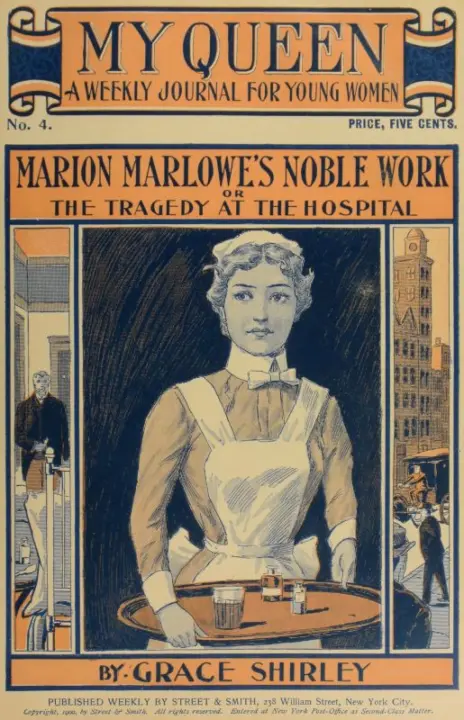
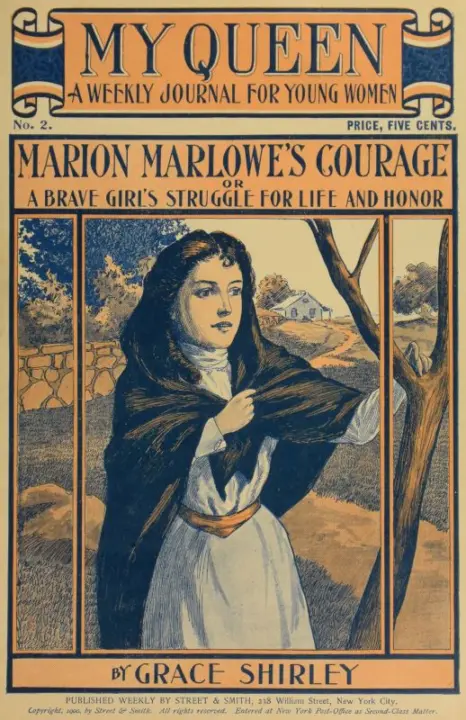
"My Queen: A Weekly Journal for Young Women. Issue 4, October 20, 1900" by Sheldon is a fictional publication written during the late 19th century. The journal appears to be aimed at young women, featuring stories that touch on issues of personal growth, romance, and social challenges faced by women at the time. The opening portion introduces the journal's serialized story, "Marion Marlowe’s Noble Work; or, The Tragedy at the Hospital," suggesting a blend of drama and lessons on character as young women navigate the complexities of life. At the start of the journal, we meet Dr. Reginald Brookes, a recent medical graduate, and his friends as they discuss their future placements in the medical field. Brookes expresses his intention to work at a penitentiary hospital to be near his love interest, Marion Marlowe, who is a dedicated nurse at Charity Hospital. The narrative quickly shifts between the lives of these characters, revealing their struggles with love, ambition, and societal expectations. Marion is portrayed as a strong yet vulnerable character who faces trials related to her work in healthcare, illustrating her role as a protector, especially of her sister Dollie. Through various interactions, the story highlights themes of sacrifice, moral lessons, and the growth of the female characters within a world of adversity.
Introduction adapted from the source catalogue; source summaries may be automatically generated.
Free to read · English · 22,557 words · No account needed
MAKE TIME FOR A GOOD BOOK
On by default. Untick to stop anonymous reading totals. Each page counts after 10 seconds in view. How this works.
Anonymous counting is on unless you have switched it off.
The man’s sallow cheeks grew scarlet at her question, but, with a shrug of his shoulders, he turned toward Dollie.
“I will bid you good-day, Miss Dollie,” he said, smilingly; “when you have graduated from your sister’s tuition, you will find life much more pleasant.” He left the room without so much as a glance at Marion, who now stood half smiling beside her sister.
“Thee did that well,” said a voice near Marion. She turned and saw an old gentleman who had been sitting quietly at a little distance. He wore the garb of a Quaker.
“You heard it, sir?” asked Marion, quickly.
The old gentleman bowed, and smiled a little sadly.
“I heard and saw it all,” he said, quietly. “I give thee my word I could not move away from that corner. I was so interested in the outcome that I deliberately remained to hear it.”
“And you approve of my action?” asked Marion, as she studied his face
closely.
“I do, indeed, daughter,” said the Quaker, firmly. “Thy sister is an innocent—protect her always, particularly from such men, who are but wolves in sheep’s clothing.”
“That is what I thought,” said Marion, as he moved away. “Come Dollie, let us go! This is no place for country maidens.”
“I don’t dare go back to the office,” said Dollie, as they went out; “he will be as angry as possible, and perhaps he will discharge me. Oh! Marion, what was the harm? Why couldn’t I go to the matinee?”
Marion drew a deep breath; she was sorely puzzled. Sometimes it seemed to her that Dollie was almost lacking in understanding.
“Dollie! Dollie!” she said, earnestly, “how can you be so foolish? As if you cared so much about a matinee that you would hurt Ralph’s feelings by going with your employer! Is it not better to deny yourself a little pleasure than to take such risks with your future happiness?”
“Ralph isn’t so small as to care, I am sure,” said Dollie, panting; “and oh, Marion, I am so sorry you talked as you did! I think you were awfully rude to poor Mr. Atherton!”
Marion bit her lips, and her eyes filled with tears. She was realizing keenly her responsibility as a sister. She should never, never have left Dollie unprotected.
“Miss Allyn warned you,” she said, almost to herself. “She is a wise woman, Dollie. If you cannot trust me, why not trust Miss Allyn? I would never have left you with her if I had not supposed you would listen to her.”
Your reading position is saved on this browser. Take it to another device with a library code. Reading pages adapt to text, rather than matching a printed edition.
Lurana Sheldon
Lurana Sheldon
Lurana Sheldon
Lurana Sheldon
BEHIND THE BOOK
This eBook is for the use of anyone anywhere in the United States and most other parts of the world at no cost and with almost no restrictions whatsoever. You may copy it, give it away or re-use it under the terms of the Project Gutenberg License included with this eBook or online at www.gutenberg.org. If you are not located in the United States, you will have to check the laws of the country where you are located before using this eBook. Read the source licence.
The original source file, including credits and licence, is retained by this library. Request an original-format copy at no charge. Please include the book title and Project Gutenberg identifier #58021.
KEEP YOUR CURIOSITY GOING
Coulson Kernahan

Maurice Baring
Frances Wright
Cécile Tormay

Frederic Jesup Stimson

W. H. P. (William Henry Pope) Jarvis