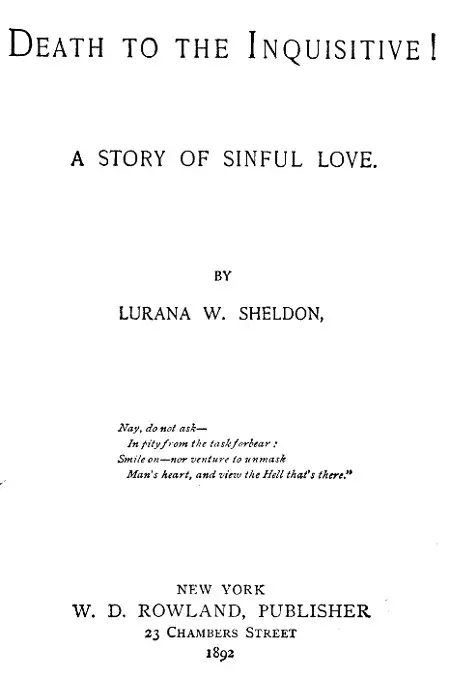
Death to the Inquisitive! A story of sinful love
Lurana Sheldon
THE CLASSIC COLLECTION · 1900
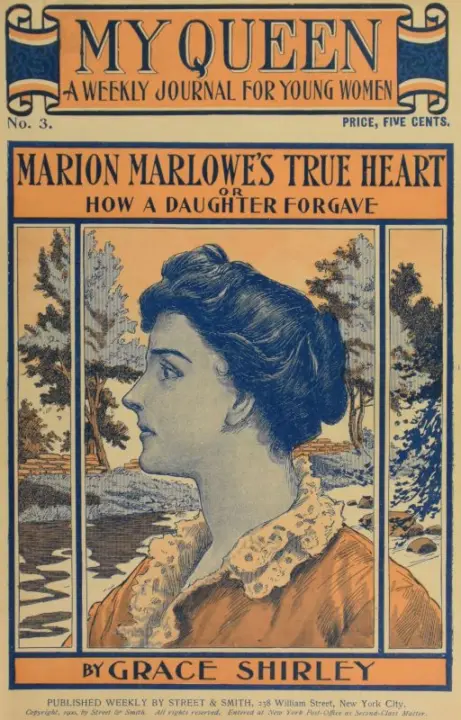
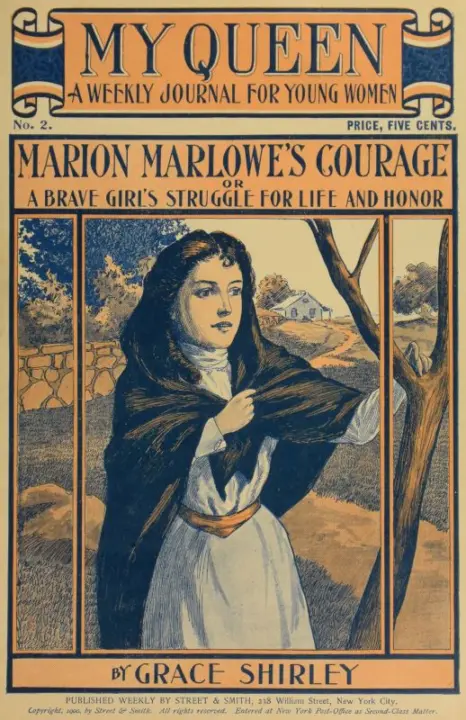
"My Queen: A Weekly Journal for Young Women. Issue 3, October 13, 1900" by Sheldon is a periodical publication aimed at young women, written in the early 20th century. The content revolves around themes of personal development, aspirations, and relationship dynamics, specifically focusing on the life of Marion Marlowe, a strong-willed young woman who returns to her family in a time of crisis. The exploration of familial relationships, emotional struggles, and societal expectations highlights the challenges faced by young women during this time. The opening of the journal introduces the Marlowe family, dealing with the impending loss of their farm due to financial strain caused by poor decisions made by the patriarch, Deacon Joshua Marlowe. His wife, Martha, is distraught over their situation, including the unhappiness of their daughters due to marital pressures from their father. The narrative quickly shifts with the return of Marion, who steps in as a fierce protector of her family and intends to confront the circumstances that have led to their hardship. The conflict between old-fashioned values and the desires of the newer generation sets the stage for a poignant exploration of forgiveness, resilience, and the quest to reclaim familial bonds.
Introduction adapted from the source catalogue; source summaries may be automatically generated.
Free to read · English · 22,721 words · No account needed
MAKE TIME FOR A GOOD BOOK
On by default. Untick to stop anonymous reading totals. Each page counts after 10 seconds in view. How this works.
Anonymous counting is on unless you have switched it off.
Without even noticing her father, Marion Marlowe crossed the room to her mother’s side, and for just a moment mother and daughter wept together.
Joshua Marlowe stared at her silently. He could hardly believe his eyes. Was this beautiful, stylishly dressed girl his daughter Marion?
After her burst of tears was over, Marion dried her eyes. It was not her nature to waste much time in weeping.
“Why didn’t you answer our letters, mother—Dollie’s and mine?” she asked, and then answered her own question without waiting for her mother.
“I suppose father would not let you,” she said, with some scorn, “and of course you were too scared to dream of disobeying him! It doesn’t seem possible that a woman could be so weak, but I forgive you, mother. I know he would only have made your life miserable for you.”
“Yew air tew hard on me, Marion,” said her father, faintly. He had always stood a little in fear of his daughter Marion.
The girl sprang to her feet and faced him, her cheeks flaming with
indignation.
“No, I’m not, father!” she said, hotly. “I am not hard enough on you! You have broken up your own family and you ought to be ashamed of it!”
“Did I send Dollie away?” asked the farmer, flaring up a little. “Did I make her run away with that scapegrace, Lawson?”
“No, you didn’t do that, father,” said Marion, sadly, “but you condemned and disowned her as soon as she was gone, when you might have known that Dollie was innocent.”
“Waal, any father would hev done the same, I reck’n,” said the old man, lamely, “but ef I did wrong, I’m a-gittin’ paid fer it, there’s no use denyin’ that, Marion.”
His mood had softened and his lips were twitching suspiciously.
As Marion looked at him she seemed suddenly to realize how old and worn he was, and in an instant her heart was bleeding for him.
“Father! Father!” she cried, going over to him as he sank upon a chair and putting her hand almost tenderly upon his shoulder. “You have been hard with us all, father; but we will forgive you! Just say that you love us, and that in future you will be more kind.”
“It’s tew late, Marion,” cried the old man, huskily. “There’s no home fer yew tew come back tew now, so it don’t make no diff’rence about your old father! We air goin’ tew the Poor Farm, yewr mother an’ me, an’ I guess she’s right—she sez it’s jedgement upon us!”
Your reading position is saved on this browser. Take it to another device with a library code. Reading pages adapt to text, rather than matching a printed edition.
Lurana Sheldon
Lurana Sheldon
Lurana Sheldon
Lurana Sheldon
BEHIND THE BOOK
This eBook is for the use of anyone anywhere in the United States and most other parts of the world at no cost and with almost no restrictions whatsoever. You may copy it, give it away or re-use it under the terms of the Project Gutenberg License included with this eBook or online at www.gutenberg.org. If you are not located in the United States, you will have to check the laws of the country where you are located before using this eBook. Read the source licence.
The original source file, including credits and licence, is retained by this library. Request an original-format copy at no charge. Please include the book title and Project Gutenberg identifier #57582.
KEEP YOUR CURIOSITY GOING
Coulson Kernahan

Maurice Baring
Frances Wright
Cécile Tormay

Frederic Jesup Stimson

W. H. P. (William Henry Pope) Jarvis