Death to the Inquisitive! A story of sinful love
Lurana Sheldon
THE CLASSIC COLLECTION · 1900
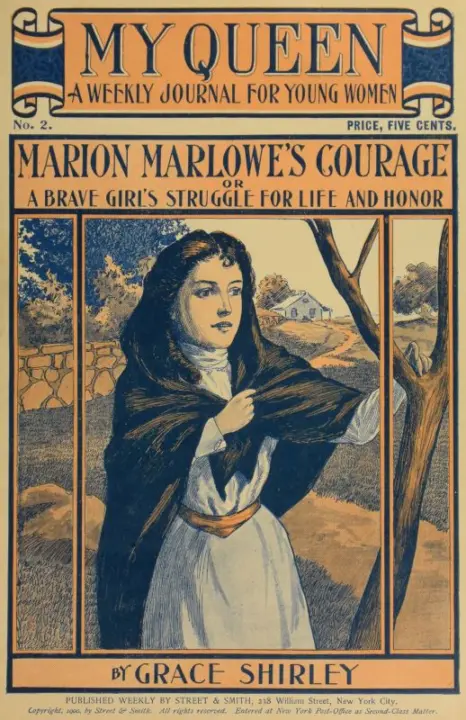
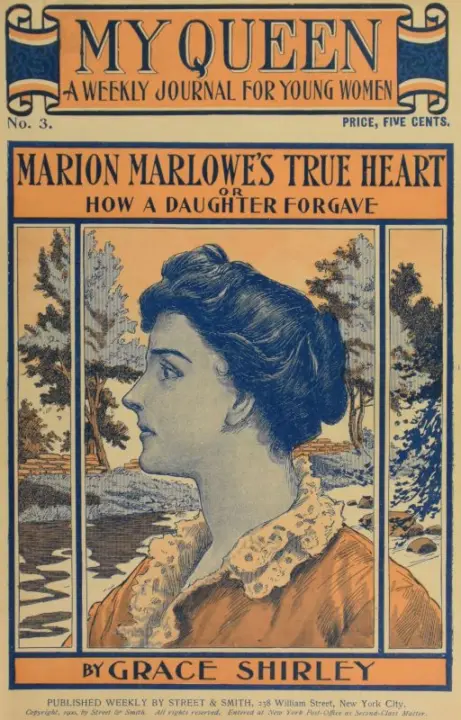
"My Queen: A Weekly Journal for Young Women. Issue 2, October 6, 1900" by Sheldon is a weekly journal written in the late 19th century. The journal features a story titled "Marion Marlowe’s Courage," chronicling the adventures of two brave twin sisters, Marion and Dollie Marlowe, as they navigate life's challenges in a big city. The narrative captures their struggles for survival after a harrowing experience with a sinister abductor, showcasing their resilience and the bonds of sisterhood as they face various adversaries, including a hostile landlady and difficulties in securing employment. At the start of the story, we meet Marion and Dollie, recently moved to the city and currently living in a cheap boarding house. Their situation is dire as they are low on funds, and on top of that, they have recently escaped from a traumatic encounter involving their abductor, Professor Dabroski. Despite the obstacles they face, Marion remains optimistic about finding work, showcasing her determination and courage, while Dollie grapples with her feelings of guilt over the burden of their troubles. Tensions arise quickly as they confront their landlady about their living situation, highlighting the prejudice and challenges they encounter in a city that appears indifferent to the plight of young women like them. As the sisters seek to redefine their lives amidst these hardships, the beginning sets the stage for themes of bravery, friendship, and a quest for self-empowerment.
Introduction adapted from the source catalogue; source summaries may be automatically generated.
Free to read · English · 26,522 words · No account needed
MAKE TIME FOR A GOOD BOOK
On by default. Untick to stop anonymous reading totals. Each page counts after 10 seconds in view. How this works.
Anonymous counting is on unless you have switched it off.
“Carlotta” and “The Olio” were eclipsed entirely, and Otto Vondergrift took occasion to brag a little the next morning.
“That hundred wasn’t a bad investment, after all,” he said to his friend Rosen. “Why, there wasn’t a dozen people left in ‘The Olio’ after Ila began singing!”
“Here she comes!” said the song writer, as Marion entered. “I’ll leave you to make love to your little rustic prima donna!”
“Here are your hundred dollars, miss,” said Vondergrift, promptly, “and I’ll give you the same price if you will sing again this evening, and to-morrow I’ll make a contract to hire you for the season.”
Marion put the money in her pocket, and then faced him tremblingly.
“I had no idea, sir, that I was to sing in a drinking place,” she said, slowly; “believe me, your money would not have tempted me if I had known it. I am a temperance woman—I don’t believe in drinking liquor.”
Otto Vondergrift was so surprised that he could hardly speak for a
moment.
“What, do you mean that you refuse my offer of one hundred dollars for an evening? Why, girl, are you mad, or are you dreaming?”
“I must refuse it, sir!” said Marion, sternly. “I do not approve of your concert hall, and I should feel disgraced were I to again appear in it!”
“Well, I’ll be blowed!” was the German’s only answer.
“I am very much obliged to you for the money,” said Marion, coolly, as she turned toward the door, after bidding him “good-morning.”
In a second a wave of disappointment and chagrin thrilled the manager’s frame; his face grew livid with rage as he took a step toward her.
“So they have bought you off at ‘The Olio,’ have they?” he sneered. “You’ve gone back on your benefactor, you little country innocent!”
“I have done nothing of the sort,” said Marion, with spirit. “I shall never sing in a concert hall again. I think it is dreadful! It is degrading!”
She swept out of the door and into the street, leaving the astounded manager cursing like a madman.
As quickly as Marion was safely out, she started for the office where her sister’s lover worked. There was joy at her heart that she was at last able to repay him.
“The end almost justifies the means,” she whispered to herself, “but I could never sing there again, never, never!”
Marion called Ralph outside into the little hallway. It was the first time they had met since Mrs. Haley told her story.
Your reading position is saved on this browser. Take it to another device with a library code. Reading pages adapt to text, rather than matching a printed edition.
Lurana Sheldon
Lurana Sheldon
Lurana Sheldon
Lurana Sheldon
BEHIND THE BOOK
This eBook is for the use of anyone anywhere in the United States and most other parts of the world at no cost and with almost no restrictions whatsoever. You may copy it, give it away or re-use it under the terms of the Project Gutenberg License included with this eBook or online at www.gutenberg.org. If you are not located in the United States, you will have to check the laws of the country where you are located before using this eBook. Read the source licence.
The original source file, including credits and licence, is retained by this library. Request an original-format copy at no charge. Please include the book title and Project Gutenberg identifier #57274.
KEEP YOUR CURIOSITY GOING
Coulson Kernahan

Maurice Baring
Frances Wright
Cécile Tormay

Frederic Jesup Stimson

W. H. P. (William Henry Pope) Jarvis