The Treasure of Hidden Valley
Willis George Emerson
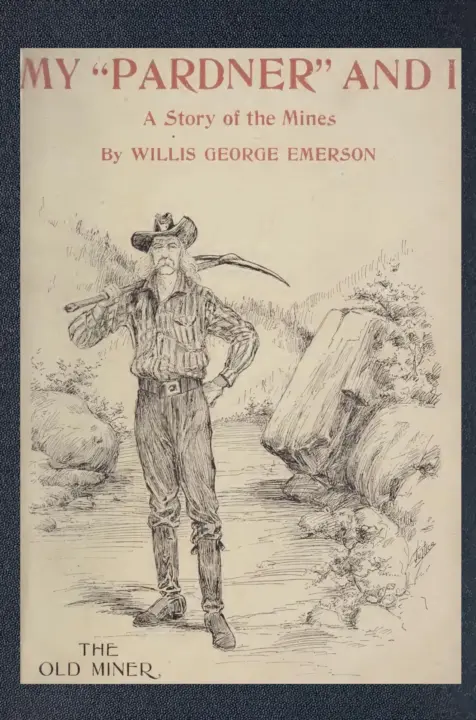
THE CLASSIC COLLECTION · 1899
"My 'Pardner' and I (Gray Rocks): A Story of the Middle-West" by Willis George Emerson is a fictional novel written in the late 19th century. The story centers around Vance Gilder, a young journalist from New York City, who discovers that he is the partial owner of a gold mine named Gray Rocks in Idaho, a property once owned by his late father. The narrative explores themes of ambition, the pursuit of wealth, and the contrasts between urban and rugged frontier life. The opening of the story introduces Vance Gilder, who is established as a cultured and ambitious individual with dreams of becoming a great journalist. He is presented with a letter from Louise Bonifield, whose father, Ben Bonifield, owns the Gray Rocks mine. In a charming encounter at his Manhattan apartment, Vance learns of his father’s legacy, which sparks curiosity about the mine's potential and his connection to the Bonfield family. As the story unfolds, the reader is invited into Vance’s world, where his aspirations clash with the realities of mining life and the complexities of relationships formed in the rugged West.
Introduction adapted from the source catalogue; source summaries may be automatically generated.
Free to read · English · 59,243 words · No account needed
MAKE TIME FOR A GOOD BOOK
On by default. Untick to stop anonymous reading totals. Each page counts after 10 seconds in view. How this works.
Anonymous counting is on unless you have switched it off.
“How Arthur and Louise are enjoying themselves!” lisped Bertha Allen, in a sweet, confiding way, to Vance.
“Do you think their enjoyment is superior to ours?” asked Vance.
“No more than mine,” she replied demurely, “but possibly more than yours.” This was followed by a silvery little laugh.
“I fear I am not very entertaining,” said Vance.
[96] “On the contrary, Mr. Gilder,” replied Bertha, “I think you are a very charming companion. Are you from Virginia?” she asked.
“No; my people were from Virginia. I was born and reared in New York
City.”
“The Bonifields are Virginians. They seem to think,” continued Bertha, “that all good people come from Virginia or Baltimore. I sometimes wish I had been born in Virginia.”
[97] “I never noticed that peculiarity,” replied Vance, “in either Colonel Bonifield or his daughter.”
“Oh, I don’t mean, Mr. Gilder, they are affected. Don’t you think I am horrid to go on talking this way to you? But really, is not Louise one of the sweetest little darlings in the world?”
Vance was bored, but turning toward Bertha Allen and smiling at her pretty up-turned face, replied:
“You ask me so many questions, Miss Allen, that I do not know which to
answer first.”
She looked archly at Vance, and said: “Do not answer either of them, for I know I would be dissatisfied with your reply. Is not that a beautiful botanical specimen? Really, Mr. Gilder,” she continued, “I sometimes do not know what I am saying. I know you will think me awfully stupid.”
The well modulated and lisping voice of Bertha Allen possessed a charm of its own, and Vance found himself interested in studying the difference between the sweet, simple, unaffected Louise, and the affected, calculating Miss Allen.
“Don’t you think, Mr. Gilder, that Louise has great
individuality?”
“I believe her to be a most exemplary young lady,” replied Vance, “and possessed of a good mind.”
“Oh, you think that, do you?” said Bertha, lisping and laughing like the silvery tones of a flute. “You are not the only one, Mr. Gilder, that thinks that way. I mean Cousin Arthur. Oh, he’s awfully smitten.”
“Indeed!” replied Vance.
“What a beautiful picture,” said Bertha presently. “The waters mirror the trees and the mountains so [98] distinctly. Let us look over the bank at our own reflections.”
“Permit me to hold your hand,” said Vance, “and I will prevent your falling. There—can you see yourself?”
“Oh, just splendidly!” lisped Bertha, “it is clear as a French plate mirror. Shall I support you, Mr. Gilder, while you look?”
Your reading position is saved on this browser. Take it to another device with a library code. Reading pages adapt to text, rather than matching a printed edition.
Willis George Emerson
Willis George Emerson
Willis George Emerson
Willis George Emerson
BEHIND THE BOOK
This eBook is for the use of anyone anywhere in the United States and most other parts of the world at no cost and with almost no restrictions whatsoever. You may copy it, give it away or re-use it under the terms of the Project Gutenberg License included with this eBook or online at www.gutenberg.org. If you are not located in the United States, you will have to check the laws of the country where you are located before using this eBook. Read the source licence.
The original source file, including credits and licence, is retained by this library. Request an original-format copy at no charge. Please include the book title and Project Gutenberg identifier #52458.
KEEP YOUR CURIOSITY GOING
Coulson Kernahan

Maurice Baring
Frances Wright
Cécile Tormay

Frederic Jesup Stimson

W. H. P. (William Henry Pope) Jarvis