The Treasure of Hidden Valley
Willis George Emerson
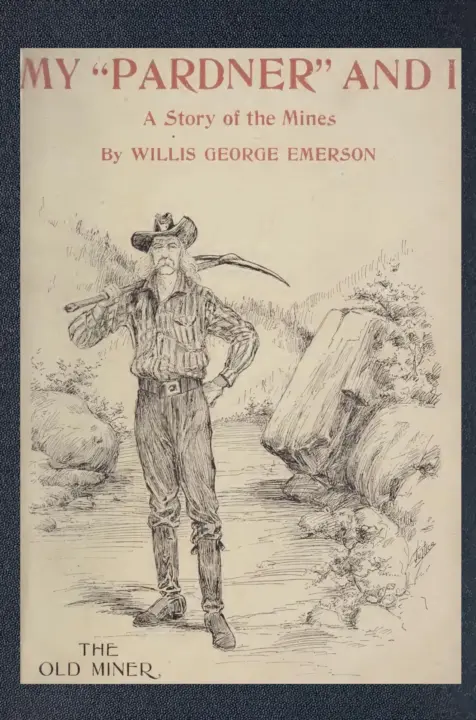
THE CLASSIC COLLECTION · 1899
"My 'Pardner' and I (Gray Rocks): A Story of the Middle-West" by Willis George Emerson is a fictional novel written in the late 19th century. The story centers around Vance Gilder, a young journalist from New York City, who discovers that he is the partial owner of a gold mine named Gray Rocks in Idaho, a property once owned by his late father. The narrative explores themes of ambition, the pursuit of wealth, and the contrasts between urban and rugged frontier life. The opening of the story introduces Vance Gilder, who is established as a cultured and ambitious individual with dreams of becoming a great journalist. He is presented with a letter from Louise Bonifield, whose father, Ben Bonifield, owns the Gray Rocks mine. In a charming encounter at his Manhattan apartment, Vance learns of his father’s legacy, which sparks curiosity about the mine's potential and his connection to the Bonfield family. As the story unfolds, the reader is invited into Vance’s world, where his aspirations clash with the realities of mining life and the complexities of relationships formed in the rugged West.
Introduction adapted from the source catalogue; source summaries may be automatically generated.
Free to read · English · 59,243 words · No account needed
MAKE TIME FOR A GOOD BOOK
On by default. Untick to stop anonymous reading totals. Each page counts after 10 seconds in view. How this works.
Anonymous counting is on unless you have switched it off.
IXTEEN [187] hours a day for three days was Vance’s first experience on the Prospector. All day and far into the evening he set type and made up forms, until finally the paper was ready to be brought out. It contained the retiring proprietor’s bow to the public, and Vance’s announcement.
The next evening he called at the Bonifields’. Louise greeted him more kindly than ever. The Colonel, after assuring him that excellent progress was being made on Gray Rocks, turned the conversation to Vance’s new venture.
“Vehy creditable, suh; vehy creditable, indeed,” said he, glancing at a copy of the Prospector which he had been reading. “Louise and I think yo’ve made an excellent beginnin’, suh, vehy excellent.”
“Indeed we do,” said Louise; “we have often heard, though, that editors were quite exclusive, and we didn’t know but that was the reason you have not called on us for so long a time.”
“Well, that is the reason,” responded Vance, jestingly. “As managing editor of the Prospector, I have been exclusively engaged in setting type, making up forms, etc.”
They laughed at Vance’s remark, and complimented [188] him on being able to impersonate all the functionaries of a printing establishment. In the midst of their conversation, Aunt Sally appeared at the door of the parlor, and courtesying low to Vance, said:
“Good evenin’, Mr. Gilder; I ‘low I’ve been wantin’ to sec yo’ fo’ some time, suh.”
Vance returned the salutation by rising and bowing politely. As he sat down he noticed the Colonel was greatly disturbed, as if he feared a storm was approaching.
“Mr. Gilder,” commenced Aunt Sally’, “I consider it my duty to inform yo’ that yo’ are makin’ as big a fool of yo’self as my brother is of hisself.”
“Come, sister,” said the Colonel, “come, come.”
“Benjamin,” said Aunt Sally, looking hard at him over her spectacles, “I shall have my say. I consideh it a duty that I owe Mr. Gilder to inform him that he is squanderin’ his money. There is not a chance in ten thousand; no, suh, not one, fo’ yo’ to eveh get back a penny of the money yo’ve given my brother. Besides, yo’re only encouragin’ Benjamin to fool his time away. I have mighty neah worn my life out takin’ care of him, Virgie and Louise. Virginia has a good deal of sense—a heap mo’, I am proud to say, than Benjamin or Louise has.”
“I hope, Mr. Gilder,” observed the Colonel, “that yo’ll remember an obse’vation I made some time ago in regard to my sister——”
Your reading position is saved on this browser. Take it to another device with a library code. Reading pages adapt to text, rather than matching a printed edition.
Willis George Emerson
Willis George Emerson
Willis George Emerson
Willis George Emerson
BEHIND THE BOOK
This eBook is for the use of anyone anywhere in the United States and most other parts of the world at no cost and with almost no restrictions whatsoever. You may copy it, give it away or re-use it under the terms of the Project Gutenberg License included with this eBook or online at www.gutenberg.org. If you are not located in the United States, you will have to check the laws of the country where you are located before using this eBook. Read the source licence.
The original source file, including credits and licence, is retained by this library. Request an original-format copy at no charge. Please include the book title and Project Gutenberg identifier #52458.
KEEP YOUR CURIOSITY GOING
Coulson Kernahan

Maurice Baring
Frances Wright
Cécile Tormay

Frederic Jesup Stimson

W. H. P. (William Henry Pope) Jarvis