The Treasure of Hidden Valley
Willis George Emerson
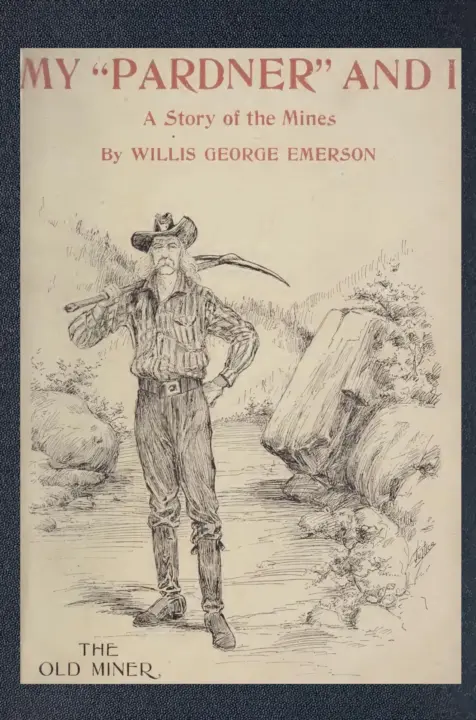
THE CLASSIC COLLECTION · 1899
"My 'Pardner' and I (Gray Rocks): A Story of the Middle-West" by Willis George Emerson is a fictional novel written in the late 19th century. The story centers around Vance Gilder, a young journalist from New York City, who discovers that he is the partial owner of a gold mine named Gray Rocks in Idaho, a property once owned by his late father. The narrative explores themes of ambition, the pursuit of wealth, and the contrasts between urban and rugged frontier life. The opening of the story introduces Vance Gilder, who is established as a cultured and ambitious individual with dreams of becoming a great journalist. He is presented with a letter from Louise Bonifield, whose father, Ben Bonifield, owns the Gray Rocks mine. In a charming encounter at his Manhattan apartment, Vance learns of his father’s legacy, which sparks curiosity about the mine's potential and his connection to the Bonfield family. As the story unfolds, the reader is invited into Vance’s world, where his aspirations clash with the realities of mining life and the complexities of relationships formed in the rugged West.
Introduction adapted from the source catalogue; source summaries may be automatically generated.
Free to read · English · 59,243 words · No account needed
MAKE TIME FOR A GOOD BOOK
On by default. Untick to stop anonymous reading totals. Each page counts after 10 seconds in view. How this works.
Anonymous counting is on unless you have switched it off.
“Yes, I sold them for $800 apiece, or $20,000. As they only paid $2,500 for them, I hardly think they can complain at the profits. Oh, you have no idea what a city Waterville has become. The great waterpower has been effectually harnessed, the streets are paved; electric car lines, planing mills, and scores of other manufacturing concerns are in full operation. Our population is now [246] numbered by thousands, instead of hundreds, while busy activity and prosperity are apparent on every hand.”
“You quite astonish me, old fellow,” replied Vance, “indeed you do; but I needed no greater proof of Waterville’s prosperity than your report of the sale of lots belonging to my New York friends. Once, old fellow, I gave you my promise to wait five years before passing judgment on your enterprise. Hardly half that time has elapsed, yet it gives me pleasure to assure you that I am already better satisfied with Waterville than I ever dared hope for.”
“Thank you,” said Homer, “your ‘Two Honorable Exceptions’ article in the New York Banner was indeed prophetic.”
“Yes,” said Vance, “while the prophecies of Col. Alexander, B. Webster Legal, Gen. Ira House, and other members of your Waterville Town Company, have been more than realized.”
“My associates,” said Homer, “in the great work of building up Waterville, have at last met with a compensation which I cannot but feel is a just one. Taking it all and all, they are a grand lot of fellows, each one a study within himself; nevertheless, collectively a phalanx of strength.”
“By the way,” he continued, “it was my noble little wife, Virgie, that started the boom last spring. She learned in some mysterious way that a private school fund had been created for her special benefit, and in order to return the money, purchased the first lots that we had sold for months and months, and from that day the boom started, until now—well, you’ll have to see the place to realize the wonderful changes and improvements.”
[247] “Hers,” said Vance, “is certainty a sweet and noble
character.”
“Yes, indeed,” replied Winthrop, laughingly, “I still think she is the most practical member of the Bonifield family.”
“Indeed,” said Vance, “I remember the allusion, and I beg to assure you that my opinion remains unchanged in regard to Louise.”
“I notice,” said Winthrop, “that our old acquaintance, J. Arthur Boast, has had quite a rise in the world—at the head of the Peacock mine, I understand.”
Your reading position is saved on this browser. Take it to another device with a library code. Reading pages adapt to text, rather than matching a printed edition.
Willis George Emerson
Willis George Emerson
Willis George Emerson
Willis George Emerson
BEHIND THE BOOK
This eBook is for the use of anyone anywhere in the United States and most other parts of the world at no cost and with almost no restrictions whatsoever. You may copy it, give it away or re-use it under the terms of the Project Gutenberg License included with this eBook or online at www.gutenberg.org. If you are not located in the United States, you will have to check the laws of the country where you are located before using this eBook. Read the source licence.
The original source file, including credits and licence, is retained by this library. Request an original-format copy at no charge. Please include the book title and Project Gutenberg identifier #52458.
KEEP YOUR CURIOSITY GOING
Coulson Kernahan

Maurice Baring
Frances Wright
Cécile Tormay

Frederic Jesup Stimson

W. H. P. (William Henry Pope) Jarvis