THE CLASSIC COLLECTION✦A dead man’s diaryCLASSIC FREE BOOKS
A dead man’s diary
Coulson Kernahan
THE CLASSIC COLLECTION · 1899
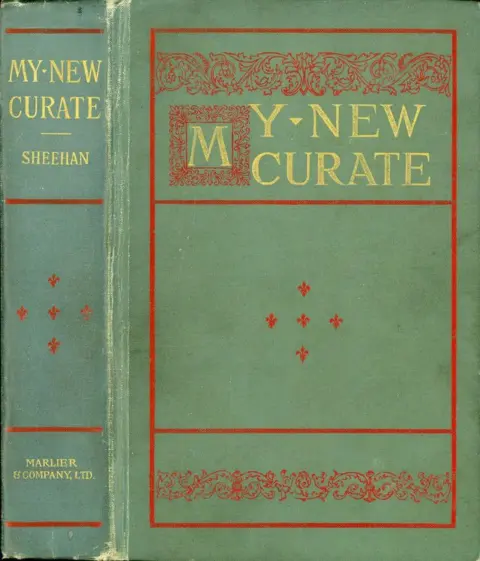
"My New Curate" by Patrick Augustine Sheehan is a novel written in the early 20th century. The story centers around Father Dan, a parish priest in an Irish village, and his experiences as he receives a new curate, Father Letheby, whose modern and energetic approach to ministry contrasts sharply with Father Dan's more traditional and resigned existence. The narrative explores themes of faith, the hardships of rural life, and the relationship between clergy and their parishioners. At the start of the book, the reader is introduced to the emotional departure of Father Dan’s old curate, Father Laverty, who leaves the parish for a new assignment. The accompanying sadness sets the tone for Father Dan's reflections on his life and the challenges that lie ahead with a new, unknown curate. Father Letheby arrives with enthusiasm and a passion to invigorate the parish, and his modern ideas quickly clash with the established leniency of the local community. This friction in expectations creates an engaging dynamic, hinting at the transformation both priests may undergo as they navigate their differences and the realities of their shared responsibilities.
Introduction adapted from the source catalogue; source summaries may be automatically generated.
Free to read · English · 107,499 words · No account needed
MAKE TIME FOR A GOOD BOOK
On by default. Untick to stop anonymous reading totals. Each page counts after 10 seconds in view. How this works.
Anonymous counting is on unless you have switched it off.
It is quite true, indeed, that he disturbs, now and again, the comforts of senile lethargy. And sometimes the old Adam will cry out, and sigh for the leaden ages, for he is pursuing with invincible determination his great work of revival in the parish. He has doubled, trebled, the confessions of the people on Saturday, and the subsequent Sunday Communions. He has seized the hearts of all the young men. He is forever preaching to them on the manliness of Christ,--His truthfulness, His honor, His fearlessness, His tenderness. He insists that Christ had a particular affection for the young. Witness how He chose His Apostles, and how He attached them to His Sacred Person. And thus my curate's confessional is thronged every Saturday night by silent, humble, thoughtful young fellows, sitting there in the dark, for the two candles at the altar rails throw but a feeble light into the blackness; and Mrs. Darcy, under all improvements, has retained her sense of economy.
"Where's the use," she says, "of lighting more than wan candle, for wan candle is as good as fifty?"
She has compromised with Father Letheby for two, for his slightest wish
is now a command.
And so the young girls and all the men go to Father Letheby's confessional. The old women and the little children come to me. They don't mind an occasional growl, which will escape me sometimes. Indeed, they say they'd rather hear one roar from the "ould man" than if Father Letheby, "wid his gran' accent," was preaching forever. But young men are sensitive; and I am not sorry.
Yet, if my Guardian Angel were to ask me, What in the world have you to grumble about? I couldn't tell him. For I never come away from that awful and sacred duty of the confessional without a sense of the deepest humiliation. I never sit in "the box," as the people call the confessional. A slight deafness in one ear, and the necessity of stretching occasionally a rheumatized foot, make it more convenient for me to sit over there, near and under the statue of our Blessed Mother. There in my arm-chair I sit, with the old cloak wrapped round me that sheltered me many a night on the mountains. And there the little children come, not a bit shy or afraid of old "Daddy Dan." They pick their way across the new carpet with a certain feeling of awkwardness, as if there were pins and needles hidden somewhere; but when they arrive at safe anchorage, they put their dirty clasped fingers on my old cassock, toss the hair from their eyes, and look me straight in the face, whilst they tell their little story to me and God. They are now well trained in the exact form of confession. Father Letheby has drilled them well. But dear me! what white souls they are! Poverty and purity have worked hand in hand to make them angelic, and their faces are transfigured by the light that shines within. And their attenuated bodies show clearly the burning lamp of holiness and faith, as a light shines soft and clear through the opal shades of porcelain or Sèvres. And the little maidens always say, "Tank you, Fader," when they receive their penance; and the boys say, "All right." I sometimes expect to hear "old fellow" added. Then the old women come; and, afraid to touch the grand carpet with their feet, they leave rather vivid impressions in brown mud on the waxed floor, which is the very thing that Miss Campion does not want; and they throw themselves backward whilst they recite in the soft, liquid Gaelic the Confiteor; and then raise themselves erect, pull up their black cloaks or brown shawls with the airs and dignity of a young barrister about to address the jury, arrange the coif of shawl or hood of cloak around their heads, and then tell you--nothing! God bless them, innocent souls! No need for these elaborate preparations. Yet what contrition, what sorrow, what love they pour forth over some simple imperfections, where even a Jansenist cannot detect the shadow of a venial sin! No wonder that my curate declares that we have material in Ireland to make it again a wonder to the world,--an Island of Saints once more! But something is wanting. He does not know what, nor do I. But he says sometimes that he feels as if he were working in the dark. He cannot get inside the natures of the people. There is a puzzle, an enigma somewhere. The people are but half revealed to us. There is a world of thought and feeling hidden away somewhere, and unrevealed. Who has the key? He is seeking for it everywhere, and cannot find it. Now, you know, he is a transcendentalist, so I don't mind these vagaries; yet he is desperately in earnest.
Your reading position is saved on this browser. Take it to another device with a library code. Reading pages adapt to text, rather than matching a printed edition.
BEHIND THE BOOK
This eBook is for the use of anyone anywhere in the United States and most other parts of the world at no cost and with almost no restrictions whatsoever. You may copy it, give it away or re-use it under the terms of the Project Gutenberg License included with this eBook or online at www.gutenberg.org. If you are not located in the United States, you will have to check the laws of the country where you are located before using this eBook. Read the source licence.
The original source file, including credits and licence, is retained by this library. Request an original-format copy at no charge. Please include the book title and Project Gutenberg identifier #20295.
KEEP YOUR CURIOSITY GOING
Coulson Kernahan

Maurice Baring
Frances Wright
Cécile Tormay

Frederic Jesup Stimson

W. H. P. (William Henry Pope) Jarvis