THE CLASSIC COLLECTION✦A dead man’s diaryCLASSIC FREE BOOKS
A dead man’s diary
Coulson Kernahan
THE CLASSIC COLLECTION · 1899
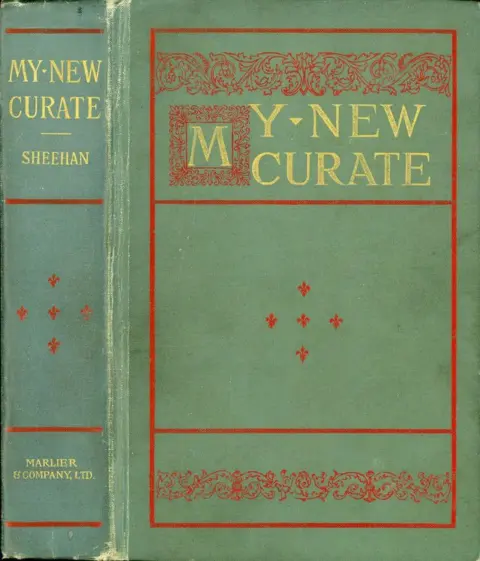
"My New Curate" by Patrick Augustine Sheehan is a novel written in the early 20th century. The story centers around Father Dan, a parish priest in an Irish village, and his experiences as he receives a new curate, Father Letheby, whose modern and energetic approach to ministry contrasts sharply with Father Dan's more traditional and resigned existence. The narrative explores themes of faith, the hardships of rural life, and the relationship between clergy and their parishioners. At the start of the book, the reader is introduced to the emotional departure of Father Dan’s old curate, Father Laverty, who leaves the parish for a new assignment. The accompanying sadness sets the tone for Father Dan's reflections on his life and the challenges that lie ahead with a new, unknown curate. Father Letheby arrives with enthusiasm and a passion to invigorate the parish, and his modern ideas quickly clash with the established leniency of the local community. This friction in expectations creates an engaging dynamic, hinting at the transformation both priests may undergo as they navigate their differences and the realities of their shared responsibilities.
Introduction adapted from the source catalogue; source summaries may be automatically generated.
Free to read · English · 107,499 words · No account needed
MAKE TIME FOR A GOOD BOOK
On by default. Untick to stop anonymous reading totals. Each page counts after 10 seconds in view. How this works.
Anonymous counting is on unless you have switched it off.
"Tell them that two of Her gracious Majesty's servants are here--brought here by the worst set of ruffians that are not yet hanged in Ireland."
"And what do ye expect the police to do?" said Jem, calmly.
"To do? Why, to get a boat and tuk us out o' thus, I suppose!"
"Look at yere feet," said Jem, "and tell me what kind of a boat would
live there?"
True enough. The angry waters were hissing, and embracing, and swirling back, and trying to leap the cliffs, and feeling with all their awful strength and agility for some channel through which they might reach and devour the prisoners.
By some secret telegraphy a crowd had soon gathered. One by one, the "byes" dropped down from the village, and to each in turn Jem had to tell all he knew about the mermen. Then commenced a running fire of chaff from every quarter.
"Where are yere banjoes, gintlemin? Ye might as well spind the Sunday pleasantly, for the sorra a wan o' ye will get off before night."
"Start 'Way down the Suwanee River,' Jem, and we'll give 'em a chorus."
"You're Jem Deady, I suppose," said one of the bailiffs. "Well, Deady, remember you're a marked mon. I gut yer cherickter last night from a gentleman as the greatest ruffian amongst all the ruffians of Kilronan--"
"Yerra, man, ye're takin' lave of yer sinses. Is 't Jem Deady? Jem Deady, the biggest omadhaun in the village."
"Jem Deady, the greatest gommal[9] that ever lived."
"Jem Deady, that doesn't know his right hand from his left."
"Jem Deady, who doesn't know enough to come in out of the wet."
"Jem Deady, the innocent, that isn't waned from his mother ayet."
During all these compliments Jem smoked placidly. I had forgotten one of the most serious duties of a novelist--the description of Jem's toilette. I had forgotten to say that a black pilot coat with velvet collar, red silk handkerchief, etc., was a veritable Nessus shirt to Jem. So passionately fond of work was he, and so high an idea had he conceived on the sacredness and nobleness of work, that integuments savoring of Sabbath indolence were particularly intolerable to him. He moved about stiffly in them, was glad to shake them off, and resume his white, lime-stained, patched, and torn, but oh! such luxuriously easy garments of every-day life. Then I regret to have to record an act of supreme vanity, that might be pardonable or venial in a young lady going to a ball or coming out in her first concert, but was simply shocking in a middle-aged man going out to Mass on a Sunday morning. Jem Deady actually powdered his face! I do not say that it was violet powder or that he used a puff. His methods were more primitive and more successful. He went to a pot where lime was seething, or rather had been seething. He took up the thick lumps and crushed them into dust. He made his face as white as if he were going to play the king in Macbeth, and Banquo's ghost was arising; and he turned his glossy locks into a cadaverous and premature grayness, and Bess didn't like it. She wanted to see him only one Sunday in "his best shuit"; but Jem, unkind fellow, would not grant her that gratification.
Your reading position is saved on this browser. Take it to another device with a library code. Reading pages adapt to text, rather than matching a printed edition.
BEHIND THE BOOK
This eBook is for the use of anyone anywhere in the United States and most other parts of the world at no cost and with almost no restrictions whatsoever. You may copy it, give it away or re-use it under the terms of the Project Gutenberg License included with this eBook or online at www.gutenberg.org. If you are not located in the United States, you will have to check the laws of the country where you are located before using this eBook. Read the source licence.
The original source file, including credits and licence, is retained by this library. Request an original-format copy at no charge. Please include the book title and Project Gutenberg identifier #20295.
KEEP YOUR CURIOSITY GOING
Coulson Kernahan

Maurice Baring
Frances Wright
Cécile Tormay

Frederic Jesup Stimson

W. H. P. (William Henry Pope) Jarvis