THE CLASSIC COLLECTION✦A dead man’s diaryCLASSIC FREE BOOKS
A dead man’s diary
Coulson Kernahan
THE CLASSIC COLLECTION · 1899
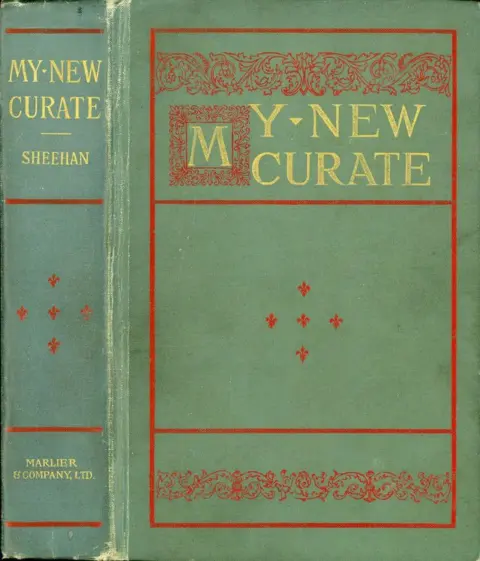
"My New Curate" by Patrick Augustine Sheehan is a novel written in the early 20th century. The story centers around Father Dan, a parish priest in an Irish village, and his experiences as he receives a new curate, Father Letheby, whose modern and energetic approach to ministry contrasts sharply with Father Dan's more traditional and resigned existence. The narrative explores themes of faith, the hardships of rural life, and the relationship between clergy and their parishioners. At the start of the book, the reader is introduced to the emotional departure of Father Dan’s old curate, Father Laverty, who leaves the parish for a new assignment. The accompanying sadness sets the tone for Father Dan's reflections on his life and the challenges that lie ahead with a new, unknown curate. Father Letheby arrives with enthusiasm and a passion to invigorate the parish, and his modern ideas quickly clash with the established leniency of the local community. This friction in expectations creates an engaging dynamic, hinting at the transformation both priests may undergo as they navigate their differences and the realities of their shared responsibilities.
Introduction adapted from the source catalogue; source summaries may be automatically generated.
Free to read · English · 107,499 words · No account needed
MAKE TIME FOR A GOOD BOOK
On by default. Untick to stop anonymous reading totals. Each page counts after 10 seconds in view. How this works.
Anonymous counting is on unless you have switched it off.
"Yes; or if he had the clay in his mouth, and the pint on the dresser,"
said his companion.
So was this great actor hissed off the stage. It was a bad breakdown, and there was no mercy. It turned the women's conversation back to their curate.
"May the Lord stringthen and help him in his endeavor, our darlin' man,"
said one.
"Amin, thin, and may the Blessed Vargin put the words into his mouth that he has to shpake," cried another. The children listened gravely. All that they could conjecture was that Father Letheby was engaged on a great and dangerous enterprise.
I never had a moment's doubt but that their prayers were heard and their predictions verified, although when Father Letheby called the next day he looked depressed and gloomy enough.
"Well," I said, "a great success, of course?"
"I'm afraid not," he said moodily.
"You broke down badly just in the middle?"
"Well, no, indeed; there was certainly no breakdown, but the whole thing was evidently a failure."
"Let me see," I cried. "There are certain infallible indications of the success or failure of a sermon. Were there any priests present?"
"About twenty, I think," he replied. "That was the worst of it. You don't mind the people at all."
"And weren't they very enthusiastic," I asked, "when you returned to
the sacristy?"
"No, indeed. Rather the contrary, which makes me think that I said something either perilous or ill-advised."
"Humph! Didn't any fellow come up to you and knock the breath out of your body by slapping you on the back?"
"No!" he replied sadly.
"Didn't any fellow say: Prospere procede, et regna?"
"No!" he said. "It was just the other way."
"Didn't any fellow shake you by the hand even, and say: Prosit!
prosit!! prosit!!!"
"I'm afraid not," he said gloomily.
"That's bad. Nor even, macte virtute esto, Titus Manlius?"
"No," he said. "There was no indication of sympathy whatsoever."
"Didn't any fellow drop into the vernacular, and say: 'Put the hand there. Sure I never doubted you,' and wring your hand as if he wanted to dislocate it?"
"No, no, no! There was simply dead silence."
"And perhaps they looked at you over their shoulders, and whispered together, as they put their surplices into their bags, and stared at you as if you were a sea-monster?"
"Something that way, indeed," said my poor curate.
"Did the bishop make any remark?"
"Yes. The bishop came over and said he was very grateful, indeed, for that beautiful sermon. But that, of course, was purely conventional."
"And the people? How did they take it?"
"They were very quiet and attentive, indeed: apparently an intelligent
congregation."
Your reading position is saved on this browser. Take it to another device with a library code. Reading pages adapt to text, rather than matching a printed edition.
BEHIND THE BOOK
This eBook is for the use of anyone anywhere in the United States and most other parts of the world at no cost and with almost no restrictions whatsoever. You may copy it, give it away or re-use it under the terms of the Project Gutenberg License included with this eBook or online at www.gutenberg.org. If you are not located in the United States, you will have to check the laws of the country where you are located before using this eBook. Read the source licence.
The original source file, including credits and licence, is retained by this library. Request an original-format copy at no charge. Please include the book title and Project Gutenberg identifier #20295.
KEEP YOUR CURIOSITY GOING
Coulson Kernahan

Maurice Baring
Frances Wright
Cécile Tormay

Frederic Jesup Stimson

W. H. P. (William Henry Pope) Jarvis