THE CLASSIC COLLECTION✦A dead man’s diaryCLASSIC FREE BOOKS
A dead man’s diary
Coulson Kernahan
THE CLASSIC COLLECTION · 1899
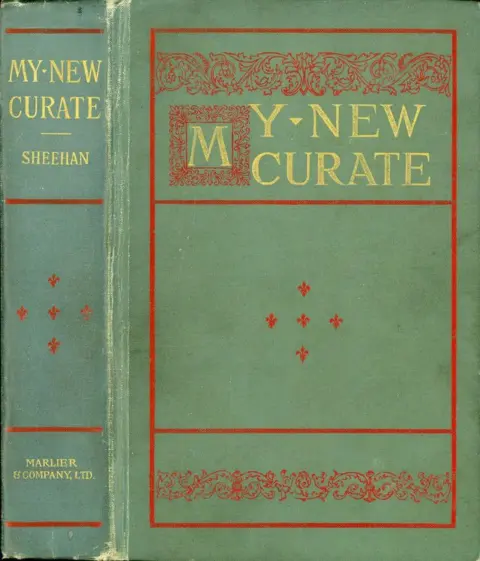
"My New Curate" by Patrick Augustine Sheehan is a novel written in the early 20th century. The story centers around Father Dan, a parish priest in an Irish village, and his experiences as he receives a new curate, Father Letheby, whose modern and energetic approach to ministry contrasts sharply with Father Dan's more traditional and resigned existence. The narrative explores themes of faith, the hardships of rural life, and the relationship between clergy and their parishioners. At the start of the book, the reader is introduced to the emotional departure of Father Dan’s old curate, Father Laverty, who leaves the parish for a new assignment. The accompanying sadness sets the tone for Father Dan's reflections on his life and the challenges that lie ahead with a new, unknown curate. Father Letheby arrives with enthusiasm and a passion to invigorate the parish, and his modern ideas quickly clash with the established leniency of the local community. This friction in expectations creates an engaging dynamic, hinting at the transformation both priests may undergo as they navigate their differences and the realities of their shared responsibilities.
Introduction adapted from the source catalogue; source summaries may be automatically generated.
Free to read · English · 107,499 words · No account needed
MAKE TIME FOR A GOOD BOOK
On by default. Untick to stop anonymous reading totals. Each page counts after 10 seconds in view. How this works.
Anonymous counting is on unless you have switched it off.
"You might add, Father Duff," said my curate, who was an interested listener to the whole argument, and who had been hitherto silent, "that these reviewers found fault with Schöpfer for ignoring the consensus patrum, and for decidedly naturalistic tendencies."
The whole Conference woke up at this new interlude. The chairman looked grateful; the bishop leaned forward.
"But the 'Civiltà Cattolica,'" said Father Duff, "which we may regard as official, says, in its review of the same book: 'Biblical history cannot be any longer stated except in agreement with the true and correct teaching of the Bible and the reasonable conclusions of the natural sciences.'"
"Quite so," said Father Letheby, "that applies to the certain discoveries of geology and astronomy. But surely you don't maintain that philology, which only affects us just now, is an exact science."
"Just as exact as the other sciences you have mentioned."
"That is, as exact as a mathematical demonstration?"
"Quite so."
"Come now," said my curate, like a fellow that was sure of himself,
"that's going too far."
"Not at all," said Father Duff; "I maintain that the evidence of history on the one hand, and the external evidence of monuments on the other, combined with the internal evidence of Scriptural idiomatisms of time and place, are equivalent to a mathematical demonstration."
"You'll admit, I suppose," said Father Letheby, "that languages change their structures and meanings very often?"
"Certainly."
"The English of Shakespeare is not ours."
"Quite so."
"Even words have come to have exactly antithetical meanings, even in a lapse of three hundred years."
"Very good."
"And it is said that, owing to accretions, the language we speak will be unintelligible in a hundred years' time."
"Possibly."
"Now, would you not say that a contemporary of Shakespeare's would be a better judge of his poetry and its allusive and natural meaning than ever so learned a linguist, after an interval of change?"
"Well, I should say so. I don't know where you are drifting."
"What is the reason that we never heard of these 'internal evidences,' these 'historical coincidences,' these 'exclusive idioms,' from Origen or Dionysius, or from Jerome or Augustine, from any one of the Fathers, who held what we hold, and what the Church has always taught, about the authorship of the Sacred Books, and to whom Hebrew and Greek were vernacular?"
"But, my dear sir, there are evident interpolations even in the Gospels. Do you really mean to tell me that that canticle of the Magnificat was uttered by a young Hebrew girl on Hebron, and was not rather the deliberate poetical conception of the author of St. Luke's Gospel?"
Your reading position is saved on this browser. Take it to another device with a library code. Reading pages adapt to text, rather than matching a printed edition.
BEHIND THE BOOK
This eBook is for the use of anyone anywhere in the United States and most other parts of the world at no cost and with almost no restrictions whatsoever. You may copy it, give it away or re-use it under the terms of the Project Gutenberg License included with this eBook or online at www.gutenberg.org. If you are not located in the United States, you will have to check the laws of the country where you are located before using this eBook. Read the source licence.
The original source file, including credits and licence, is retained by this library. Request an original-format copy at no charge. Please include the book title and Project Gutenberg identifier #20295.
KEEP YOUR CURIOSITY GOING
Coulson Kernahan

Maurice Baring
Frances Wright
Cécile Tormay

Frederic Jesup Stimson

W. H. P. (William Henry Pope) Jarvis