THE CLASSIC COLLECTION✦A dead man’s diaryCLASSIC FREE BOOKS
A dead man’s diary
Coulson Kernahan
THE CLASSIC COLLECTION · 1899
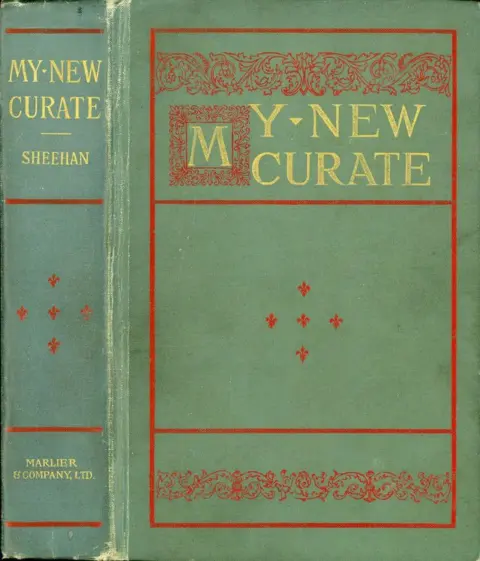
"My New Curate" by Patrick Augustine Sheehan is a novel written in the early 20th century. The story centers around Father Dan, a parish priest in an Irish village, and his experiences as he receives a new curate, Father Letheby, whose modern and energetic approach to ministry contrasts sharply with Father Dan's more traditional and resigned existence. The narrative explores themes of faith, the hardships of rural life, and the relationship between clergy and their parishioners. At the start of the book, the reader is introduced to the emotional departure of Father Dan’s old curate, Father Laverty, who leaves the parish for a new assignment. The accompanying sadness sets the tone for Father Dan's reflections on his life and the challenges that lie ahead with a new, unknown curate. Father Letheby arrives with enthusiasm and a passion to invigorate the parish, and his modern ideas quickly clash with the established leniency of the local community. This friction in expectations creates an engaging dynamic, hinting at the transformation both priests may undergo as they navigate their differences and the realities of their shared responsibilities.
Introduction adapted from the source catalogue; source summaries may be automatically generated.
Free to read · English · 107,499 words · No account needed
MAKE TIME FOR A GOOD BOOK
On by default. Untick to stop anonymous reading totals. Each page counts after 10 seconds in view. How this works.
Anonymous counting is on unless you have switched it off.
And we had, and a good many of them,--dear, old Irish melodies that would melt an icicle and put blood into a marble statue. No nonsense at my table, I assure you. No operatic rubbish, but genuine Irish music, with the right lilt and the right sentiment. I did let a young fellow once sing, "I Dreamt that I Dwelt in Marble Halls"; but I told him never to repeat it. But it was worth while going miles to hear my curate singing, in his own fine voice, that superb ballad of that true and gentle patriot, Thomas Davis, "The Mess-tent is Full, and the Glasses are Set."
Dear me! what a mercurial race we are; and how the mercury runs up and down in the barometer of our human hearts! I could see the young priests' faces whitening at the words:
"God prosper old Ireland! You'd think them afraid, So pale grew the chiefs of the Irish Brigade!"
and softening out in lines of tenderness when the end came:
"For, on far foreign fields, from Dunkirk to Belgrade, Lie the soldiers and chiefs of the Irish Brigade."
Then we had "The West's Awake," and "Dear Land," and then we all arose and sang together, "God bless the Pope, the great, the good." I was going to say "sang in unison," but I am afraid I should be trespassing on the sacred precincts of truth; yet if that grand old man in Rome, that electric spark in the vase of alabaster, sitting in that lonely chamber, behind the long, empty, gas-lit state apartments, could hear those voices there above the western seas, he would surely realize more keenly what he understands already, that he can always call upon his Irish reserves to ring, as with a fence of steel, the chair and the prerogatives of Peter.
Then came the "Good nights." I pulled aside an old friend, a great theologian, who has all kinds of musty, dusty, leather-bound, water-stained volumes on his shelves.
"Did you ever hear," I whispered, "of a mysterious thing, called the
Kampaner Thal?"
"Never," he said, emphatically.
"You couldn't conjecture what it is?"
"No," he said, with deliberation; "but I can aver it is neither Greek,
Latin, nor Irish."
"Would you mind looking up your cyclopædias," I pleaded, "and letting me know immediately that you find it?"
"Of course," he replied. Then, jerking his thumb over his shoulder: "I
suppose it is this chap?"
"It is," I said. "He reads a good deal--"
"Look here, Father Dan, I don't know what we're coming to. Did you ever see such a sight as that table to-night?"
"Never," I replied, resignedly.
Your reading position is saved on this browser. Take it to another device with a library code. Reading pages adapt to text, rather than matching a printed edition.
BEHIND THE BOOK
This eBook is for the use of anyone anywhere in the United States and most other parts of the world at no cost and with almost no restrictions whatsoever. You may copy it, give it away or re-use it under the terms of the Project Gutenberg License included with this eBook or online at www.gutenberg.org. If you are not located in the United States, you will have to check the laws of the country where you are located before using this eBook. Read the source licence.
The original source file, including credits and licence, is retained by this library. Request an original-format copy at no charge. Please include the book title and Project Gutenberg identifier #20295.
KEEP YOUR CURIOSITY GOING
Coulson Kernahan

Maurice Baring
Frances Wright
Cécile Tormay

Frederic Jesup Stimson

W. H. P. (William Henry Pope) Jarvis