THE CLASSIC COLLECTION✦A dead man’s diaryCLASSIC FREE BOOKS
A dead man’s diary
Coulson Kernahan
THE CLASSIC COLLECTION · 1899
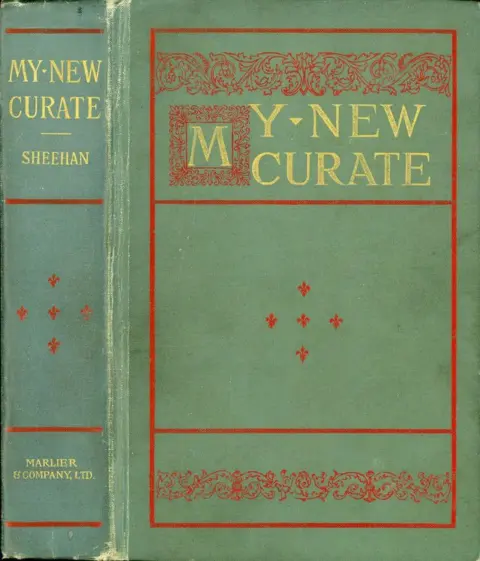
"My New Curate" by Patrick Augustine Sheehan is a novel written in the early 20th century. The story centers around Father Dan, a parish priest in an Irish village, and his experiences as he receives a new curate, Father Letheby, whose modern and energetic approach to ministry contrasts sharply with Father Dan's more traditional and resigned existence. The narrative explores themes of faith, the hardships of rural life, and the relationship between clergy and their parishioners. At the start of the book, the reader is introduced to the emotional departure of Father Dan’s old curate, Father Laverty, who leaves the parish for a new assignment. The accompanying sadness sets the tone for Father Dan's reflections on his life and the challenges that lie ahead with a new, unknown curate. Father Letheby arrives with enthusiasm and a passion to invigorate the parish, and his modern ideas quickly clash with the established leniency of the local community. This friction in expectations creates an engaging dynamic, hinting at the transformation both priests may undergo as they navigate their differences and the realities of their shared responsibilities.
Introduction adapted from the source catalogue; source summaries may be automatically generated.
Free to read · English · 107,499 words · No account needed
MAKE TIME FOR A GOOD BOOK
On by default. Untick to stop anonymous reading totals. Each page counts after 10 seconds in view. How this works.
Anonymous counting is on unless you have switched it off.
"Oh, dear, dear, and to think of our Lord with the straw under Him, and His feet covered with the frost of that cowld night--"
"And the poor child! Look at her; why, she's only a little girl, like Norah; and not a woman near to help her in her throuble."
"Look at His little hands stretched out, like any ordinary child. Glory be to His Holy Name. Sure, only for Him where 'ud we be?"
"And poor St. Joseph! No wondher he's fretting. To think of thim two
cratures in his hands, and he not having house or home to shelter
thim!"
"Wisha, Mary, 't was a pity we worn't there that blessed night. Sure,
't is we'd give 'em the best we had in the world, an' our hearts'
blood."
I shared to the full this feeling about St. Joseph. And when, after Father Letheby's Mass, I came down, and brought over my old arm-chair, and placed it in front of the crib, and put down my snuff-box, and my breviary, and my spectacles, and gave myself up to the contemplation of that wonderful and pathetic drama, St. Joseph would insist on claiming the largest share of my pity and sympathy. Somehow I felt that mother and child understood each other perfectly,--that she saw everything through the eyes of God, and that therefore there was not much room for wonderment; but that to St. Joseph the whole thing was an unspeakable mystery of humiliation and love, infinite abasement and infinite dignity; and I thought I saw him looking from the child-face of his spouse to the child-face of the Infant, and somehow asking himself, "What is it all?" even though he explicitly understood the meaning and magnitude of the mighty mystery.
Father Letheby has a new series of pictures of the Life of our Lord, painted by a French artist, whose name I can never recall except when I sneeze,--Tissot. I do not like them at all. They are too realistic,--and, after all, the ideal is the real. I have a special, undiluted dislike of one picture,--the Magnificat. I'd have torn it up, and put the fragments in the fire, but that it was not mine. But how in the world any Catholic could paint my beautiful child-prophetess of Hebron as Tissot has done baffles comprehension. But he has one lovely picture, "Because there was no Room." The narrow lane of the Jewish city,--the steep stairs to the rooms,--the blank walls perforated by a solitary, narrow window,--the rough stones, and the gentle animal that bore Mary, treading carefully over them,--the Jewish women, regretfully refusing admission,--the sweet, gentle face of the maiden mother,--and the pathetic, anxious, despairing look on the features of St. Joseph,--make this a touching and beautiful picture. Poor St. Joseph! "Come, take the reins of the patient animal, and lead him and his sacred burden out into the night! There is no room in the City of David for the children of David. Out under the stars, shining brilliantly through the frosty atmosphere, over the white, rugged road, into an unknown country, and 'Whither, O my God?' on thy lips, as the child at thy side shuddered, and no finger from heaven nor voice from earth directed thee; unless, indeed, that faint flashes of light athwart the net of stars told thee that the angels were cutting their way down through the darkness, and into the spheres of men, and that all heaven was in a tumult of expectation, whilst in yonder city men slept, as they always sleep unconscious when God is near. And then, when the feeble plaint broke from Mary's lips, I cannot go further, and the gentle beast turned aside into the rocks and whins, and called to his companions of the stable, and the meek-eyed ox looked calmly at the intruders, and there--there--dear God! to think of it all--In mundo erat, et mundus eum non cognovit."
Your reading position is saved on this browser. Take it to another device with a library code. Reading pages adapt to text, rather than matching a printed edition.
BEHIND THE BOOK
This eBook is for the use of anyone anywhere in the United States and most other parts of the world at no cost and with almost no restrictions whatsoever. You may copy it, give it away or re-use it under the terms of the Project Gutenberg License included with this eBook or online at www.gutenberg.org. If you are not located in the United States, you will have to check the laws of the country where you are located before using this eBook. Read the source licence.
The original source file, including credits and licence, is retained by this library. Request an original-format copy at no charge. Please include the book title and Project Gutenberg identifier #20295.
KEEP YOUR CURIOSITY GOING
Coulson Kernahan

Maurice Baring
Frances Wright
Cécile Tormay

Frederic Jesup Stimson

W. H. P. (William Henry Pope) Jarvis