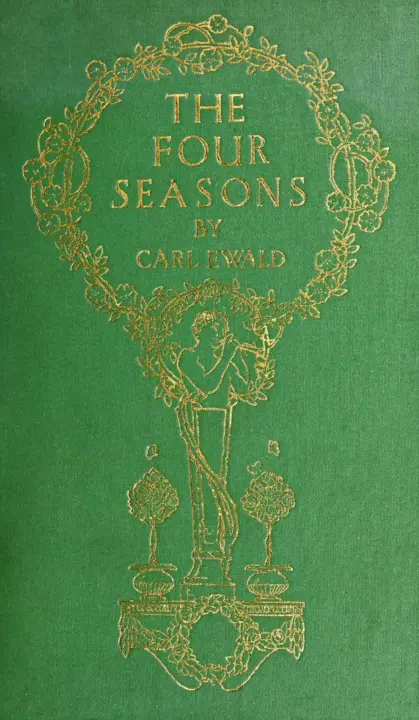
The Four Seasons
Carl Ewald
THE CLASSIC COLLECTION · 1906
"My Little Boy" by Carl Ewald, translated from the Danish by Alexander Teixeira de Mattos, is a collection of childhood reflections and anecdotes written in the early 20th century. The book captures the joys, curiosities, and challenges of a father as he navigates the early years of his son's life, exploring themes of innocence, growth, and the complexities of human nature. The narrative follows a father as he observes and interacts with his little boy, showcasing the child’s imaginative spirit and his journey from toddlerhood into the world of learning and societal norms. Through various episodes—the boy's first encounters with nature, his infectious curiosity about the world, and his developing social consciousness—the father reflects on the bittersweet transition from carefree childhood to the structured environment of school. A pivotal moment occurs as the father grapples with the implications of sending his son to school, representing a poignant shift in their relationship and the loss of the unfiltered joy of childhood, ultimately expressing the love and apprehension felt by a parent watching their child grow up.
Introduction adapted from the source catalogue; source summaries may be automatically generated.
Free to read · English · 14,099 words · No account needed
MAKE TIME FOR A GOOD BOOK
On by default. Untick to stop anonymous reading totals. Each page counts after 10 seconds in view. How this works.
Anonymous counting is on unless you have switched it off.
We have beer-soup and Aunt Anna to dinner. Now beer-soup is a nasty dish and Aunt Anna is not very nice either.
She has yellow teeth and a little hump and very severe eyes, which are not even both equally severe. She is nearly always scolding us and, when she sees a chance, she pinches us.
The worst of all, however, is that she is constantly setting us a good example, which can easily end by gradually and inevitably driving us to embrace wickedness.
Aunt Anna does not like beer-soup any more than we do. But of course she eats it with a voluptuous expression on her face and looks angrily at my little boy, who does not even make an attempt to behave nicely:
"Why doesn't the little boy eat his delicious beer-soup?" she asks.
A scornful silence.
"Such delicious beer-soup! I know a poor, wretched boy who would be awfully glad to have such delicious beer-soup."
My little boy looks with great interest at Auntie, who is swallowing her soup with eyes full of ecstatic bliss:
"Where is he?" he asks.
Aunt Anna pretends not to hear.
"Where is the poor boy?" he asks again.
"Yes, where is he?" I ask. "What's his name?"
Aunt Anna gives me a furious glance.
"What's his name, Aunt Anna?" asks my little boy. "Where does he live? He can have my beer-soup with pleasure."
"Mine too," I say, resolutely, and I push my plate from me.
My little boy never takes his great eyes off Aunt Anna's face. Meanwhile, she has recovered herself:
"There are many poor boys who would thank God if they could get such delicious beer-soup," she says. "Very many. Everywhere."
"Yes, but tell us of one, Auntie," I say.
My little boy has slipped down from his chair. He stands with his chin just above the table and both his hands round his plate, ready to march off with the beer-soup to the poor boy, if only he can get his address.
But Aunt Anna does not allow herself to be played with:
"Heaps of poor boys," she says again. "Hun-dreds! And therefore another little boy, whom I will not name, but who is in this room, ought to be ashamed that he is not thankful for his beer-soup."
My little boy stares at Aunt Anna like the bird fascinated by the snake.
"Such delicious beer-soup!" she says. "I must really ask for another
little helping."
Aunt Anna revels in her martyrdom. My little boy stands speechless, with open mouth and round eyes.
I push my chair back and say, with genuine exasperation:
Your reading position is saved on this browser. Take it to another device with a library code. Reading pages adapt to text, rather than matching a printed edition.
Carl Ewald
Carl Ewald
Carl Ewald
BEHIND THE BOOK
This eBook is for the use of anyone anywhere in the United States and most other parts of the world at no cost and with almost no restrictions whatsoever. You may copy it, give it away or re-use it under the terms of the Project Gutenberg License included with this eBook or online at www.gutenberg.org. If you are not located in the United States, you will have to check the laws of the country where you are located before using this eBook. Read the source licence.
The original source file, including credits and licence, is retained by this library. Request an original-format copy at no charge. Please include the book title and Project Gutenberg identifier #35543.
KEEP YOUR CURIOSITY GOING
Coulson Kernahan

Maurice Baring
Frances Wright
Cécile Tormay

Frederic Jesup Stimson

W. H. P. (William Henry Pope) Jarvis