THE CLASSIC COLLECTION✦An outlaw’s diary: the CommuneCLASSIC FREE BOOKS
An outlaw’s diary: the Commune
Cécile Tormay
THE CLASSIC COLLECTION · 1909
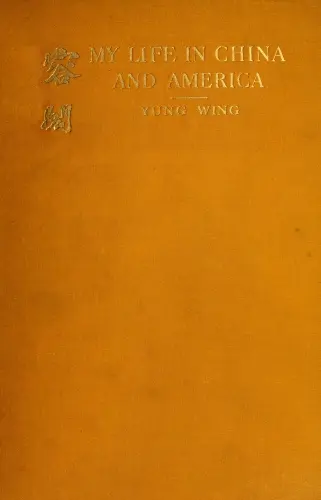
"My Life in China and America" by Yung Wing is a memoir written in the early 20th century. This work chronicles the author's experiences growing up in China, pursuing education in the United States, and his subsequent return to China, highlighting his efforts to reform Chinese education. The narrative aims to weave the story of personal growth and cultural exchange while aiming for the enlightenment and betterment of China through Western ideals and education. The opening of the memoir introduces Yung Wing's early life in Nam Ping, near Macao, where he begins his education under the guidance of Mrs. Gutzlaff. It describes his family's decision to send him to a foreign school, which set the stage for his extraordinary journey. Yung Wing reflects on his initial impressions of the school, his interactions with Mrs. Gutzlaff, and the influence of their relationship on his life. He recounts early childhood escapades, such as his attempt to escape from the confines of the school, and ultimately lays the groundwork for his later academic pursuits in American institutions, which would significantly shape his identity and ambitions.
Introduction adapted from the source catalogue; source summaries may be automatically generated.
Free to read · English · 62,380 words · No account needed
MAKE TIME FOR A GOOD BOOK
On by default. Untick to stop anonymous reading totals. Each page counts after 10 seconds in view. How this works.
Anonymous counting is on unless you have switched it off.
The machinery was not finished till the early spring of 1865. It was shipped direct from New York to Shanghai, China; while it was doubling the Cape of Good Hope on its way to the East, I took passage in another direction, back to China. I wanted to encircle the globe once in my life, and this was my opportunity. I could say after that, that I had circumnavigated the globe. So I planned to go back by way of San Francisco. In order to do that, I had to take into consideration the fact that the Union Pacific from Chicago to San Francisco via Omaha was not completed, nor was any steamship line subsidized by the United States government to cross the Pacific from San Francisco to any seaport, either in Japan or China at the time. On that account I was obliged to take a circuitous route, by taking a coast steamer from New York to Panama, cross the Isthmus, and from there take passage in another coast steamer up the Mexican coast to San Francisco, Cal.
At San Francisco, I was detained two weeks where I had to wait for a vessel to bridge me over the broad Pacific, either to Yokohama or Shanghai. At that time, as there was no other vessel advertised to sail for the East, I was compelled to take passage on board the “Ida de Rogers,” a Nantucket bark. There were six passengers, including myself. We had to pay $500 each for passage from San Francisco to Yokohama. The crew consisted of the captain, who had with him his wife, and a little boy six years old, a mate, three sailors and a cook, a Chinese boy. The “Ida de Rogers” was owned by Captain Norton who hailed from Nantucket. She was about one hundred and fifty feet long--an old tub at that. She carried no cargo and little or no ballast, except bilge-water, which may have come from Nantucket, for aught I know. The skipper, true to the point of the country where they produce crops of seamen of microscopic ideas, was found to be not at all deficient in his close calculations of how to shave closely in every bargain and, in fact, in everything in life. In this instance, we had ample opportunity to find out under whom we were sailing. Before we were fairly out of the “Golden Gate,” we were treated every day with salted mackerel, which I took to be the daily and fashionable dish of Nantucket. The cook we had made matters worse, as he did not seem to know his business and was no doubt picked up in San Francisco just to fill the vacancy. The mackerel was cooked and brought on the table without being freshened, and the Indian meal cakes that were served with it, were but half baked, so that day after day we practically all left the table disgusted and half starved. Not only was the food bad and unhealthy, but the skipper’s family was of a very low type. The skipper himself was a most profane man, and although I never heard the wife swear, yet she seemed to enjoy her husband’s oaths. Their little boy who was not more than six years old, seemed to have surpassed the father in profanity. It may be said that the young scamp had mastered his shorter and longer catechism of profanity completely, for he was not wanting in expressions of the most disgusting and repulsive kind, as taught him by his sire, yet his parents sat listening to him with evident satisfaction, glancing around at the passengers to catch their approval. One of the passengers, an Englishman, who stood near listening and smoking his pipe, only remarked ironically, “You have a smart boy there.” At this the skipper nodded, while the mother seemed to gloat over her young hopeful. Such a scene was of daily occurrence, and one that we could not escape, since we were cooped up in such narrow quarters on account of the smallness of the vessel. There was not even a five-foot deck where one could stretch his legs. We were most of the time shut up in the dining room, as it was the coolest spot we could find. Before our voyage was half over, we had occasion to land at one of the most northerly islands of the Hawaiian group for fresh water and provisions. While the vessel was being victualed, all the passengers landed and went out to the country to take a stroll, which was a great relief. We were gone nearly all day. We all re-embarked early in the evening. It seemed that the captain had filled the forward hold with chickens and young turkeys. We congratulated ourselves that the skipper after all had swung round to show a generous streak, which had only needed an opportunity to show itself, and that for the rest of the voyage he was no doubt going to feed us on fresh chickens and turkeys to make up for the salted mackerel, which might have given us the scurvy had we continued on the same diet. For the first day or so, after we resumed our voyage, we had chicken and fish for our breakfast and dinners, but that was the last we saw of the fresh provisions. We saw no turkey on the table. On making inquiry, the cook told us that both the chickens and the turkeys were bought, not for our table, but for speculation, to be sold on arrival in Yokohama. Unfortunately for the skipper, the chickens and turkeys for want of proper food and fresh air, had died a few days before our arrival at the port.
Your reading position is saved on this browser. Take it to another device with a library code. Reading pages adapt to text, rather than matching a printed edition.
BEHIND THE BOOK
This eBook is for the use of anyone anywhere in the United States and most other parts of the world at no cost and with almost no restrictions whatsoever. You may copy it, give it away or re-use it under the terms of the Project Gutenberg License included with this eBook or online at www.gutenberg.org. If you are not located in the United States, you will have to check the laws of the country where you are located before using this eBook. Read the source licence.
The original source file, including credits and licence, is retained by this library. Request an original-format copy at no charge. Please include the book title and Project Gutenberg identifier #54635.
KEEP YOUR CURIOSITY GOING
Cécile Tormay

Moritz Busch
John L. Ransom
Frances Wright
Cécile Tormay

Mabel Potter Daggett