THE CLASSIC COLLECTION✦A dead man’s diaryCLASSIC FREE BOOKS
A dead man’s diary
Coulson Kernahan
THE CLASSIC COLLECTION · 1892
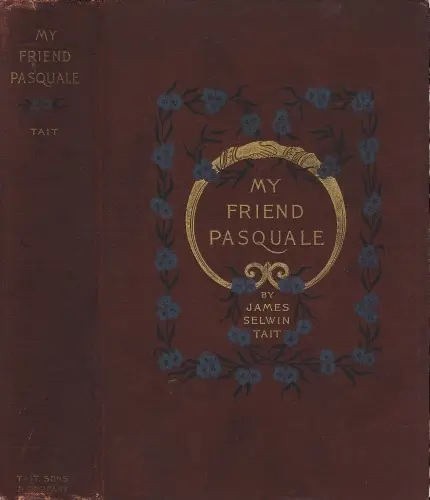
"My Friend Pasquale and Other Stories" by James Selwin Tait is a collection of fictional narratives likely written in the late 19th century. The book opens with a story centered on the titular character, the enigmatic Pasquale, and the events surrounding a chance encounter that transforms the narrator's life. Themes of friendship, duty, and the darker aspects of human nature begin to unfold as the narrator reflects on his relationship with Pasquale, hinting at a blend of tragedy and mystery. The opening of the book introduces us to the narrator, who journeys home from work only to find himself inadvertently engaged in a disturbing scene involving a dog fight. He witnesses the rescue of Pasquale, a passionate stranger who intervenes in the brutality. Their fateful meeting ignites a unique friendship filled with intriguing conversations and underlying tensions. As Pasquale’s complex character emerges—emotionally charged yet affectionate—the narrator begins to ponder the deeper implications of their bond and the dark turns that may await them. This initial chapter sets a compelling tone for the collection, suggesting a rich exploration of both companionship and fate that will likely unravel throughout the stories.
Introduction adapted from the source catalogue; source summaries may be automatically generated.
Free to read · English · 60,340 words · No account needed
MAKE TIME FOR A GOOD BOOK
On by default. Untick to stop anonymous reading totals. Each page counts after 10 seconds in view. How this works.
Anonymous counting is on unless you have switched it off.
“There, Alice,” she at last exclaimed, “there is my likeness, and really, dear, it is as like you as it can be, or else my old eyes are deceiving me.”
“Oh, grannie, it is a beauty--like me, is it? Ah! you are flattering me, and yet, really, truly, I almost seem to be gazing at myself when I look at it. I hope, dearest, I shall be as beautiful as you are when I am old; but I think only a good life can make a handsome old age.”
By way of reply the other stroked the beautiful dark brown hair which frowned over the fair Grecian features, and murmured, “You will always be beautiful, my darling; God has given you not only a beautiful face, but a beautiful and unselfish disposition to match it.”
“Oh, grandma! is that splendid-looking Indian Tallahassee?” inquired Alice, pointing to a well-executed etching of an Indian chief, evidently of the Seminole tribe, from the turbaned head and long-waving locks.
“Yes, dear, that is our noble friend, Tallahassee.”
Long the young wife’s eyes gazed on the spirited etching, which revealed an Indian warrior or buck in his youthful prime, his luminous eyes and handsome aquiline features dignified with all the Seminole pride of race, but wearing, as well, a certain refinement of expression rarely seen except in very highly civilized society.
But it is very doubtful if the young wife’s attention was riveted on the Indian’s likeness, for when she raised her head, there was an air of troubled perplexity visible on her face which the inspection of the portrait could not account for. Was she thinking of her ill-starred brother?
“What you must have suffered, dear grannie. I wonder you could ever bear to hear the name of Florida again.”
“No, dear, I have none of that feeling. Some of the happiest moments of my life were spent there, and I am hopeful that I may visit it once again, now that it is so easy of access.
“I wonder whether our old friend, Tallahassee, has forgotten us yet.”
“Why, surely he is not living yet!” exclaimed the grand-daughter in an
astonished voice.
“Yes, dear, I believe he is; he certainly was alive a year ago, although he is now an old and heartbroken man. The settlement of the State by emigrants has driven him from his old haunts and from every new home as fast as he has made it, and the tribe has dwindled down to a mere handful of followers and himself; the very tender mercies of the pale face are cruel to the red man.”
“But did he own no land?”
Your reading position is saved on this browser. Take it to another device with a library code. Reading pages adapt to text, rather than matching a printed edition.
BEHIND THE BOOK
This eBook is for the use of anyone anywhere in the United States and most other parts of the world at no cost and with almost no restrictions whatsoever. You may copy it, give it away or re-use it under the terms of the Project Gutenberg License included with this eBook or online at www.gutenberg.org. If you are not located in the United States, you will have to check the laws of the country where you are located before using this eBook. Read the source licence.
The original source file, including credits and licence, is retained by this library. Request an original-format copy at no charge. Please include the book title and Project Gutenberg identifier #49484.
KEEP YOUR CURIOSITY GOING
Coulson Kernahan

Maurice Baring
Frances Wright
Cécile Tormay

Frederic Jesup Stimson

W. H. P. (William Henry Pope) Jarvis