THE CLASSIC COLLECTION✦A dead man’s diaryCLASSIC FREE BOOKS
A dead man’s diary
Coulson Kernahan
THE CLASSIC COLLECTION · 1892
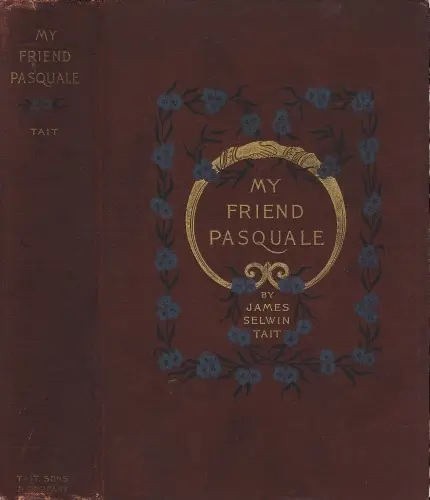
"My Friend Pasquale and Other Stories" by James Selwin Tait is a collection of fictional narratives likely written in the late 19th century. The book opens with a story centered on the titular character, the enigmatic Pasquale, and the events surrounding a chance encounter that transforms the narrator's life. Themes of friendship, duty, and the darker aspects of human nature begin to unfold as the narrator reflects on his relationship with Pasquale, hinting at a blend of tragedy and mystery. The opening of the book introduces us to the narrator, who journeys home from work only to find himself inadvertently engaged in a disturbing scene involving a dog fight. He witnesses the rescue of Pasquale, a passionate stranger who intervenes in the brutality. Their fateful meeting ignites a unique friendship filled with intriguing conversations and underlying tensions. As Pasquale’s complex character emerges—emotionally charged yet affectionate—the narrator begins to ponder the deeper implications of their bond and the dark turns that may await them. This initial chapter sets a compelling tone for the collection, suggesting a rich exploration of both companionship and fate that will likely unravel throughout the stories.
Introduction adapted from the source catalogue; source summaries may be automatically generated.
Free to read · English · 60,340 words · No account needed
MAKE TIME FOR A GOOD BOOK
On by default. Untick to stop anonymous reading totals. Each page counts after 10 seconds in view. How this works.
Anonymous counting is on unless you have switched it off.
When the elder lady finished her tragic story the younger one crept softly to her side, and the tears stole down her cheeks as she buried her face on the other’s shoulder murmuring, “Oh poor, poor grannie, what a terrible ordeal it must have been to go through.”
After the acute feelings naturally called up by the narration of so painful an incident had subsided, the young wife inquired why she had never been told of the terrible affair before.
“Because, dear, I have shuddered even to think of the thing, it left such a horrible impression on my mind.”
“Dear grannie,” murmured the other sympathetically. “Oh, if one tenth of the misery which you endured happens to me through the removal of my ring, I know I shall die, I could never stand any great strain; people were stronger then than they are now.
“I wonder, grannie, what you were like when you were my age,” resumed the speaker; “have you no old miniatures among your collections of relics?”
“No, my dear, but I have an old scrap-book which contains a drawing of myself, sketched during my honeymoon by my husband, who was quite a famous etcher before that accident to his arm. There is also, I think, an etching of Tallahassee, and one of the old plantation.”
Very naturally, nothing would content the youthful bride until she had
seen the drawings, and her grandmamma left the piazza to fetch the
album.
When left alone, an anxious expression crept over the former’s face, and the point of her tiny boot tapped the boarded floor, nervously and somewhat impatiently.
“I wonder if that was Tom whom I saw beckoning to me in the thicket, and if so, what trouble has he been getting into now?”
At that moment a low voice called her softly by name, and suppressing the scream of alarm which rose to her lips, she turned to find the person of whom she was thinking, her scapegrace brother Tom, half hidden in the shrubbery which separated the main building from some outhouses.
Before she could frame any greeting, a letter fluttered to her feet, and the alarming visitor disappeared as her grandmamma returned, album in hand.
All that the letter said, when surreptitiously opened, was, “I must meet you at the end of the peach walk at eight to-night; don’t fail to be there; my safety concerned.”
Meantime, with spectacles adjusted, the old lady with gentle fingers turned over the leaves of the antiquated album, now yellowed with its half century of age.
Your reading position is saved on this browser. Take it to another device with a library code. Reading pages adapt to text, rather than matching a printed edition.
BEHIND THE BOOK
This eBook is for the use of anyone anywhere in the United States and most other parts of the world at no cost and with almost no restrictions whatsoever. You may copy it, give it away or re-use it under the terms of the Project Gutenberg License included with this eBook or online at www.gutenberg.org. If you are not located in the United States, you will have to check the laws of the country where you are located before using this eBook. Read the source licence.
The original source file, including credits and licence, is retained by this library. Request an original-format copy at no charge. Please include the book title and Project Gutenberg identifier #49484.
KEEP YOUR CURIOSITY GOING
Coulson Kernahan

Maurice Baring
Frances Wright
Cécile Tormay

Frederic Jesup Stimson

W. H. P. (William Henry Pope) Jarvis