THE CLASSIC COLLECTION✦Towards democracyCLASSIC FREE BOOKS
Towards democracy
Edward Carpenter
THE CLASSIC COLLECTION · 1916
"My days and dreams" by Edward Carpenter is an autobiography written in the early 20th century. It charts four phases of a life—from a constrained Brighton childhood through Cambridge and public lecturing in northern towns to later years of manual work among the working classes—interweaving personal reflection with critiques of class convention, religion, sexuality, and artistic influence.
The opening of this autobiography explains that the notes began in 1890 and were expanded irregularly, with bracketed dates marking when sections were written. The first chapter recalls an uncomfortable youth in fashionable Brighton, loneliness at home and school, a formative year at the Lycée in Versailles, and solace found in the sea and Sussex Downs; it also describes early loves—music, home chemistry, and intense but inarticulate boyhood attachments—alongside a sharp critique of empty “young lady” society, affectionate portraits of two elder sisters, and a lively sketch of a younger brother who became a decorated naval officer. The next chapter offers vivid portraits of his parents: a liberal, mystically inclined father shaped by the Navy and philosophy, and a tireless, self-effacing mother whose death left the family unmoored; evening household scenes and her later passing lead into his father’s decline. The early Cambridge chapter then covers a brief Heidelberg interlude, immersion in Trinity Hall’s rowing culture, study for the mathematical tripos and a fellowship, and ordination—followed by disillusion with parish life, a fraught exchange with the Bishop over the sacrifice of Isaac, and an uneasy curacy under F. D. Maurice. In parallel, he moves into heretical, reform-minded circles (influenced by W. K. Clifford and Mazzini), discovers Whitman’s comradeship and democratic vision, and feels his life drifting away from academic convention. A restorative Italian sojourn and the impact of Greek sculpture deepen his new ideals, while counsel from a frank, art-loving friend steels him to leave the Church. The section closes with his first, self-financed poetry volume—issued with hope but meeting little response.
Introduction adapted from the source catalogue; source summaries may be automatically generated.
Free to read · English · 98,981 words · No account needed
MAKE TIME FOR A GOOD BOOK
On by default. Untick to stop anonymous reading totals. Each page counts after 10 seconds in view. How this works.
Anonymous counting is on unless you have switched it off.
Early in 1883, as I have said, I gave my first lecture on social questions, and from that time forward I spoke on these subjects. In the summer of ’84 I went again to the United States, my chief object again being to see Whitman—though I had also friends to visit. I crossed the Atlantic as a steerage passenger—in a big Inman boat, the City of Berlin—with seven or eight hundred other steerage passengers. It was a great experience. I have described it in my poem “On an Atlantic Steamship.” The fact of my venturing it shows the determination with which I was working down into a knowledge of the life of the people. Besides, I had crossed as a saloon passenger before, and I felt that that was intolerable! The experience was not nearly so rude as I had expected. We had good weather, which of course is everything, and were on deck all day; the nationalities, Swedes, German, Irish, English, etc., were kept apart from each other below; I secured a cabin with a very decent set of young English fellows, and we got on first-rate. The food was quite clean and good. So well satisfied was I that I actually returned (from Quebec) in the steerage section!
I spent three or four days in Philadelphia and saw Whitman each day (of which I have given an account elsewhere[13]); and then went on to Massachusetts. The visit to Whitman did not help me so much as the first time. He was very friendly; he gave me introductions to Dr. Bucke in Canada, and to W. Sloane Kennedy, and was generally kind; but his self-centredness (arising no doubt largely from physical causes) had increased, and seemed difficult to overcome.
In Massachusetts I stayed with my friends the Rileys, who had at one time been on St. George’s farm (Ruskin’s) near Sheffield. They were now on a farm near Townsend Centre, and I remained with them about three weeks, joining in the life, doing a bit on the farm with them, and seeing something of the neighbours. George Riley, the son, and I were chums, and spent some of the time walking together—on one occasion a two days ‘out’ to Wachusett, mountain and lake, a charming neighborhood. During the time I also visited Sloane Kennedy, at Belmont, and together we went to Walden pond, bathed in it, and added a stone to Thoreau’s cairn. Thence to Pennsylvania, beyond Pittsburg, to stay with Mrs. Hardy and her three daughters—also people I had known in Sheffield—who together were ‘running’ a big farm and making it pay well, an excellent example of female management. Thence, after a pleasant stay of four or five days, across Lake Erie to Toronto and so to London, to see Dr. Bucke. Dr. Bucke was acting as head and superintendent of a large Asylum for Insane folk—over a thousand patients—which he managed excellently. I found him very interesting. We had long talks about Whitman; he showed me his Whitman books, pictures, etc., and then after another four or five days I got the steamer at Toronto, and went down the St. Lawrence to Quebec. The Lake itself, the passages of the thousand islands and of the successive rapids, were a great delight. I had only an hour or two at Quebec, unfortunately—not time to see much of the town; and then I embarked on the Parisian for home. Here again the lower reaches of this magnificent river, the coast of Gaspé, and of Labrador, the hundreds of icebergs we saw that day, becalmed in a glassy blue sea, and in blazing sunlight, were most interesting. We slipped through the straits of Belle-Isle and had an enjoyable passage to Liverpool.
Your reading position is saved on this browser. Take it to another device with a library code. Reading pages adapt to text, rather than matching a printed edition.
Edward Carpenter
Edward Carpenter
Edward Carpenter
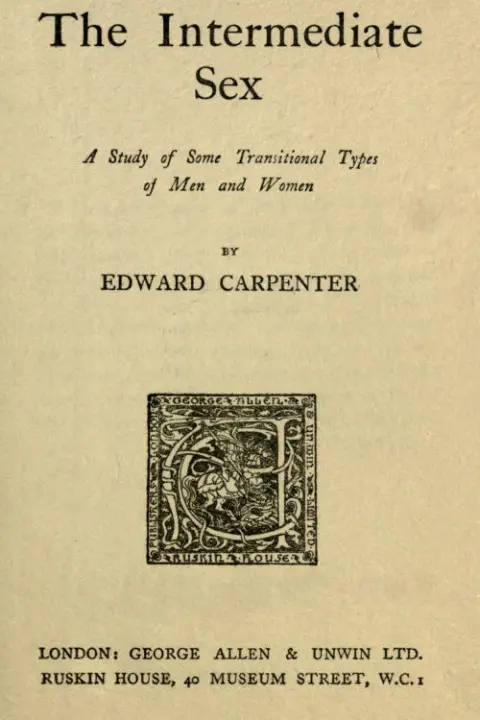
Edward Carpenter
BEHIND THE BOOK
This eBook is for the use of anyone anywhere in the United States and most other parts of the world at no cost and with almost no restrictions whatsoever. You may copy it, give it away or re-use it under the terms of the Project Gutenberg License included with this eBook or online at www.gutenberg.org. If you are not located in the United States, you will have to check the laws of the country where you are located before using this eBook. Read the source licence.
The original source file, including credits and licence, is retained by this library. Request an original-format copy at no charge. Please include the book title and Project Gutenberg identifier #78612.
KEEP YOUR CURIOSITY GOING
John L. Ransom

Herman W. Mudgett

Harriet Monroe
Daniel Dulany Addison
Charles Lanman

Harold Rosher