THE CLASSIC COLLECTION✦Towards democracyCLASSIC FREE BOOKS
Towards democracy
Edward Carpenter
THE CLASSIC COLLECTION · 1916
"My days and dreams" by Edward Carpenter is an autobiography written in the early 20th century. It charts four phases of a life—from a constrained Brighton childhood through Cambridge and public lecturing in northern towns to later years of manual work among the working classes—interweaving personal reflection with critiques of class convention, religion, sexuality, and artistic influence.
The opening of this autobiography explains that the notes began in 1890 and were expanded irregularly, with bracketed dates marking when sections were written. The first chapter recalls an uncomfortable youth in fashionable Brighton, loneliness at home and school, a formative year at the Lycée in Versailles, and solace found in the sea and Sussex Downs; it also describes early loves—music, home chemistry, and intense but inarticulate boyhood attachments—alongside a sharp critique of empty “young lady” society, affectionate portraits of two elder sisters, and a lively sketch of a younger brother who became a decorated naval officer. The next chapter offers vivid portraits of his parents: a liberal, mystically inclined father shaped by the Navy and philosophy, and a tireless, self-effacing mother whose death left the family unmoored; evening household scenes and her later passing lead into his father’s decline. The early Cambridge chapter then covers a brief Heidelberg interlude, immersion in Trinity Hall’s rowing culture, study for the mathematical tripos and a fellowship, and ordination—followed by disillusion with parish life, a fraught exchange with the Bishop over the sacrifice of Isaac, and an uneasy curacy under F. D. Maurice. In parallel, he moves into heretical, reform-minded circles (influenced by W. K. Clifford and Mazzini), discovers Whitman’s comradeship and democratic vision, and feels his life drifting away from academic convention. A restorative Italian sojourn and the impact of Greek sculpture deepen his new ideals, while counsel from a frank, art-loving friend steels him to leave the Church. The section closes with his first, self-financed poetry volume—issued with hope but meeting little response.
Introduction adapted from the source catalogue; source summaries may be automatically generated.
Free to read · English · 98,981 words · No account needed
MAKE TIME FOR A GOOD BOOK
On by default. Untick to stop anonymous reading totals. Each page counts after 10 seconds in view. How this works.
Anonymous counting is on unless you have switched it off.
Having many friends in London, and a good many relations, I naturally, during all the years of my sojourn at Millthorpe, have been in the habit of paying fairly frequent visits to the big city. It is good to have one’s roots in the country, but it is also necessary to have one’s branches in the great towns where one can come into contact with the winds and storms of human life.
A considerable social storm at which I was present was that of the so-called “Bloody Sunday” in November ’87. A socialist meeting had been announced for 3 p.m. in Trafalgar Square, to protest against the Irish policy of the Government, and the authorities (for conscience doth make cowards of us all) probably thinking Socialism a much greater ‘terror’ than it really was, had vetoed the meeting and drawn a ring of police, two deep, all round the interior part of the Square. Of course the Socialists had to make an active protest, if only in order to bring the case into court; and three leading members of the S.D.F.—Hyndman, John Burns and Cunninghame Graham—agreed to march up arm-in-arm and force their way if possible into the charmed circle. Somehow Hyndman was lost in the crowd on the way to the battle, but Graham and Burns pushed their way through, challenged the forces of ‘Law and Order,’ came to blows, and were duly mauled by the police, arrested, and locked up.
I was in the Square at the time, and like most of the crowd there more as a sightseer than anything else. Indeed, though a large crowd it was of a most good-humored and peaceable kind; but the way in which it was ‘worked up,’ provoked and irritated by the authorities, was a caution; and gave me the strongest impression that this was done purposely, with the intention of leading to a collision. If this was not so the only explanation must be that abject fear, on the part of the authorities, was the moving cause. As I say, the crowd was a most good-humored, easy-going, smiling crowd; but presently it was transformed. A regiment of mounted police came cantering up. The order had gone forth that we were to be ‘kept moving.’ To keep a crowd moving is I believe a technical term for the process of riding roughshod in all directions, scattering, frightening and batoning the people—the idea no doubt being to prevent the formation of knots or the consolidation of organized bodies among the crowd. In this case there was really no sign of any organized movement on the part of the people against the police, nor had I heard of any plan to that effect, further than the march-up of the three leaders already mentioned. I was standing—with my friend Robert Muirhead, Cambridge mathematician and Smith’s Prizeman, two peaceable enough members of society as may be supposed—on an island-refuge just where the Strand debouches into Trafalgar Square, when we found ourselves violently pushed about by mounted and foot police and told to ‘move on.’ Whether Muirhead did not move on fast enough, or what the trouble was, was never explained; but the next moment I saw him seized by the collar by a mounted man and dragged along, apparently towards a police-station, while a bobby on foot aided in the arrest. I jumped to the rescue and slanged the two constables, for which I got a whack on the cheekbone from a baton (which distressed the more respectable members of my family for some weeks after), but Muirhead was released, and we soon regained our footing on the refuge, from which for some time we watched the police continuing, at considerable risk to life and limb, to circle round and insult the ‘mob.’ I mention these little details just to show the kind of thing that happens. Purely as the result of this ill-timed action there were one or two ugly rushes I believe and a few broken heads; but the damage of ‘Bloody Sunday’ did not after all amount to much.
Your reading position is saved on this browser. Take it to another device with a library code. Reading pages adapt to text, rather than matching a printed edition.
Edward Carpenter
Edward Carpenter
Edward Carpenter
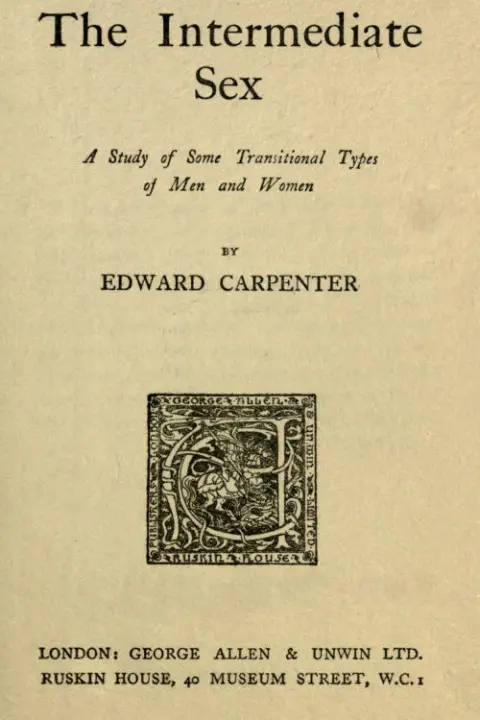
Edward Carpenter
BEHIND THE BOOK
This eBook is for the use of anyone anywhere in the United States and most other parts of the world at no cost and with almost no restrictions whatsoever. You may copy it, give it away or re-use it under the terms of the Project Gutenberg License included with this eBook or online at www.gutenberg.org. If you are not located in the United States, you will have to check the laws of the country where you are located before using this eBook. Read the source licence.
The original source file, including credits and licence, is retained by this library. Request an original-format copy at no charge. Please include the book title and Project Gutenberg identifier #78612.
KEEP YOUR CURIOSITY GOING
John L. Ransom

Herman W. Mudgett

Harriet Monroe
Daniel Dulany Addison
Charles Lanman

Harold Rosher