THE CLASSIC COLLECTION✦Towards democracyCLASSIC FREE BOOKS
Towards democracy
Edward Carpenter
THE CLASSIC COLLECTION · 1916
"My days and dreams" by Edward Carpenter is an autobiography written in the early 20th century. It charts four phases of a life—from a constrained Brighton childhood through Cambridge and public lecturing in northern towns to later years of manual work among the working classes—interweaving personal reflection with critiques of class convention, religion, sexuality, and artistic influence.
The opening of this autobiography explains that the notes began in 1890 and were expanded irregularly, with bracketed dates marking when sections were written. The first chapter recalls an uncomfortable youth in fashionable Brighton, loneliness at home and school, a formative year at the Lycée in Versailles, and solace found in the sea and Sussex Downs; it also describes early loves—music, home chemistry, and intense but inarticulate boyhood attachments—alongside a sharp critique of empty “young lady” society, affectionate portraits of two elder sisters, and a lively sketch of a younger brother who became a decorated naval officer. The next chapter offers vivid portraits of his parents: a liberal, mystically inclined father shaped by the Navy and philosophy, and a tireless, self-effacing mother whose death left the family unmoored; evening household scenes and her later passing lead into his father’s decline. The early Cambridge chapter then covers a brief Heidelberg interlude, immersion in Trinity Hall’s rowing culture, study for the mathematical tripos and a fellowship, and ordination—followed by disillusion with parish life, a fraught exchange with the Bishop over the sacrifice of Isaac, and an uneasy curacy under F. D. Maurice. In parallel, he moves into heretical, reform-minded circles (influenced by W. K. Clifford and Mazzini), discovers Whitman’s comradeship and democratic vision, and feels his life drifting away from academic convention. A restorative Italian sojourn and the impact of Greek sculpture deepen his new ideals, while counsel from a frank, art-loving friend steels him to leave the Church. The section closes with his first, self-financed poetry volume—issued with hope but meeting little response.
Introduction adapted from the source catalogue; source summaries may be automatically generated.
Free to read · English · 98,981 words · No account needed
MAKE TIME FOR A GOOD BOOK
On by default. Untick to stop anonymous reading totals. Each page counts after 10 seconds in view. How this works.
Anonymous counting is on unless you have switched it off.
Impasse of the old order of Society, 311
Imperialism, shopkeeping, 140, 230
“Indulgences” at French school, 22
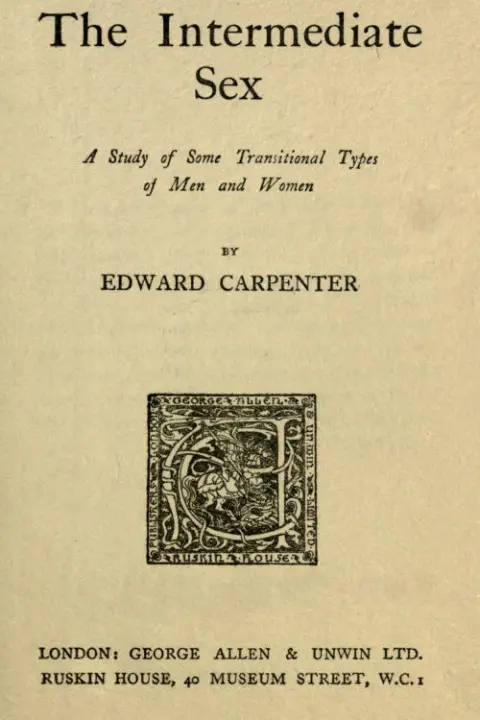
Intermediate Sex, The, 209
Invalid woman, the, of the Victorian drawing-rooms, 95
Ioläus, Anthology of Friendship, 200
Ishikawa, Sanshiro, Japanese friend, calls our houses “prisons,” 166; himself imprisoned in Japan, 277; comes to England, Belgium, France, 278, 279
Japan, Labour troubles in, 276; translations of Civilization, Toward Democracy, etc., 276–278
Japanese verdicts on the War, 279
Johnston, Councillor James, of Manchester, 263
Johnston, Dr. J., of Bolton, his Visit to Walt Whitman, 250
Joynes, James L., 236, 237
Judges, High Court and others, their fitness for the post, 212, 213
Justice, organ of the S.D.F., 115
Kaffirs, the, 229
Key, Ellen, her works, 197
Kingsford, Anna, and the Hermetic Society, 240–245
Kropotkin, Peter, 134, 218–220
Labour, Chants of, 136
Labour Press, Manchester, publishes my books, 195, 198;
goes bankrupt, 199
Labour Prophet, The, 108
Landladies, joys of, 90, 91
Latham, Henry, Tutor of Trin. Hall, 51, 57, 74
“Laws of Morality,” 205
“Laws of Nature,” 204
Leaves of Grass, 64, 201
Lectures, University Extension, Leeds, Halifax, Skipton, 78 ff.;
Nottingham, York, Hull, Barnsley, 83 ff.;
Sheffield and Chesterfield, 90 ff.;
on Astronomy, 78, 80, 92;
on Light and Sound, 84;
on Pioneers of Science, 92;
on Music, 105;
on Socialism, etc., 115, 257, 258 ff.;
at Greenock, 262;
in London and elsewhere, ch. xiv.
Le Rouge, Paul, translation of Prisons book, 276
Lewis, Edward, 97, 246, 265, 266
Life, uses of, 302–307;
daily life at seventy, 307–309
Light and Sound, lectures on, 84
Limerick, Mona, 245
Literary beginnings, 28, 49
Lock, Fossett, 61
Lodge, Oliver, 246
Love’s Coming-of-Age, 195 ff., 209;
translations of, 272
Lowell, Russell, 87
Lytton, Constance, 231
Macdonald, Ramsay, 245
Macmillan, Margaret, 245
Maguire, Tom, 134
Maitland, Edward, and the Hermetic Society, 240–245
Manual work, need of, 101, 110, 112, 114;
manual workers, solidity of their lives, 312;
friends among, 102, 112
March-Phillipps, Lisle, and the Boer War, 234;
With Rimington, 235
Margesson, Lady Isabel, 246
Market-gardening, 110, 137, 138
Marriage, decline of, 96
Marx, his theory of Surplus-value, 114, 140
Mathematics, reading for Tripos, 48;
proof of Taylor’s Theorem, 49;
place in Tripos, 52
Maurice, Fredk. D., 38;
incumbent of St. Edward’s, 55–58
Max Flint, 176;
story of his life, 176–182;
at Millthorpe, 180, 181;
Christian or Jew? 182
Merrill, George, arrival at Millthorpe, 159 ff.;
early life, 160;
talent for housework, etc., 162
Millthorpe, 91, 111;
migration to, 112, 113;
life at, 137, 147, 149, 157, 167, 282;
rendezvous of all classes, 164
Morris, William, 115, 125;
his temperament, 216;
visit to Millthorpe, 217
Moses: a drama, 75, 190
Mother, my, 41 ff.;
death of, 106
Moulton, Fletcher, Senior Wrangler, 211
Muirhead, Robert F., 49, 212, 255
Music, piano and composition, 24;
Beethoven, 33;
lectures on, 105
Nadler-Nuellens, Lilly, 270–272;
translates Towards Democracy, 272;
comes to England, 272
Najívin, Ivan, novelist and mystic; translations into Russian, 280
Narcissus and other Poems, 71, 190
Neo-Paganism, 265;
lectures on, 267, 268
Nevinson, H. W., 235, 245
“New Fellowship, The,” 222;
its early members, 225
New Movements in 1881, 240, 245
Newton, “Sir Isaac,” 18
Niagara, 89
Nietzsche, 205
Nobili, Riccardo, art-critic, 273
Non-governmental Society, 209
Northern Towns, 80, ch. iv.
Norton, Charles, of Harvard, 87
Oates, C. G., of Leeds, 83
“Olivia,” 69
Olivier, Sydney, 245
Open-air life, 101, 145
Ordination, 52;
difficulties with the Bishop, 53–55;
abandonment of Orders, 58 ff., 72 ff.
Pamphlets on Sex and Marriage, 195
Parish Council, contest, 158;
work on, 291–293
Parson, a new kind of, wanted, 291
Payne, Iden, 245
Perfect Way, The, 241
Personal reform first, 321
Your reading position is saved on this browser. Take it to another device with a library code. Reading pages adapt to text, rather than matching a printed edition.
Edward Carpenter
Edward Carpenter
Edward Carpenter
Edward Carpenter
BEHIND THE BOOK
This eBook is for the use of anyone anywhere in the United States and most other parts of the world at no cost and with almost no restrictions whatsoever. You may copy it, give it away or re-use it under the terms of the Project Gutenberg License included with this eBook or online at www.gutenberg.org. If you are not located in the United States, you will have to check the laws of the country where you are located before using this eBook. Read the source licence.
The original source file, including credits and licence, is retained by this library. Request an original-format copy at no charge. Please include the book title and Project Gutenberg identifier #78612.
KEEP YOUR CURIOSITY GOING
John L. Ransom

Herman W. Mudgett

Harriet Monroe
Daniel Dulany Addison
Charles Lanman

Harold Rosher