THE CLASSIC COLLECTION✦Towards democracyCLASSIC FREE BOOKS
Towards democracy
Edward Carpenter
THE CLASSIC COLLECTION · 1916
"My days and dreams" by Edward Carpenter is an autobiography written in the early 20th century. It charts four phases of a life—from a constrained Brighton childhood through Cambridge and public lecturing in northern towns to later years of manual work among the working classes—interweaving personal reflection with critiques of class convention, religion, sexuality, and artistic influence.
The opening of this autobiography explains that the notes began in 1890 and were expanded irregularly, with bracketed dates marking when sections were written. The first chapter recalls an uncomfortable youth in fashionable Brighton, loneliness at home and school, a formative year at the Lycée in Versailles, and solace found in the sea and Sussex Downs; it also describes early loves—music, home chemistry, and intense but inarticulate boyhood attachments—alongside a sharp critique of empty “young lady” society, affectionate portraits of two elder sisters, and a lively sketch of a younger brother who became a decorated naval officer. The next chapter offers vivid portraits of his parents: a liberal, mystically inclined father shaped by the Navy and philosophy, and a tireless, self-effacing mother whose death left the family unmoored; evening household scenes and her later passing lead into his father’s decline. The early Cambridge chapter then covers a brief Heidelberg interlude, immersion in Trinity Hall’s rowing culture, study for the mathematical tripos and a fellowship, and ordination—followed by disillusion with parish life, a fraught exchange with the Bishop over the sacrifice of Isaac, and an uneasy curacy under F. D. Maurice. In parallel, he moves into heretical, reform-minded circles (influenced by W. K. Clifford and Mazzini), discovers Whitman’s comradeship and democratic vision, and feels his life drifting away from academic convention. A restorative Italian sojourn and the impact of Greek sculpture deepen his new ideals, while counsel from a frank, art-loving friend steels him to leave the Church. The section closes with his first, self-financed poetry volume—issued with hope but meeting little response.
Introduction adapted from the source catalogue; source summaries may be automatically generated.
Free to read · English · 98,981 words · No account needed
MAKE TIME FOR A GOOD BOOK
On by default. Untick to stop anonymous reading totals. Each page counts after 10 seconds in view. How this works.
Anonymous counting is on unless you have switched it off.
In 1884 or so the founding of the New Fellowship in London (from which afterwards the Fabian Society sprang) brought me into touch with Havelock Ellis and Olive Schreiner. As I think I have already said, Ellis discovered in the proverbial penny box of a second-hand publisher, and soon after its publication, the little first edition of my Towards Democracy; and rescuing it wrote to me. Thus began my friendship with him, and afterwards with the authoress of The Story of An African Farm. A prophet is seldom acclaimed in his own country; and the work which Ellis has done in that most important field of Sexual Psychology is even yet by no means recognized in England as it ought to be—even though the subject is becoming extremely ‘actual’ here in the present day, and though elsewhere over the world his pioneer work is most honorably received and respected. The six massive volumes of his Studies in the Psychology of Sex form a masterpiece of large-minded and yet extremely detailed observation and generalization, and provide a survey of the most impartial character over this vast realm, and such as can be obtained nowhere else. For though the Germans have written extensively in this field their books—more Teutonico—are generally overladen with detail, huge jungles through which it is difficult to find one’s way. Ellis combines with the Englishman’s perspicacity and love of order a remarkable erudition and command of particulars. And at the present juncture when the world is waking up to the absolute necessity of a reasonable understanding and frank recognition of sex-things, the appearance of his book may almost be characterized as ‘providential.’ This quality may indeed be suspected in the fact that the author began making notes for his magnum opus at a very early age, driven thereto by some sort of instinct, nor finished his work till he was about fifty. I know of few things in literature more touching than the postscript to his last volume—the Nunc Dimittis after some thirty years of toil: “It was perhaps fortunate for my peace that I failed at the outset to foresee all the perils that beset my path. I knew indeed that those who investigate sincerely and intimately any subject which men are accustomed to pass by on the other side lay themselves open to misunderstanding and even obloquy. But I supposed that a secluded student who approached vital social problems with precaution, making no direct appeal to the general public, but only to the public’s teachers, and who wrapped up the results of his inquiries in technically written volumes open to few—I supposed that such a student was at all events secure from any gross form of attack on the part of the police or the government under whose protection he imagined that he lived. That proved to be a mistake. When only one volume of these Studies had been written and published in England, a prosecution instigated by the Government put an end to the sale of that volume in England, and led me to resolve that the subsequent volumes should not be published in my own country.[24] I do not complain. I am grateful for the early and generous sympathy with which my work was received in Germany and the United States, and I recognize that it has had a wider circulation, both in English and the other chief languages of the world, than would have been possible by the modest method of issue which the government of my own country induced me to abandon. Nor has the effort to crush my work resulted in any change in that work by so much as a single word. With help, or without it, I have followed my own path to the end.... He who follows in the steps of Nature after a law that was not made by man, and is above and beyond man, has time as well as eternity on his side, and can afford to be both patient and fearless. Men die, but the ideas they seek to kill live. Our books may be thrown to the flames, but in the next generation those flames become human souls.”
Your reading position is saved on this browser. Take it to another device with a library code. Reading pages adapt to text, rather than matching a printed edition.
Edward Carpenter
Edward Carpenter
Edward Carpenter
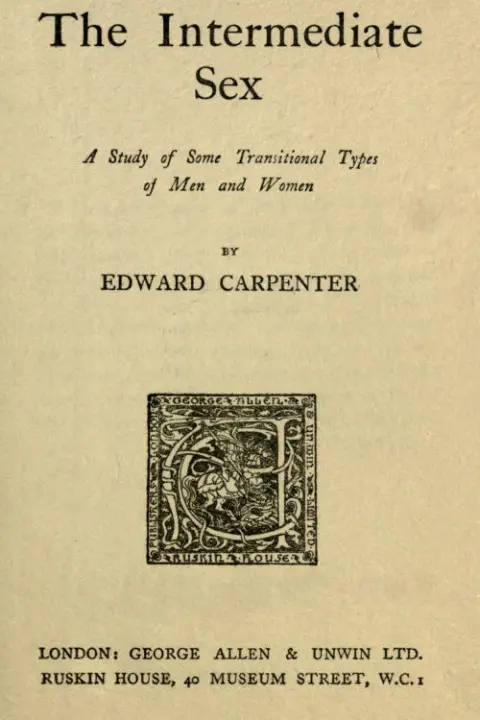
Edward Carpenter
BEHIND THE BOOK
This eBook is for the use of anyone anywhere in the United States and most other parts of the world at no cost and with almost no restrictions whatsoever. You may copy it, give it away or re-use it under the terms of the Project Gutenberg License included with this eBook or online at www.gutenberg.org. If you are not located in the United States, you will have to check the laws of the country where you are located before using this eBook. Read the source licence.
The original source file, including credits and licence, is retained by this library. Request an original-format copy at no charge. Please include the book title and Project Gutenberg identifier #78612.
KEEP YOUR CURIOSITY GOING
John L. Ransom

Herman W. Mudgett

Harriet Monroe
Daniel Dulany Addison
Charles Lanman

Harold Rosher