THE CLASSIC COLLECTION✦Towards democracyCLASSIC FREE BOOKS
Towards democracy
Edward Carpenter
THE CLASSIC COLLECTION · 1916
"My days and dreams" by Edward Carpenter is an autobiography written in the early 20th century. It charts four phases of a life—from a constrained Brighton childhood through Cambridge and public lecturing in northern towns to later years of manual work among the working classes—interweaving personal reflection with critiques of class convention, religion, sexuality, and artistic influence.
The opening of this autobiography explains that the notes began in 1890 and were expanded irregularly, with bracketed dates marking when sections were written. The first chapter recalls an uncomfortable youth in fashionable Brighton, loneliness at home and school, a formative year at the Lycée in Versailles, and solace found in the sea and Sussex Downs; it also describes early loves—music, home chemistry, and intense but inarticulate boyhood attachments—alongside a sharp critique of empty “young lady” society, affectionate portraits of two elder sisters, and a lively sketch of a younger brother who became a decorated naval officer. The next chapter offers vivid portraits of his parents: a liberal, mystically inclined father shaped by the Navy and philosophy, and a tireless, self-effacing mother whose death left the family unmoored; evening household scenes and her later passing lead into his father’s decline. The early Cambridge chapter then covers a brief Heidelberg interlude, immersion in Trinity Hall’s rowing culture, study for the mathematical tripos and a fellowship, and ordination—followed by disillusion with parish life, a fraught exchange with the Bishop over the sacrifice of Isaac, and an uneasy curacy under F. D. Maurice. In parallel, he moves into heretical, reform-minded circles (influenced by W. K. Clifford and Mazzini), discovers Whitman’s comradeship and democratic vision, and feels his life drifting away from academic convention. A restorative Italian sojourn and the impact of Greek sculpture deepen his new ideals, while counsel from a frank, art-loving friend steels him to leave the Church. The section closes with his first, self-financed poetry volume—issued with hope but meeting little response.
Introduction adapted from the source catalogue; source summaries may be automatically generated.
Free to read · English · 98,981 words · No account needed
MAKE TIME FOR A GOOD BOOK
On by default. Untick to stop anonymous reading totals. Each page counts after 10 seconds in view. How this works.
Anonymous counting is on unless you have switched it off.
He certainly did not like anything resembling sentimentality. A friend tells me that he used to recite the following stanza, apparently delighting in its quaintness—but whether Morris composed it himself or had found it elsewhere he does not know:—
I sits with my feet in a brook,
And if any one asks me for why,
I hits him a crack with my crock,
For it’s sentiment kills me, says I.
Among those who came from time to time to speak for our Socialist group in Sheffield or to stay at our “Commonwealth” Café were, besides William Morris, two notable personalities—Peter Kropotkin and Annie Besant. Their work and influence, both world-wide—the one in the Anarchist, and the other in the Theosophist, field—have been really important. Though never myself strictly identified with either of these movements I have been in touch with them, and consequently in more or less friendly relation with their two leading spirits during a long period—now nearly thirty years. Both characters are certainly remarkable for their vigour, their sincerity, their ability and devotion. Kropotkin at the age of seventy and after fifty years of passionate conflict with ‘government’ and ‘authority’ still retains his sunny and almost childlike temperament and still believes in the speedy oncoming of an age of perfectly voluntary and harmonious co-operation in the human race. Indeed it is mainly due to him that this magnificent dream has spread so far and wide over the world, and has done so much as it has towards its own realization. The dramatic circumstances too of Kropotkin’s own life have greatly helped—his early escapes from prison and from death, his abandonment of a princely inheritance to become the companion and fellow-prisoner of criminals and outcasts, his later life spent in poverty and among obscure circles of enthusiasts—these things combined with encyclopædic knowledge and a high scientific reputation have compelled attention and respect. As in the case of many ardent social reformers, and certainly in the case of most notorious Anarchists, there is a charming naïveté about Kropotkin. It is so easy—if you believe that all human evil is summed up in the one fatal word ‘government’ (or it may be that the word is ‘white-slave-traffic,’ or ‘war,’ or ‘drink,’ or anything else)—to order your life and your theories accordingly. Everything is explained by its relation to one thing. It is easy, but it is misleading. And Kropotkin’s writings, despite their erudition, suffer from this naïveté. Whether it be History (his French Revolution), or Natural History (his Mutual Aid) or economic theory (his Paroles d’un Revolté) the reader finds one solution for everything, and the countervailing facts and principles consistently—though certainly not intentionally—ignored. This detracts from the value of the writings; though in justice it should be said that the principles on which Kropotkin so vigorously insists—i.e. individual liberty and free association—are of foundational importance. In a country like Russia—obsessed by authority and officialism—it is not unnatural that its reformers, such as Tolstoy and Kropotkin, should be almost over-conscious of the governmental evil; and this fact rather encourages the hope that Russia may one day after all be the leader in the great European reaction towards a freer and more voluntary state of society.
Your reading position is saved on this browser. Take it to another device with a library code. Reading pages adapt to text, rather than matching a printed edition.
Edward Carpenter
Edward Carpenter
Edward Carpenter
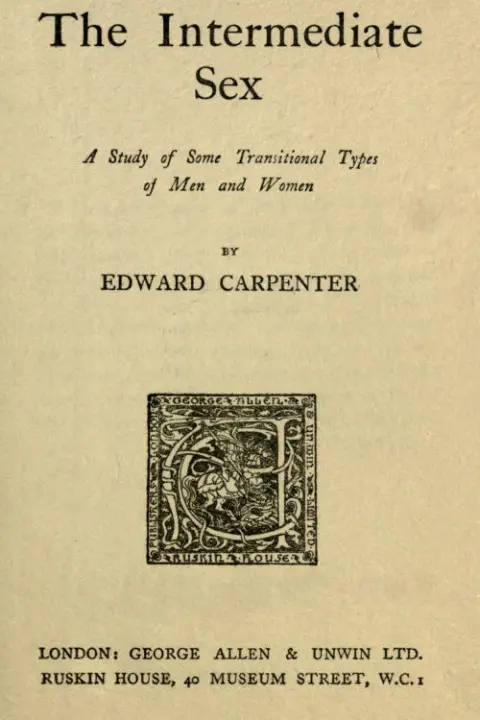
Edward Carpenter
BEHIND THE BOOK
This eBook is for the use of anyone anywhere in the United States and most other parts of the world at no cost and with almost no restrictions whatsoever. You may copy it, give it away or re-use it under the terms of the Project Gutenberg License included with this eBook or online at www.gutenberg.org. If you are not located in the United States, you will have to check the laws of the country where you are located before using this eBook. Read the source licence.
The original source file, including credits and licence, is retained by this library. Request an original-format copy at no charge. Please include the book title and Project Gutenberg identifier #78612.
KEEP YOUR CURIOSITY GOING
John L. Ransom

Herman W. Mudgett

Harriet Monroe
Daniel Dulany Addison
Charles Lanman

Harold Rosher