THE CLASSIC COLLECTION✦Towards democracyCLASSIC FREE BOOKS
Towards democracy
Edward Carpenter
THE CLASSIC COLLECTION · 1916
"My days and dreams" by Edward Carpenter is an autobiography written in the early 20th century. It charts four phases of a life—from a constrained Brighton childhood through Cambridge and public lecturing in northern towns to later years of manual work among the working classes—interweaving personal reflection with critiques of class convention, religion, sexuality, and artistic influence.
The opening of this autobiography explains that the notes began in 1890 and were expanded irregularly, with bracketed dates marking when sections were written. The first chapter recalls an uncomfortable youth in fashionable Brighton, loneliness at home and school, a formative year at the Lycée in Versailles, and solace found in the sea and Sussex Downs; it also describes early loves—music, home chemistry, and intense but inarticulate boyhood attachments—alongside a sharp critique of empty “young lady” society, affectionate portraits of two elder sisters, and a lively sketch of a younger brother who became a decorated naval officer. The next chapter offers vivid portraits of his parents: a liberal, mystically inclined father shaped by the Navy and philosophy, and a tireless, self-effacing mother whose death left the family unmoored; evening household scenes and her later passing lead into his father’s decline. The early Cambridge chapter then covers a brief Heidelberg interlude, immersion in Trinity Hall’s rowing culture, study for the mathematical tripos and a fellowship, and ordination—followed by disillusion with parish life, a fraught exchange with the Bishop over the sacrifice of Isaac, and an uneasy curacy under F. D. Maurice. In parallel, he moves into heretical, reform-minded circles (influenced by W. K. Clifford and Mazzini), discovers Whitman’s comradeship and democratic vision, and feels his life drifting away from academic convention. A restorative Italian sojourn and the impact of Greek sculpture deepen his new ideals, while counsel from a frank, art-loving friend steels him to leave the Church. The section closes with his first, self-financed poetry volume—issued with hope but meeting little response.
Introduction adapted from the source catalogue; source summaries may be automatically generated.
Free to read · English · 98,981 words · No account needed
MAKE TIME FOR A GOOD BOOK
On by default. Untick to stop anonymous reading totals. Each page counts after 10 seconds in view. How this works.
Anonymous counting is on unless you have switched it off.
Towards the later part of my time at Brighton the natural épanchement of youth led me often to seek consolation and an escape from the wounds of daily life in intercourse with Nature. The Brighton social life—with its greetings where no kindness is—was to me chilly in the extreme, and I often used in later years to feel that I “caught cold” (morally speaking) whenever I returned to it. The scenery and surroundings of Brighton are also bare and chilly enough; and trees, whose friendly covert I have always loved, do not exist there; but the place has two Nature-elements in it—and these two singularly wild and untampered—the Sea and the Downs. We lived within two hundred yards of the sea, and its voice was in our ears night and day. On terrific stormy nights it was a “grisly joy” to go down to the water’s edge at 10 or 11 p.m.—pitchy darkness—feeling one’s way with feet or hands, over the stony beach, hardly able to stand for the wind—and to watch the white breakers suddenly leap out of the gulf close upon one—the “scream of the madden’d beach dragged down by the wave,” the booming of the wind, like distant guns, and the occasional light of some vessel laboring for its life in the surge.
But the Downs were my favorite refuge. On sunny days I would wander on over them for miles, not knowing very clearly where I was going—in a strange broody moony state—glad to find some hollow (like that described in Jefferies’ Story of my Heart) where one could lie secluded for any length of time and see only the clouds and the grasses and an occasional butterfly, or hear the distant bark of a dog or the far rumble of a railway train. The Downs twined themselves with all my thought and speculations of that time. Their chaste subdued gracious outlines and quiet colour have a peculiar charm. Their strongest line is generally some white edge of cliffs or curve of the shore itself, their deepest tint the blue of the sea or occasionally a field of red clover or one overgrown with charlock. For the rest they wear the faint blue-green colour of thin turf through which the chalk almost shows. Over the velvety sward and among the fine herbage cropped by plentiful sheep run innumerable tiny flowers dwarfed by salt wind and scanty soil—thistles, whose chins rest on the ground out of which they grow; patches of sweet thyme which the wild bees love, of pink centaury and thrift and madder and dwarf-broom, and that sweet yellow lotus or bird’s-foot trefoil, which runs all over the world, in Siberia and Alps and Himalayas the same, one of the commonest and friendliest of all the flowers that grow. Overhead the lark sings, the clouds drift through the untampered blue, the bee and the butterfly sweep past on the breeze. Three or four miles from Brighton, and one is in a world remote from man. Except an occasional shepherd there is hardly a human to be seen. Here and there in a hollow nestles the tiniest hamlet—an old farmhouse, one or two cottages, a dwarf church faced with rough work of flints, a few trees and a well. Taking its character from the sky—as all chalk and limestone countries largely do—this land has an ethereal beauty in summer weather; but on wintry and gray days it is monotonous and sad. The shepherd then huddles himself in his cloak in the lee of the gorse-bush, the cloudy rack drives over the backs of his sheep, line behind line the Downs stretch, colorless, unbroken by any hint of tree or habitation; the wind whistles among the thin grass stems with a peculiar shrill and mournful pipe, and in its pauses the sullen and distant roar of the sea is heard.
Your reading position is saved on this browser. Take it to another device with a library code. Reading pages adapt to text, rather than matching a printed edition.
Edward Carpenter
Edward Carpenter
Edward Carpenter
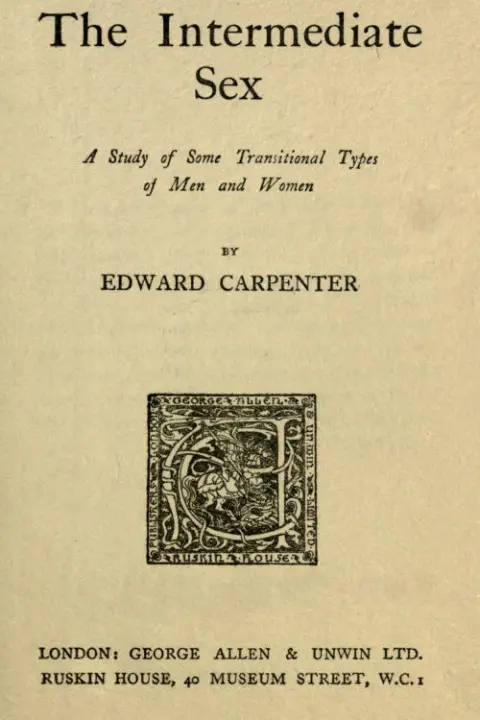
Edward Carpenter
BEHIND THE BOOK
This eBook is for the use of anyone anywhere in the United States and most other parts of the world at no cost and with almost no restrictions whatsoever. You may copy it, give it away or re-use it under the terms of the Project Gutenberg License included with this eBook or online at www.gutenberg.org. If you are not located in the United States, you will have to check the laws of the country where you are located before using this eBook. Read the source licence.
The original source file, including credits and licence, is retained by this library. Request an original-format copy at no charge. Please include the book title and Project Gutenberg identifier #78612.
KEEP YOUR CURIOSITY GOING
John L. Ransom

Herman W. Mudgett

Harriet Monroe
Daniel Dulany Addison
Charles Lanman

Harold Rosher