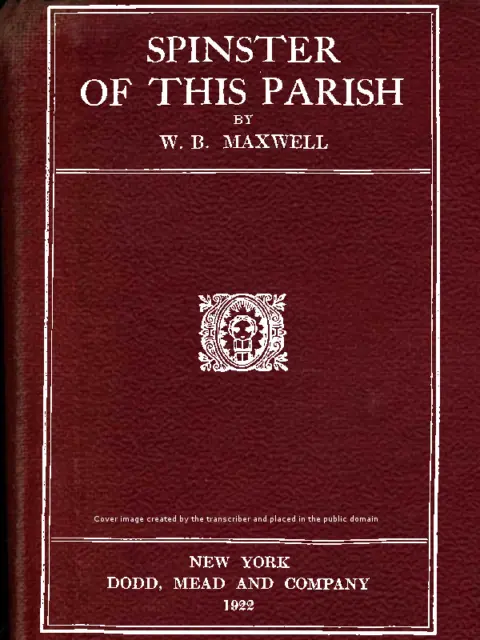
Spinster of This Parish
W. B. (William Babington) Maxwell
THE CLASSIC COLLECTION · 1911
"Mrs. Thompson: A Novel" by W. B. Maxwell is a fictional work likely written in the early 20th century. The story revolves around the character of Mrs. Thompson, a middle-aged woman who has transformed her late husband's struggling shop into a thriving business. As a strong and capable woman, Mrs. Thompson navigates the challenges of both her professional life and her relationship with her daughter, Enid, while also managing the complexities that arise from her personal ambitions. The opening of the novel introduces us to Mrs. Thompson as she oversees her shop, demonstrating her business acumen and managerial skills. The bustling atmosphere of the shop, filled with employees preparing for their half-holiday, sets the stage for her character as a dedicated and respected leader. Mrs. Thompson's impending decision to promote a young shop assistant, Dicky Marsden, sparks conversation among her employees, hinting at underlying dynamics and potential conflicts. Her relationship with her daughter begins to reveal itself as a crucial element of the narrative, making one ponder how her successes and aspirations may affect their bond as they navigate societal expectations and personal desires.
Introduction adapted from the source catalogue; source summaries may be automatically generated.
Free to read · English · 101,918 words · No account needed
MAKE TIME FOR A GOOD BOOK
On by default. Untick to stop anonymous reading totals. Each page counts after 10 seconds in view. How this works.
Anonymous counting is on unless you have switched it off.
But Miss Enid, who seemed unutterably bored, was staring out of the carriage in the other direction. She had not been listening to Mr. Prentice, and she did not hear him when he addressed her directly.
"Then good-bye. Drive on, coachman.... There," and Mrs. Thompson turned gaily to her daughter. "That's more than enough business for Thursday afternoon, isn't it, Enid?"
They drove along the London road, through the pretty village of Haggart's Cross, as far as the chalk cliffs beneath the broad downs; and then, descending again, through beech woods and fir plantations to the valley where the river Malling runs and twists beside the railway line all the way home to the town.
The world was fresh and bright, with the May wind blowing softly and the May flowers budding sweetly. Cattle in the green fields, birds in the blue sky, pinafored children chanting a lesson behind the latticed panes of their schoolhouse, primroses peeping from grassy banks, and, far and near, the white hawthorn shedding its perfume, giving its fragrant message of spring, of hope, of life--plenty of things to look at with pleasure, plenty of things to talk about, though one might often have seen them before.
But Enid was somehow languid, listless, even lumpish, and Mrs. Thompson did nearly all the looking and talking.
"I always think that is such an imposing place. The entrance seems to warn one off--to tell one not to forget what a tremendous swell the owner is."
They were passing the lodge-gates of a great nobleman's seat, and one had a rapid impression of much magnificence. Stone piers, sculptured urns, floreated iron, massive chains; and behind the forbidding barrier a vista of swept gravel and mown grass, with solemn conifers proudly ranked, and standard rhododendrons just beginning pompously to bloom--no glimpse of the mansion itself, but an intuitive perception of something vast, remote, unattainable.
Enid looked through the bars at my lord's gravel drive attentively, almost wistfully, perhaps thinking of the few and august people to whom these splendours would be familiar--of the lucky people who are brought up in palaces instead of in shops.
"It is a meet of hounds." Miss Enid broke a long silence to give her mother this information. "And when I was staying at Colonel Salter's, I met a man who had once been to a ball there."
"Ah, well," said Mrs. Thompson, with cheerful briskness, "now you mention hunting, that reminds me. We must get you on horseback again.... You do like your riding, don't you?"
"Oh, yes," said Enid listlessly.
Your reading position is saved on this browser. Take it to another device with a library code. Reading pages adapt to text, rather than matching a printed edition.
W. B. (William Babington) Maxwell
BEHIND THE BOOK
This eBook is for the use of anyone anywhere in the United States and most other parts of the world at no cost and with almost no restrictions whatsoever. You may copy it, give it away or re-use it under the terms of the Project Gutenberg License included with this eBook or online at www.gutenberg.org. If you are not located in the United States, you will have to check the laws of the country where you are located before using this eBook. Read the source licence.
The original source file, including credits and licence, is retained by this library. Request an original-format copy at no charge. Please include the book title and Project Gutenberg identifier #39515.
KEEP YOUR CURIOSITY GOING
Coulson Kernahan

Maurice Baring
Frances Wright
Cécile Tormay

Frederic Jesup Stimson

W. H. P. (William Henry Pope) Jarvis