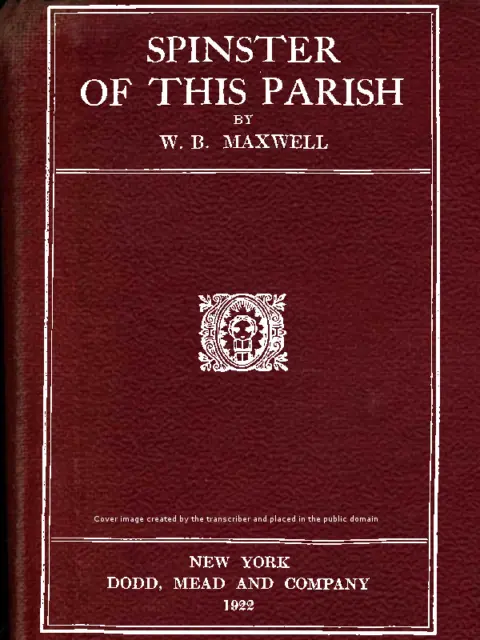
Spinster of This Parish
W. B. (William Babington) Maxwell
THE CLASSIC COLLECTION · 1911
"Mrs. Thompson: A Novel" by W. B. Maxwell is a fictional work likely written in the early 20th century. The story revolves around the character of Mrs. Thompson, a middle-aged woman who has transformed her late husband's struggling shop into a thriving business. As a strong and capable woman, Mrs. Thompson navigates the challenges of both her professional life and her relationship with her daughter, Enid, while also managing the complexities that arise from her personal ambitions. The opening of the novel introduces us to Mrs. Thompson as she oversees her shop, demonstrating her business acumen and managerial skills. The bustling atmosphere of the shop, filled with employees preparing for their half-holiday, sets the stage for her character as a dedicated and respected leader. Mrs. Thompson's impending decision to promote a young shop assistant, Dicky Marsden, sparks conversation among her employees, hinting at underlying dynamics and potential conflicts. Her relationship with her daughter begins to reveal itself as a crucial element of the narrative, making one ponder how her successes and aspirations may affect their bond as they navigate societal expectations and personal desires.
Introduction adapted from the source catalogue; source summaries may be automatically generated.
Free to read · English · 101,918 words · No account needed
MAKE TIME FOR A GOOD BOOK
On by default. Untick to stop anonymous reading totals. Each page counts after 10 seconds in view. How this works.
Anonymous counting is on unless you have switched it off.
Late one evening, when Marsden was taking what he called his night-cap in the drawing-room, he began to ask questions about the Sheraton desk and cabinets.
"Those things are not at all bad--but they aren't genuine, I suppose?"
"The desk is genuine," said Mrs. Marsden; "but the other things are
modern."
"They are uncommonly good imitations," said Marsden; and he knelt in front of one of the cabinets and studied it carefully. "This is an excellently made piece--tip-top workmanship. Why, it must be worth twenty or thirty guineas."
"Yes, it cost something like that."
"Where did you get it?"
"It came out of the shop."
"Ah. Exactly what I supposed;" and he got up from his knees, and stood looking at her thoughtfully. "Out of the shop. Just so.... I must think this out."
But his train of thought was interrupted by a timid knock at the door. It was their last new housemaid, come to ask if the master and the mistress required anything further to-night. She remained on the threshold, breathing hard, and staring shyly, while she waited for an answer--a bouncing, apple-cheeked, country bumpkin of a girl, who had accepted very modest wages for this her first place.
"No," said Marsden shortly, "I don't want anything more--What's your
name?"
"Susan, sir."
"All right. Then shut the door, Susan."
"Good night, Susan," said Mrs. Marsden kindly.
"Where did you pick her up?" asked Marsden, when the girl had gone. "She's healthy enough and plump enough--but she looks half-baked."
"She will do very well, if you give her time to learn."
"Oh, I'll let her learn, if you can teach her.... But what was I saying? Oh, yes--about the furniture!"
Then he walked round the room, pointing at different things, and
continuing his questions.
"Did this come out of the shop?"
"Yes."
"And this?... And those chairs?... And the sofa?"
She did not understand why he asked. But he soon explained himself. He said that all this furniture was taken out of the shop, and it therefore belonged to the firm--or at any rate could not be considered as her private property.
"A partnership is a partnership," he added sententiously.
"But it was ages before the partnership. And all the things were paid
for by me."
"No, not paid for," he said quickly. "Not paid for in cash--just a matter of writing down a debit somewhere and a credit somewhere else, and saying it was accounted for. But from the point of view of the shop, that's a bogus transaction."
"How absurd!"
"No, not absurd--common sense. The shop never got a penny profit, and
it seems to me that--"
Your reading position is saved on this browser. Take it to another device with a library code. Reading pages adapt to text, rather than matching a printed edition.
W. B. (William Babington) Maxwell
BEHIND THE BOOK
This eBook is for the use of anyone anywhere in the United States and most other parts of the world at no cost and with almost no restrictions whatsoever. You may copy it, give it away or re-use it under the terms of the Project Gutenberg License included with this eBook or online at www.gutenberg.org. If you are not located in the United States, you will have to check the laws of the country where you are located before using this eBook. Read the source licence.
The original source file, including credits and licence, is retained by this library. Request an original-format copy at no charge. Please include the book title and Project Gutenberg identifier #39515.
KEEP YOUR CURIOSITY GOING
Coulson Kernahan

Maurice Baring
Frances Wright
Cécile Tormay

Frederic Jesup Stimson

W. H. P. (William Henry Pope) Jarvis