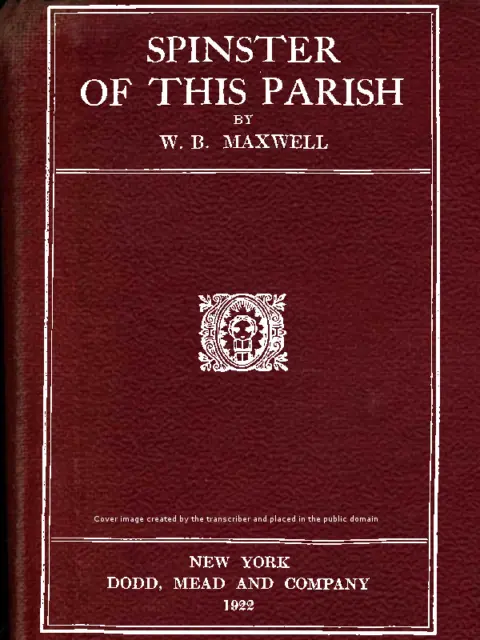
Spinster of This Parish
W. B. (William Babington) Maxwell
THE CLASSIC COLLECTION · 1911
"Mrs. Thompson: A Novel" by W. B. Maxwell is a fictional work likely written in the early 20th century. The story revolves around the character of Mrs. Thompson, a middle-aged woman who has transformed her late husband's struggling shop into a thriving business. As a strong and capable woman, Mrs. Thompson navigates the challenges of both her professional life and her relationship with her daughter, Enid, while also managing the complexities that arise from her personal ambitions. The opening of the novel introduces us to Mrs. Thompson as she oversees her shop, demonstrating her business acumen and managerial skills. The bustling atmosphere of the shop, filled with employees preparing for their half-holiday, sets the stage for her character as a dedicated and respected leader. Mrs. Thompson's impending decision to promote a young shop assistant, Dicky Marsden, sparks conversation among her employees, hinting at underlying dynamics and potential conflicts. Her relationship with her daughter begins to reveal itself as a crucial element of the narrative, making one ponder how her successes and aspirations may affect their bond as they navigate societal expectations and personal desires.
Introduction adapted from the source catalogue; source summaries may be automatically generated.
Free to read · English · 101,918 words · No account needed
MAKE TIME FOR A GOOD BOOK
On by default. Untick to stop anonymous reading totals. Each page counts after 10 seconds in view. How this works.
Anonymous counting is on unless you have switched it off.
"Fifteen hundred goes to her, and the rest to me."
"Indeed it doesn't," said Prentice warmly.
"It's all right," said Marsden. "It was arranged between her and me."
"But I know nothing of any such arrangement. I can't permit it for a
moment."
"You can't permit it!" said Marsden indignantly. "What the dickens has
it got to do with you?"
Mr. Collins, with an assumption of tactful delicacy, had pushed back his chair. "Excuse me. This is a private conversation. I hasten to withdraw." And he went across to Archibald Bence and Mrs. Marsden, and talked to them in a rapid undertone.
Mr. Prentice went on protesting; and Marsden, cutting him short, called
loudly to his wife.
"Jane, tell him that it is all right."
"Yes," she said. "Quite all right, Mr. Prentice."
"Oh, you mean that you are giving him a present of fifteen hundred
pounds?"
"It's not a present," said Marsden.
"No," said Mrs. Marsden, "it was a bargain."
"Between ourselves, and concerning nobody else;" and Marsden glared at
Mr. Prentice.
Nevertheless Mr. Prentice still expostulated. "I think it is highly improper. I would never have consented to--"
"Pardon me," said Collins, "if I intrude--but it has been impossible not to catch the gist of your discussion. Really it seems to me that it is too late for you, Prentice, to tender advice on the point--and that the lady's wish must decide the matter. If Mrs. Marsden announces that she wishes--"
"Just so, Mr. Collins;" and Marsden looked at him gratefully.
"Exactly," said Bence soothingly. "That's how it strikes me, too."
Marsden looked at Bence with surprise and pleasure.
They all seemed to be on his side. He appealed to his wife with a
rather boisterous joviality.
"Jane, speak up for me. Tell them that you did wish it."
"Yes, I did wish it."
"Then there is no more to be said," continued Bence, smoothly and glibly. "On an occasion like this, one naturally wishes to avoid any acrimonious talk. Especially in a peculiar case like the present--when a gentleman and a lady are parting,--there's no need for them to part other than as good friends. That, madam, I feel certain is also your wish."
"Yes," said Mrs. Marsden in a low voice, "I do greatly wish it."
"Thank you, Jane. I'm sure I do. But I don't know why we should make speeches about it, or get Mr. Bence to expound our sentiments."
"Forgive me," said Bence, "if I trespass. You are leaving us, Mr. Marsden--and I share Mrs. Marsden's desire that you should not leave us with any feeling of ill-will."
Your reading position is saved on this browser. Take it to another device with a library code. Reading pages adapt to text, rather than matching a printed edition.
W. B. (William Babington) Maxwell
BEHIND THE BOOK
This eBook is for the use of anyone anywhere in the United States and most other parts of the world at no cost and with almost no restrictions whatsoever. You may copy it, give it away or re-use it under the terms of the Project Gutenberg License included with this eBook or online at www.gutenberg.org. If you are not located in the United States, you will have to check the laws of the country where you are located before using this eBook. Read the source licence.
The original source file, including credits and licence, is retained by this library. Request an original-format copy at no charge. Please include the book title and Project Gutenberg identifier #39515.
KEEP YOUR CURIOSITY GOING
Coulson Kernahan

Maurice Baring
Frances Wright
Cécile Tormay

Frederic Jesup Stimson

W. H. P. (William Henry Pope) Jarvis