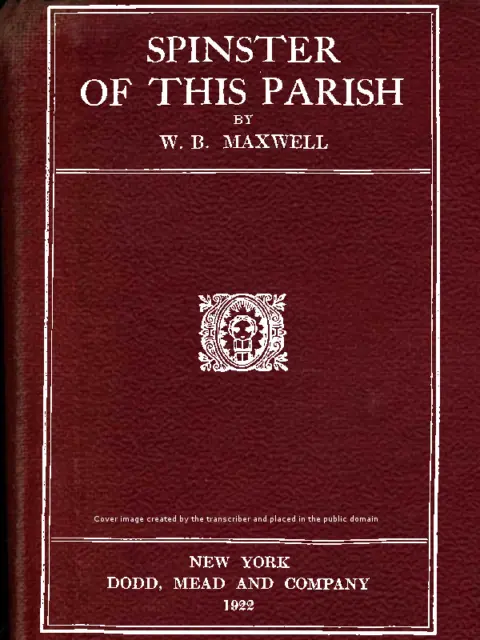
Spinster of This Parish
W. B. (William Babington) Maxwell
THE CLASSIC COLLECTION · 1911
"Mrs. Thompson: A Novel" by W. B. Maxwell is a fictional work likely written in the early 20th century. The story revolves around the character of Mrs. Thompson, a middle-aged woman who has transformed her late husband's struggling shop into a thriving business. As a strong and capable woman, Mrs. Thompson navigates the challenges of both her professional life and her relationship with her daughter, Enid, while also managing the complexities that arise from her personal ambitions. The opening of the novel introduces us to Mrs. Thompson as she oversees her shop, demonstrating her business acumen and managerial skills. The bustling atmosphere of the shop, filled with employees preparing for their half-holiday, sets the stage for her character as a dedicated and respected leader. Mrs. Thompson's impending decision to promote a young shop assistant, Dicky Marsden, sparks conversation among her employees, hinting at underlying dynamics and potential conflicts. Her relationship with her daughter begins to reveal itself as a crucial element of the narrative, making one ponder how her successes and aspirations may affect their bond as they navigate societal expectations and personal desires.
Introduction adapted from the source catalogue; source summaries may be automatically generated.
Free to read · English · 101,918 words · No account needed
MAKE TIME FOR A GOOD BOOK
On by default. Untick to stop anonymous reading totals. Each page counts after 10 seconds in view. How this works.
Anonymous counting is on unless you have switched it off.
Several times therefore a brougham was procured from Mr. Young's stables, and mistress and maid went for a quiet afternoon drive. Yates would have preferred to enjoy these airings earlier in the day, but she agreed with Mrs. Marsden that a morning drive might appear "conspicuous." As it was, Yates made the excursion quite sufficiently remarkable--hot-water bottle for the patient's feet, rugs for her legs, three or four shawls for her shoulders.
"And don't you drive too fast," said Yates sternly to Mr. Young's coachman. "Take us along quiet.... And if you meet any of those great engines on the road, just turn round and go the other way."
"I don't want you frightened," she told Mrs. Marsden, "if only for half
a minute."
Mr. Young's horses, at an easy jog trot, took them along very, very quietly; some air, but not too much, blew in upon them pleasantly; and throughout the drive the two women talked unceasingly of the same engrossing subject.
"Which do you hope for, yourself, ma'am?"
"Yates, I scarcely know."
"Well, ma'am, I'll tell you candid, it's a girl I am hoping for."
"But whichever it is--boy or girl--you'll love it just the same, won't
you, Yates?"
"Indeed I shall, ma'am."
And they discussed christian names.
"If it is a boy, of course I shall wish him to have his father's name
for one."
"Yes, I suppose so, ma'am."
"Richard for his first name; and, if Mr. Marsden approves, I shall call him Martin. I should like him to bear the name of Saint Martin--for a little romantic reason of my own. And I also like the name of Roderick--if that isn't too grand."
"I like the plain names best," said Yates. "If it's a girl, I do hope and trust you'll give her your own name, ma'am. You can never get a better name than Jane. Let her be Miss Jane."
They met no ugly traction engines to upset the horses, and disturb the patient's composure. They chose the level sheltered roads, and avoided the dangerous windy hills; and Mrs. Marsden looked through the half-shut window at the featureless landscape, and thought it almost beautiful, even at this dead time of the year. It was bare and nearly colourless,--all the hedgerows of a dull brown, the far-off woods a misty grey, and here and there, seen through the black field-gates, patches of snow faintly sparkling beneath the feeble light. The tardy spring as yet showed scarce a sign of nascent energy. But the winter had no terrors for her now. There was summer in her heart.
The date had passed; and, passing, had left apparent certainty.
Yates was wildly excited, irrepressibly jubilant.
Your reading position is saved on this browser. Take it to another device with a library code. Reading pages adapt to text, rather than matching a printed edition.
W. B. (William Babington) Maxwell
BEHIND THE BOOK
This eBook is for the use of anyone anywhere in the United States and most other parts of the world at no cost and with almost no restrictions whatsoever. You may copy it, give it away or re-use it under the terms of the Project Gutenberg License included with this eBook or online at www.gutenberg.org. If you are not located in the United States, you will have to check the laws of the country where you are located before using this eBook. Read the source licence.
The original source file, including credits and licence, is retained by this library. Request an original-format copy at no charge. Please include the book title and Project Gutenberg identifier #39515.
KEEP YOUR CURIOSITY GOING
Coulson Kernahan

Maurice Baring
Frances Wright
Cécile Tormay

Frederic Jesup Stimson

W. H. P. (William Henry Pope) Jarvis