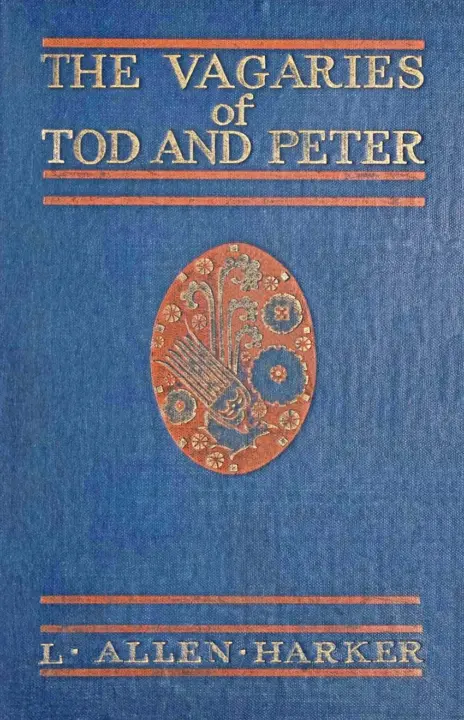
The Vagaries of Tod and Peter
L. Allen (Lizzie Allen) Harker
THE CLASSIC COLLECTION · 1912
"Mr. Wycherly's Wards" by L. Allen Harker is a novel written in the early 20th century. The story revolves around Mr. Wycherly, who takes guardianship of two boys, Edmund and Montagu, after the death of their aunt, Miss Esperance. The novel explores the challenges and humorous situations that arise as Mr. Wycherly relocates to Oxford and attempts to manage life with his wards, while grappling with the expectations of society and their new living conditions. The opening of the novel introduces Mr. Wycherly's sudden decision to move to Oxford, driven by a desire to create a comforting environment for the boys after their aunt's passing. As he settles into a quirky old house, the chaos of their new living situation becomes apparent when he realizes that they lack a capable servant. The boys, each with distinct personalities, are depicted as lively companions who readily adapt to their new home, and they playfully interact with their guardian as they adjust to their new lives. This initial chapter sets the stage for a mix of humor and heartfelt moments as the family dynamics unfold in their new environment.
Introduction adapted from the source catalogue; source summaries may be automatically generated.
Free to read · English · 65,838 words · No account needed
MAKE TIME FOR A GOOD BOOK
On by default. Untick to stop anonymous reading totals. Each page counts after 10 seconds in view. How this works.
Anonymous counting is on unless you have switched it off.
Herrick sighed, and stepped out from behind the curtains. "I suppose I must esplain," she said, "but I thought everybody knowed that game; it's my most favourite play. This," she said, waving her hand dramatically, "is a gloomy wood"--mere printers' ink can never depict the darkness and density of that wood as portrayed in Herrick's voice--"and you are a wandering prince."
"Which of us?" asked Edmund; "or are we both princes?"
"No, there can't be two, there can only be one. You'd better be him," she said, pointing to Montagu, "you're the biggest, and the littler one can be his servant."
"A varlet," Montagu, who was just then much under the influence of Sir Walter Scott, suggested helpfully.
"A Scotch varlet, mind," Edmund stipulated.
"And presently you see," continued the little girl as though there had been no interruption of any kind, "a most frowning sort of castle, but just as you're wondering what you'll do there appears at the window----"
"Castles haven't got windows," Edmund objected, "only kind of slits."
"This castle has a casement," Herrick responded with dignity. "Don't interrupt--and the curtains are drawn, but pesenly they are drawn back, and then you see the most beautiful princess you ever dreamed of----"
"And then?" asked Montagu.
"Why, you go down on your knees, of course, and say so. Now, let's begin; you do need such a lot of esplanation."
The princess retired behind her curtains; the prince and the varlet, who manifested an unseemly inclination to giggle, marched about the room.
"By my halidome!" exclaimed the prince, who had determined to play the part after the fashion of his then favourite characters, "this place is stoutly fortified."
"Will we win through, think ye?" asked the varlet familiarly.
"Hush!" said a voice from behind the curtains.
They were parted. First the ravishingly lovely countenance (it really was an adorably pretty little face, intensely solemn and earnest) appeared, then more of the princess, till she stood revealed in short embroidered muslin frock and a blue sash.
Flump! Prince and varlet went down on their knees.
"What light from yonder window breaks?" exclaimed the prince, who had been doing "Romeo and Juliet" at school, and thought the quotation appropriate.
"An' wha'll yon lassie be, prince?" asked the varlet.
"I," said the princess slowly and solemnly, "I am the Princess
Hildegarde----"
"Losh me!" interjected the varlet.
"Silence, dog!" said the prince severely. "How came you here, fair
lady?"
"I am imprisoned in this dreadful castle," the princess continued plaintively, "by a wicked baron, an enemy of my kingly father."
"Where is the baron, lady? That we may slay him!" valiantly exclaimed
the prince.
Your reading position is saved on this browser. Take it to another device with a library code. Reading pages adapt to text, rather than matching a printed edition.
L. Allen (Lizzie Allen) Harker
L. Allen (Lizzie Allen) Harker
L. Allen (Lizzie Allen) Harker
L. Allen (Lizzie Allen) Harker
BEHIND THE BOOK
This eBook is for the use of anyone anywhere in the United States and most other parts of the world at no cost and with almost no restrictions whatsoever. You may copy it, give it away or re-use it under the terms of the Project Gutenberg License included with this eBook or online at www.gutenberg.org. If you are not located in the United States, you will have to check the laws of the country where you are located before using this eBook. Read the source licence.
The original source file, including credits and licence, is retained by this library. Request an original-format copy at no charge. Please include the book title and Project Gutenberg identifier #54418.
KEEP YOUR CURIOSITY GOING
Coulson Kernahan

Maurice Baring
Frances Wright
Cécile Tormay

Frederic Jesup Stimson

W. H. P. (William Henry Pope) Jarvis