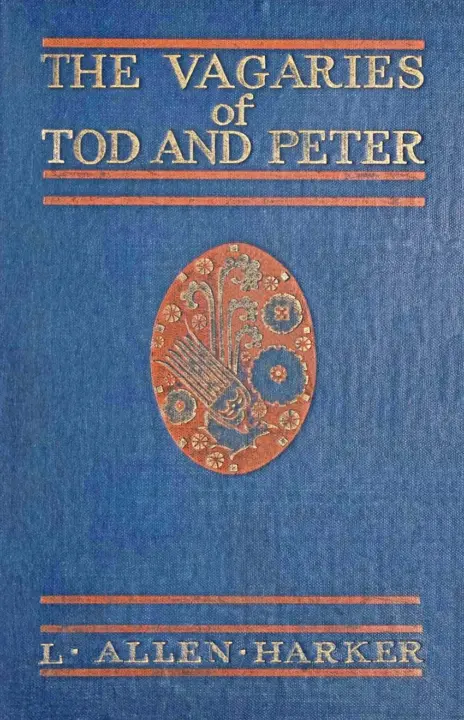
The Vagaries of Tod and Peter
L. Allen (Lizzie Allen) Harker
THE CLASSIC COLLECTION · 1912
"Mr. Wycherly's Wards" by L. Allen Harker is a novel written in the early 20th century. The story revolves around Mr. Wycherly, who takes guardianship of two boys, Edmund and Montagu, after the death of their aunt, Miss Esperance. The novel explores the challenges and humorous situations that arise as Mr. Wycherly relocates to Oxford and attempts to manage life with his wards, while grappling with the expectations of society and their new living conditions. The opening of the novel introduces Mr. Wycherly's sudden decision to move to Oxford, driven by a desire to create a comforting environment for the boys after their aunt's passing. As he settles into a quirky old house, the chaos of their new living situation becomes apparent when he realizes that they lack a capable servant. The boys, each with distinct personalities, are depicted as lively companions who readily adapt to their new home, and they playfully interact with their guardian as they adjust to their new lives. This initial chapter sets the stage for a mix of humor and heartfelt moments as the family dynamics unfold in their new environment.
Introduction adapted from the source catalogue; source summaries may be automatically generated.
Free to read · English · 65,838 words · No account needed
MAKE TIME FOR A GOOD BOOK
On by default. Untick to stop anonymous reading totals. Each page counts after 10 seconds in view. How this works.
Anonymous counting is on unless you have switched it off.
Mrs. William Wycherly was Lady Alicia's youngest daughter. Montagu vaguely remembered that there was a great fuss at the time of bonnie Margaret's marriage, and that he had heard it whispered that she had run away and that her mother was very angry. So he looked with great interest at the gracious and beautiful young woman who had been so kind to them when they were little. Certainly retribution did not appear to have overtaken her. She looked radiantly well and happy, and Montagu decided that her husband looked kind and pleasant. Herrick stood leaning up against her mother's knee, silently taking stock first of Montagu, then of Edmund, then of Montagu again, turning her gravely scrutinising eyes from one to the other without a trace of embarrassment or shyness.
Presently Mr. Wycherly suggested that the boys should show Herrick the
garden.
"Will you go with them, darling?" asked her mother, and Herrick,
evidently satisfied with her investigations, declared her willingness to
do so.
Once outside the parlour door, the steep, crooked staircase attracted
her attention.
"I'd like to go up that; can I, boy?" she asked Edmund.
"Let's take her and show her our attic," he suggested. Edmund loved the
attics.
"Shall I carry you?" asked Montagu; "it's a long stair."
"Certainly not," said the little girl with great dignity; "peoples as old as me always walk upstairs."
She fell up a good many times during the ascent, for she kept stepping on her long coat in front, and every time she tripped she said: "Oh, dear, how tahsome!"
At length they reached the attic, and the moment she saw the four-post bed with the curtains she made a dart towards it, crying joyfully, "Oh, what a beautiful castle it will make. Now we can play my game."
She attempted to scramble up on to the bed, but again the coat got in
the way and prevented her.
"Please take it off," she commanded, standing quite still, "and my
bonnet."
Montagu unbuttoned the coat and untied the strings of the bonnet.
"That's better," she said; "now we can begin."
In a moment she was up on the bed and had darted behind the curtains which she immediately drew closely till she was well hidden.
Montagu and Edmund looked at one another. What in the world did this
portend?
Presently the curtains were parted a little, and a round, rosy face
appeared in the aperture.
The boys stood at the end of the bed looking awkward and sheepish.
"Go on," she said impatiently; and she stamped her foot. "You must
say it now."
"But we don't know what to say. Is it a game like proverbs, or what?"
asked Edmund.
Your reading position is saved on this browser. Take it to another device with a library code. Reading pages adapt to text, rather than matching a printed edition.
L. Allen (Lizzie Allen) Harker
L. Allen (Lizzie Allen) Harker
L. Allen (Lizzie Allen) Harker
L. Allen (Lizzie Allen) Harker
BEHIND THE BOOK
This eBook is for the use of anyone anywhere in the United States and most other parts of the world at no cost and with almost no restrictions whatsoever. You may copy it, give it away or re-use it under the terms of the Project Gutenberg License included with this eBook or online at www.gutenberg.org. If you are not located in the United States, you will have to check the laws of the country where you are located before using this eBook. Read the source licence.
The original source file, including credits and licence, is retained by this library. Request an original-format copy at no charge. Please include the book title and Project Gutenberg identifier #54418.
KEEP YOUR CURIOSITY GOING
Coulson Kernahan

Maurice Baring
Frances Wright
Cécile Tormay

Frederic Jesup Stimson

W. H. P. (William Henry Pope) Jarvis