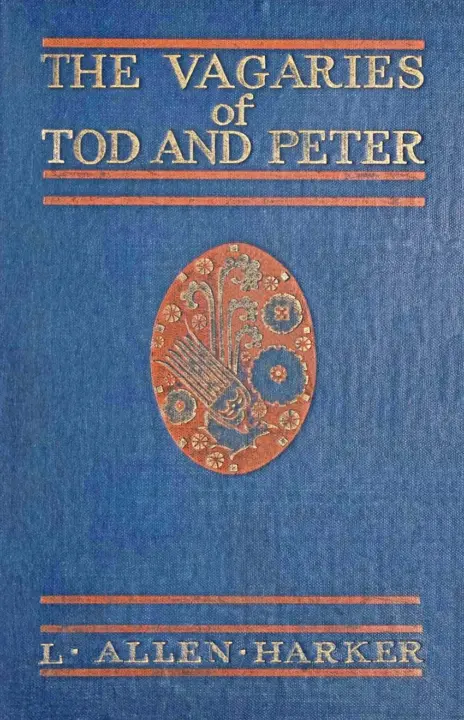
The Vagaries of Tod and Peter
L. Allen (Lizzie Allen) Harker
THE CLASSIC COLLECTION · 1912
"Mr. Wycherly's Wards" by L. Allen Harker is a novel written in the early 20th century. The story revolves around Mr. Wycherly, who takes guardianship of two boys, Edmund and Montagu, after the death of their aunt, Miss Esperance. The novel explores the challenges and humorous situations that arise as Mr. Wycherly relocates to Oxford and attempts to manage life with his wards, while grappling with the expectations of society and their new living conditions. The opening of the novel introduces Mr. Wycherly's sudden decision to move to Oxford, driven by a desire to create a comforting environment for the boys after their aunt's passing. As he settles into a quirky old house, the chaos of their new living situation becomes apparent when he realizes that they lack a capable servant. The boys, each with distinct personalities, are depicted as lively companions who readily adapt to their new home, and they playfully interact with their guardian as they adjust to their new lives. This initial chapter sets the stage for a mix of humor and heartfelt moments as the family dynamics unfold in their new environment.
Introduction adapted from the source catalogue; source summaries may be automatically generated.
Free to read · English · 65,838 words · No account needed
MAKE TIME FOR A GOOD BOOK
On by default. Untick to stop anonymous reading totals. Each page counts after 10 seconds in view. How this works.
Anonymous counting is on unless you have switched it off.
Jane-Anne made a dreadful mess. All over his coat, his chair (even the writing-table did not escape), fell the "Magnolia Bloom."
"What a very disagreeable smell the stuff has got," said Mr. Wycherly, and sneezed. He hated common scents.
At this psychological moment, when they were both smothered in powder and clouds of it were in the air, Mrs. Dew opened the study door, announcing:
"Mr. Gloag, sir."
Jane-Anne started violently and upset the box, and the visitor announced
came into the room.
He was tall and young, with a keen, clean-shaven face, merry dark eyes, and dark curly hair worn a thought longer than is usual with young men.
He stopped short on the threshold, for really the pair before him presented a most extraordinary appearance.
Mr. Wycherly leapt to his feet, exclaiming:
"Curly, my dear fellow, I am delighted to see you." He had quite
forgotten the "Magnolia Bloom" in his pleasure at beholding an old
friend.
"Am I interrupting a rehearsal, or what?" the young man asked, as he
shook hands warmly.
Mr. Wycherly sneezed again. "Oh, this abominable powder; I had forgotten it for the moment. Now, Curly, you are an actor; you are familiar with make-up in every shape and form. Will you kindly tell this young lady whether you consider us improved by this whitewash?"
The situation jumped to the eye. The young man laughed.
"You are both of you rather new to the use of powder, I should say; no one ever leaves it on, you know."
"Then what on earth is the use of it?" demanded Mr. Wycherly.
"It has, perhaps, a softening effect, but it is never used in such
quantities."
"Go and wash, Jane-Anne," said Mr. Wycherly, "and I must do the same, then ask Mrs. Dew--no, come yourself with a dustpan and brush and clear up as well as you can. Curly will go downstairs."
In absolute silence Jane-Anne did as she was bid. It took a long time to clean Mr. Wycherly's study. There seemed a great deal of "Magnolia Bloom" for eighteenpence when she had finished. She emptied the dustpan into the dustbin, then she went and fetched The Peeress. Mrs. Dew had gone out to get something extra for dinner, as the gentleman was going to stay, so Jane-Anne had the kitchen to herself. She tore The Peeress across and across and thrust it down into the hottest part of the fire, putting more coal on the top of it lest her aunt should see it and wonder.
"There," said Jane-Anne, poking viciously. "You're a horrid, meretricious, lying old thing, that you are."
Your reading position is saved on this browser. Take it to another device with a library code. Reading pages adapt to text, rather than matching a printed edition.
L. Allen (Lizzie Allen) Harker
L. Allen (Lizzie Allen) Harker
L. Allen (Lizzie Allen) Harker
L. Allen (Lizzie Allen) Harker
BEHIND THE BOOK
This eBook is for the use of anyone anywhere in the United States and most other parts of the world at no cost and with almost no restrictions whatsoever. You may copy it, give it away or re-use it under the terms of the Project Gutenberg License included with this eBook or online at www.gutenberg.org. If you are not located in the United States, you will have to check the laws of the country where you are located before using this eBook. Read the source licence.
The original source file, including credits and licence, is retained by this library. Request an original-format copy at no charge. Please include the book title and Project Gutenberg identifier #54418.
KEEP YOUR CURIOSITY GOING
Coulson Kernahan

Maurice Baring
Frances Wright
Cécile Tormay

Frederic Jesup Stimson

W. H. P. (William Henry Pope) Jarvis