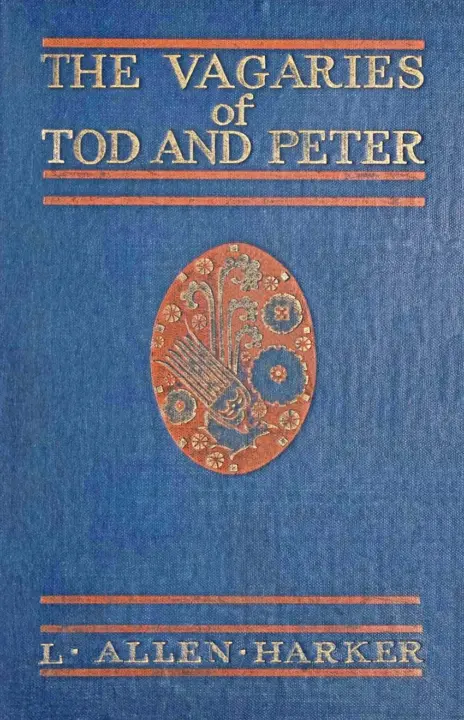
The Vagaries of Tod and Peter
L. Allen (Lizzie Allen) Harker
THE CLASSIC COLLECTION · 1912
"Mr. Wycherly's Wards" by L. Allen Harker is a novel written in the early 20th century. The story revolves around Mr. Wycherly, who takes guardianship of two boys, Edmund and Montagu, after the death of their aunt, Miss Esperance. The novel explores the challenges and humorous situations that arise as Mr. Wycherly relocates to Oxford and attempts to manage life with his wards, while grappling with the expectations of society and their new living conditions. The opening of the novel introduces Mr. Wycherly's sudden decision to move to Oxford, driven by a desire to create a comforting environment for the boys after their aunt's passing. As he settles into a quirky old house, the chaos of their new living situation becomes apparent when he realizes that they lack a capable servant. The boys, each with distinct personalities, are depicted as lively companions who readily adapt to their new home, and they playfully interact with their guardian as they adjust to their new lives. This initial chapter sets the stage for a mix of humor and heartfelt moments as the family dynamics unfold in their new environment.
Introduction adapted from the source catalogue; source summaries may be automatically generated.
Free to read · English · 65,838 words · No account needed
MAKE TIME FOR A GOOD BOOK
On by default. Untick to stop anonymous reading totals. Each page counts after 10 seconds in view. How this works.
Anonymous counting is on unless you have switched it off.
It never occurred to Jane-Anne that the way to use powder was to put it on and take it off again. That would have appeared to her a wasteful work of supererogation. She liberally bedaubed her face with the "snow-white" powder and anxiously regarded the result.
Her eyes looked very dark and large, and her eyebrows, what she had left of them, very black. It had rather an ageing effect on the whole, for so liberal had she been with the powder that her hair all round the temples was iron grey.
She was not quite sure whether she liked the effect or not. Even to her own prejudiced eyes it was a trifle bizarre and pronounced.
Where was the soft sheen of the butterfly's wing promised to "Amabelle"?
"Perhaps it looks different to other people," she reflected.
She crept to the foot of the stairs and listened.
Yes, her aunt was safely in the kitchen. She darted through the housekeeper's room and upstairs to Mr. Wycherly's door, and went in.
He looked up from the letter he was writing with his usual kindly smile of welcome, then suddenly he laughed.
"My dear Jane-Anne," he exclaimed, "have you been baking?"
Jane-Anne stood still in the middle of the room and hung her head.
"It's Magnolia Bloom," she mumbled.
"It's what?" Mr. Wycherly demanded.
"Magnolia Bloom," she repeated, her cheeks very hot indeed beneath the
powder.
"Is that some new kind of flour?" asked Mr. Wycherly, "and if so why in the world do you not wash your face?"
"It's not flour, sir, it's powder--face powder--to make one white and pretty? Don't you like it?"
Mr. Wycherly sat back in his chair gazing in speechless wonder at Jane-Anne. That a girl who admired Lord Byron's poetry, who could learn the Greek alphabet in two evenings, who showed a real appreciation of what was noble and uplifting in the history of her country, could make such an absolute guy of herself in all good faith was to him quite incomprehensible. Boys did not do these things. He was fairly nonplussed.
"Where did you get this--ahem--bloom?" he asked quietly.
"I bought it, sir, with that eighteenpence."
"Have you much more of it?"
"Oh, yes, sir, a whole box."
"Please bring it, and you shall similarly adorn me and see how I look."
Jane-Anne was puzzled. He certainly had not admired her, but then, again, he had not condemned, and he wanted some himself. Swiftly and softly as a panther (lest she should meet her aunt) she fetched the powder and the screw of cotton wool from her room.
"Now," said Mr. Wycherly, "do me."
Your reading position is saved on this browser. Take it to another device with a library code. Reading pages adapt to text, rather than matching a printed edition.
L. Allen (Lizzie Allen) Harker
L. Allen (Lizzie Allen) Harker
L. Allen (Lizzie Allen) Harker
L. Allen (Lizzie Allen) Harker
BEHIND THE BOOK
This eBook is for the use of anyone anywhere in the United States and most other parts of the world at no cost and with almost no restrictions whatsoever. You may copy it, give it away or re-use it under the terms of the Project Gutenberg License included with this eBook or online at www.gutenberg.org. If you are not located in the United States, you will have to check the laws of the country where you are located before using this eBook. Read the source licence.
The original source file, including credits and licence, is retained by this library. Request an original-format copy at no charge. Please include the book title and Project Gutenberg identifier #54418.
KEEP YOUR CURIOSITY GOING
Coulson Kernahan

Maurice Baring
Frances Wright
Cécile Tormay

Frederic Jesup Stimson

W. H. P. (William Henry Pope) Jarvis