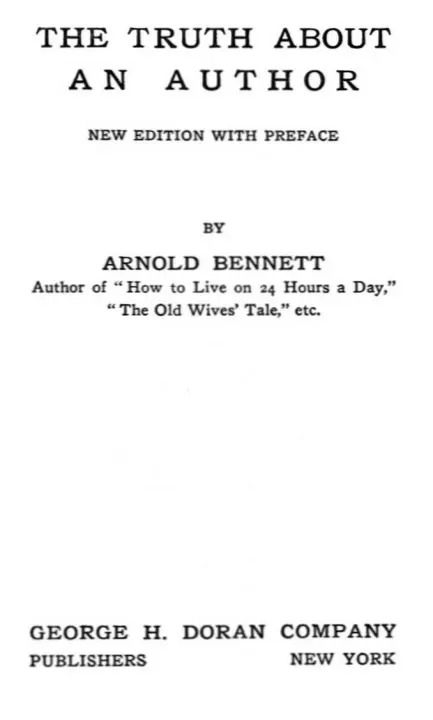
The Truth About an Author
Arnold Bennett
THE CLASSIC COLLECTION · 1922
"Mr. Prohack" by Arnold Bennett is a novel written during the early 20th century. It follows the life of Arthur Charles Prohack, a middle-class civil servant in London, as he navigates the challenges of post-war life, particularly the financial strains that affect his family. Through Mr. Prohack's character, Bennett explores themes of class, economic pressures, and the complexities of family dynamics within the backdrop of a changing society. At the start of the narrative, we are introduced to Mr. Prohack as he enacts his familiar morning routine, revealing his habitual nature and his somewhat ambivalent position as a government official at the Treasury. As he enjoys his breakfast quietly, his interaction with his wife, Eve, begins to uncover the stresses within their household concerning household finances. This opening portion showcases their witty banter, shedding light on their familial relationships, particularly the growing pressure they face as the "new poor." Throughout their conversation, Mr. Prohack's awareness of the wider social issues, coupled with his ironic humor, lays the groundwork for a story rich in social commentary, reflecting the struggles of the middle class grappling with identity and purpose in the wake of the war.
Introduction adapted from the source catalogue; source summaries may be automatically generated.
Free to read · English · 119,575 words · No account needed
MAKE TIME FOR A GOOD BOOK
On by default. Untick to stop anonymous reading totals. Each page counts after 10 seconds in view. How this works.
Anonymous counting is on unless you have switched it off.
"What is the significance of this flag-raising?" asked Mr. Prohack.
"The significance is that the owner has come aboard," Charlie replied, not wholly without self-consciousness. "Come on. Have a look at her. Come on, skipper. Do the honours. She used to be a Mediterranean trader. The former owner turned her into a yacht. He says she cost him a hundred thousand by the time she was finished. I can believe it."
Mr. Prohack also believed it, easily; he believed it more and more easily as he was trotted from deck to deck and from bedroom to bedroom, and sitting-room to sitting-room, and library to smoking-room, and music-room to lounge, and especially from bathroom to bathroom. In no land habitation had Mr. Prohack seen so many, or such marmoreal, or such luxurious bathrooms. What particularly astonished Mr. Prohack was the exceeding and minute finish of everything, and what astonished him even more than the finish was the cleanliness of everything.
"Dirty place to be in, sir, Southampton," grinned the skipper. "We do
the best we can."
They reached the dining-room, an apartment in glossy bird's-eye maple set in the midst of the virgin-white promenade deck.
"By the way, lunch, please," said Charlie.
"Yes, sir," responded eagerly the elder of two attendants in jackets
striped blue and white.
"Have a wash, guv'nor? Thanks, skipper, that'll do for the present."
Mr. Prohack washed in amplitudinous marble, and wiped his paternal face upon diaper into which was woven the name "Northwind." He then, with his son, ate an enormous and intricate lunch and drank champagne out of crystal engraved with the name "Northwind," served to him by a ceremonious person in white gloves. Charlie was somewhat taciturn, but over the coffee he seemed to brighten up.
"Well, what do you think of the old hulk?"
"She must need an awful lot of men," said Mr. Prohack.
"Pretty fair. The wages bill is seven hundred a month."
"She's enormous," continued Mr. Prohack lamely.
"Oh, no! Seven hundred tons Thames measurement. You see those funnels over there," and Charlie pointed through the port windows to a row of four funnels rising over great sheds. "That's the Mauretania. She's a hundred times as big as this thing. She could almost sling this affair in her davits."
"Indeed! Still, I maintain that this antique wreck is enormous," Mr.
Prohack insisted.
They walked out on deck.
"Hello! Here's the chit. You can always count on her!" said Charles.
The launch was again approaching the yacht, and a tiny figure with a despatch case on her lap sat smiling in the stern-sheets.
"She's come down by train," Charles explained.
Your reading position is saved on this browser. Take it to another device with a library code. Reading pages adapt to text, rather than matching a printed edition.
Arnold Bennett
Arnold Bennett
Arnold Bennett
Arnold Bennett
BEHIND THE BOOK
This eBook is for the use of anyone anywhere in the United States and most other parts of the world at no cost and with almost no restrictions whatsoever. You may copy it, give it away or re-use it under the terms of the Project Gutenberg License included with this eBook or online at www.gutenberg.org. If you are not located in the United States, you will have to check the laws of the country where you are located before using this eBook. Read the source licence.
The original source file, including credits and licence, is retained by this library. Request an original-format copy at no charge. Please include the book title and Project Gutenberg identifier #12773.
KEEP YOUR CURIOSITY GOING
Coulson Kernahan

Maurice Baring
Frances Wright
Cécile Tormay

Frederic Jesup Stimson

W. H. P. (William Henry Pope) Jarvis