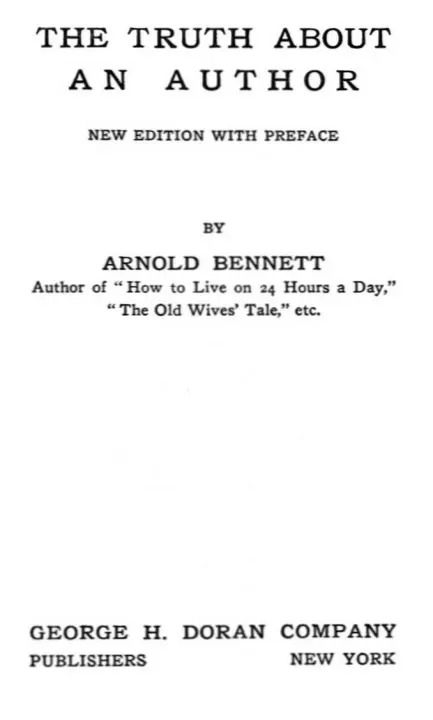
The Truth About an Author
Arnold Bennett
THE CLASSIC COLLECTION · 1922
"Mr. Prohack" by Arnold Bennett is a novel written during the early 20th century. It follows the life of Arthur Charles Prohack, a middle-class civil servant in London, as he navigates the challenges of post-war life, particularly the financial strains that affect his family. Through Mr. Prohack's character, Bennett explores themes of class, economic pressures, and the complexities of family dynamics within the backdrop of a changing society. At the start of the narrative, we are introduced to Mr. Prohack as he enacts his familiar morning routine, revealing his habitual nature and his somewhat ambivalent position as a government official at the Treasury. As he enjoys his breakfast quietly, his interaction with his wife, Eve, begins to uncover the stresses within their household concerning household finances. This opening portion showcases their witty banter, shedding light on their familial relationships, particularly the growing pressure they face as the "new poor." Throughout their conversation, Mr. Prohack's awareness of the wider social issues, coupled with his ironic humor, lays the groundwork for a story rich in social commentary, reflecting the struggles of the middle class grappling with identity and purpose in the wake of the war.
Introduction adapted from the source catalogue; source summaries may be automatically generated.
Free to read · English · 119,575 words · No account needed
MAKE TIME FOR A GOOD BOOK
On by default. Untick to stop anonymous reading totals. Each page counts after 10 seconds in view. How this works.
Anonymous counting is on unless you have switched it off.
Eve brought in to her husband, who had improved his moral stamina and his physical charm by means of the finest of his dressing-gowns, a dark, thin young man, clothed to marvellous perfection, with a much-loved moustache, and looking as fresh as if he was just going to a party. Mr. Prohack of course recognised him as one of the guests.
"Good morning," said Mr. Prohack. "So you are the detective."
"Yes, sir," answered the detective, formally.
"Do you know, all the evening I was under the impression that you were First Secretary to the Czecho-Slovakian Legation."
"No, sir," answered the detective, formally.
"Well! Well! I think there is a proverb to the effect that appearances
are deceptive."
"Is there indeed, sir?" said the detective, with unshaken gravity. "In our business we think that appearances ought to be deceptive."
"Now talking of your business," Mr. Prohack remarked with one of his efforts to be very persuasive. "What about this unfortunate affair?"
"Yes, sir, what about it?" The detective looked askance at Eve.
"I suppose there's no doubt the thing's been stolen--By the way, sit on the end of the bed, will you? Then you'll be near me."
"Yes, sir," said the detective, sitting down. "There is no doubt the necklace has been removed by some one, either for a nefarious purpose or for a joke."
"Ah! A joke?" meditated Mr. Prohack, aloud.
"It certainly hasn't been taken for a joke," said Eve warmly. "Nobody that I know well enough for them to play such a trick would dream of playing it."
"Then," said Mr. Prohack, "we are left all alone with the nefarious purpose. I had a sort of a notion that I should meet the nefarious purpose, and here it is! I suppose there's little hope?"
"Well, sir. You know what happens to a stolen pearl necklace. The pearls are separated. They can be sold at once, one at a time, or they can be kept for years and then sold. Pearls, except the very finest, leave no trace when they get a fair start."
"What I can't understand," Eve exclaimed, "is how it could have dropped off without me noticing it."
"Oh! I can easily understand that," said Mr. Prohack, with a peculiar
intonation.
"I've known ladies lose even their hair without noticing anything," said the detective firmly. "Not to mention other items."
"But without anybody else noticing it either?" Eve pursued her own train
of thought.
"Somebody did notice it," said the detective, writing on a small piece
of paper.
"Who?"
"The person who took the necklace."
Your reading position is saved on this browser. Take it to another device with a library code. Reading pages adapt to text, rather than matching a printed edition.
Arnold Bennett
Arnold Bennett
Arnold Bennett
Arnold Bennett
BEHIND THE BOOK
This eBook is for the use of anyone anywhere in the United States and most other parts of the world at no cost and with almost no restrictions whatsoever. You may copy it, give it away or re-use it under the terms of the Project Gutenberg License included with this eBook or online at www.gutenberg.org. If you are not located in the United States, you will have to check the laws of the country where you are located before using this eBook. Read the source licence.
The original source file, including credits and licence, is retained by this library. Request an original-format copy at no charge. Please include the book title and Project Gutenberg identifier #12773.
KEEP YOUR CURIOSITY GOING
Coulson Kernahan

Maurice Baring
Frances Wright
Cécile Tormay

Frederic Jesup Stimson

W. H. P. (William Henry Pope) Jarvis