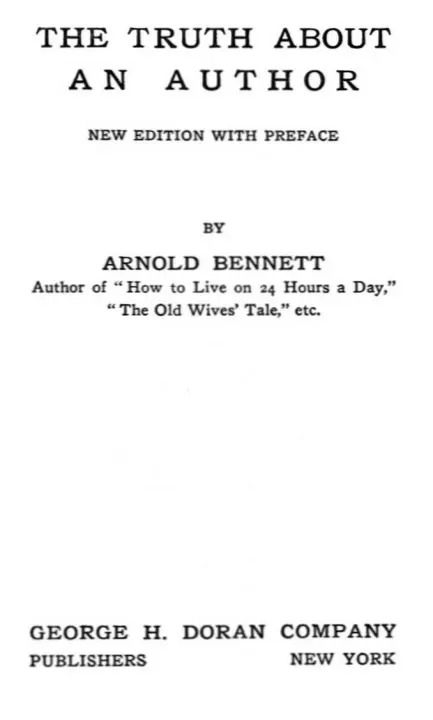
The Truth About an Author
Arnold Bennett
THE CLASSIC COLLECTION · 1922
"Mr. Prohack" by Arnold Bennett is a novel written during the early 20th century. It follows the life of Arthur Charles Prohack, a middle-class civil servant in London, as he navigates the challenges of post-war life, particularly the financial strains that affect his family. Through Mr. Prohack's character, Bennett explores themes of class, economic pressures, and the complexities of family dynamics within the backdrop of a changing society. At the start of the narrative, we are introduced to Mr. Prohack as he enacts his familiar morning routine, revealing his habitual nature and his somewhat ambivalent position as a government official at the Treasury. As he enjoys his breakfast quietly, his interaction with his wife, Eve, begins to uncover the stresses within their household concerning household finances. This opening portion showcases their witty banter, shedding light on their familial relationships, particularly the growing pressure they face as the "new poor." Throughout their conversation, Mr. Prohack's awareness of the wider social issues, coupled with his ironic humor, lays the groundwork for a story rich in social commentary, reflecting the struggles of the middle class grappling with identity and purpose in the wake of the war.
Introduction adapted from the source catalogue; source summaries may be automatically generated.
Free to read · English · 119,575 words · No account needed
MAKE TIME FOR A GOOD BOOK
On by default. Untick to stop anonymous reading totals. Each page counts after 10 seconds in view. How this works.
Anonymous counting is on unless you have switched it off.
When she had got the tea into the cup, she poured it into the saucer and blew on it and began to drink loudly. After two sips she plucked at a piece of bread-and-butter, conveyed it into her mouth, and before doing anything further to it, sirruped up some more tea. And in this way she went on. Her table manners convinced Mr. Prohack that her claim to respectability was authentic.
"And now," said Mr. Prohack, gazing through the curtained window at the blank wall that ended above him at the edge of the pavement, so as not to embarrass her, "will you tell me why you spent the night in my area?"
"Because some one locked the gate on me, sir, while I was hiding under the shed where the dustbins are."
"I quite see," said Mr. Prohack, "I quite see. But why did you go down into the area? Were you begging, or what?"
"Me begging, sir!" she exclaimed, and ceased to cry, fortified by the
tonic of aroused pride.
"No, of course you weren't begging," said Mr. Prohack. "You may have
given to beggars--"
"That I have, sir." She cried again.
"But you don't beg. I quite see. Then what?"
"It's no use me a-trying to tell you, sir. You won't believe me." Her voice was extraordinarily thin and weak, and seldom achieved anything that could fairly be called pronunciation.
"I shall," said Mr. Prohack. "I'm a great believer. You try me. You'll
see."
"It's like this. I was converted last night, and that's where the trouble began, if it's the last word I ever speak."
"Theology?" murmured Mr. Prohack, turning to look at her and marvelling at the romantic quality of basements.
"There was a mission on at the Methodists' in Paddington Street, and in I went. Seems strange to me to be going into a Methodists', seeing as I'm so friendly with Mr. Milcher."
"Who is Mr. Milcher?"
"Milcher's the sexton at St. Nicodemus, sir. Or I should say sacristan. They call him sacristan instead of sexton because St. Nicodemus is High, as I daresay you know, sir, living so close."
Mr. Prohack was conscious of a slight internal shiver, which he could not explain, unless it might be due to a subconscious premonition of unpleasantness to come.
"I know that I live close to St. Nicodemus," he replied. "Very close. Too close. But I did not know how High St. Nicodemus was. However, I'm interrupting you." He perceived with satisfaction that his gift of inspiring people with confidence was not failing him on this occasion.
Your reading position is saved on this browser. Take it to another device with a library code. Reading pages adapt to text, rather than matching a printed edition.
Arnold Bennett
Arnold Bennett
Arnold Bennett
Arnold Bennett
BEHIND THE BOOK
This eBook is for the use of anyone anywhere in the United States and most other parts of the world at no cost and with almost no restrictions whatsoever. You may copy it, give it away or re-use it under the terms of the Project Gutenberg License included with this eBook or online at www.gutenberg.org. If you are not located in the United States, you will have to check the laws of the country where you are located before using this eBook. Read the source licence.
The original source file, including credits and licence, is retained by this library. Request an original-format copy at no charge. Please include the book title and Project Gutenberg identifier #12773.
KEEP YOUR CURIOSITY GOING
Coulson Kernahan

Maurice Baring
Frances Wright
Cécile Tormay

Frederic Jesup Stimson

W. H. P. (William Henry Pope) Jarvis