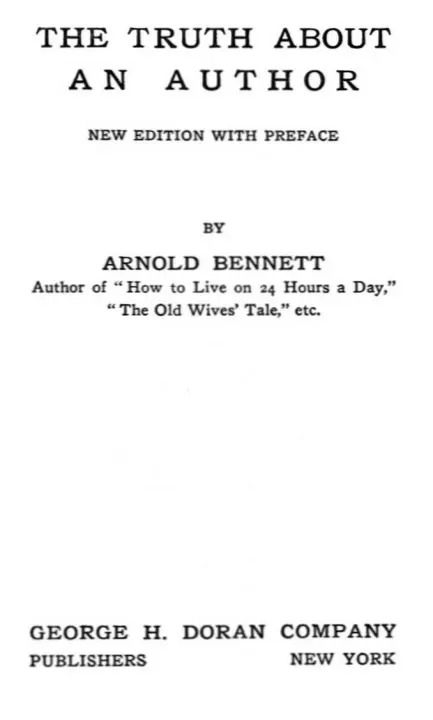
The Truth About an Author
Arnold Bennett
THE CLASSIC COLLECTION · 1922
"Mr. Prohack" by Arnold Bennett is a novel written during the early 20th century. It follows the life of Arthur Charles Prohack, a middle-class civil servant in London, as he navigates the challenges of post-war life, particularly the financial strains that affect his family. Through Mr. Prohack's character, Bennett explores themes of class, economic pressures, and the complexities of family dynamics within the backdrop of a changing society. At the start of the narrative, we are introduced to Mr. Prohack as he enacts his familiar morning routine, revealing his habitual nature and his somewhat ambivalent position as a government official at the Treasury. As he enjoys his breakfast quietly, his interaction with his wife, Eve, begins to uncover the stresses within their household concerning household finances. This opening portion showcases their witty banter, shedding light on their familial relationships, particularly the growing pressure they face as the "new poor." Throughout their conversation, Mr. Prohack's awareness of the wider social issues, coupled with his ironic humor, lays the groundwork for a story rich in social commentary, reflecting the struggles of the middle class grappling with identity and purpose in the wake of the war.
Introduction adapted from the source catalogue; source summaries may be automatically generated.
Free to read · English · 119,575 words · No account needed
MAKE TIME FOR A GOOD BOOK
On by default. Untick to stop anonymous reading totals. Each page counts after 10 seconds in view. How this works.
Anonymous counting is on unless you have switched it off.
"Don't I tell you I'm suffering from horrible complications?" cried Mr.
Prohack.
"What kind of complications?"
"Every kind. My aim has always been to keep my life simple, and I succeeded very well--perhaps too well--until I inherited money. I don't mind money, but I do mind complications. I don't want a large house--because it means complications. I desire Sissie's happiness, but I hate weddings. I desire to be looked after, but I hate strange servants. I can find pleasure in a motor-car, but I hate even the risk of accidents. I have no objection to an income, but I hate investments. And so on. All I ask is to live simply and sensibly, but instead of that my existence is transformed into a quadratic equation. And I can't stop it. My happiness is not increasing--it's decreasing. I spend more and more time in wondering whither I am going, what I am after, and where precisely is the point of being alive at all. That's a fact, and now you know it."
Dr. Veiga rose from his chair and deliberately sat down on the side of his patient's bed. The gesture in itself was sufficiently unprofessional, but he capped it with another of which probably no doctor had ever been guilty in a British sick-room before; he pulled out a pocket-knife and became his own manicure, surveying his somewhat neglected hands with a benevolently critical gaze, smiling at them as if to say: "What funny hands you are!"
And Mr. Prohack felt that the doctor was saying: "What a funny Prohack
you are!"
"My friend," said Dr. Veiga at length (with his voice), "my friend, I will not conceal from you that your alarm was justified. You are suffering from one of the commonest and one of the gravest mental derangements. I'm surprised, but there it is. You haven't yet discovered that it's the earth you're living on. You fancy it may be Sirius, Uranus, Aldebaran or Jupiter--let us say Jupiter. Perhaps in one of these worlds matters are ordered differently, and their truth is not our truth; but let me assure you that the name of your planet is the Earth and that on the earth one great unalterable truth prevails. Namely:--You can't do this"--here Dr. Veiga held up a pared and finished finger and wagged it to and fro with solemnity--"you can't do this without moving your finger ... You were aware of this great truth? Then why are you upset because you can't wag your finger without moving it?... Perhaps I'm being too subtle for you. Let me put the affair in another way. You've lost sight of the supreme earthly fact that everything has not merely a consequence, but innumerable consequences. You knew when you married that you were creating endless consequences, and now you want to limit the consequences. You knew when you accepted a fortune that you were creating endless consequences, and now you want to limit them too. You want to alter the rules after the game has started. You set in motion circumstances which were bound to influence the development of the members of your family, and when the inevitable new developments begin, you object, simply because you hadn't foreseen them. You knew that money doesn't effectively exist until it's spent and that you can't spend money without causing consequences, and when your family causes consequences by bringing the money to life you complain that you're a martyr to the consequences and that you hadn't bargained for complications. My poor friend, you have made one crucial mistake in your career,--the mistake of being born. Happily the mistake is curable. I can give you several prescriptions. The first is prussic acid. If you don't care for that you can donate the whole of your fortune to the Sinking Fund for extinguishing the National Debt and you can return to the Treasury. If you don't care for that you can leave your family mysteriously and go and live in Timbuctoo by yourself. If you don't care for that you can buy a whip and forbid your wife and daughter to grow older or change in any way on pain of a hundred lashes. And if you don't like that you can acquaint yourself with the axioms that neither you nor anybody else are the centre of the universe and that what you call complications are simply another name for life itself. Worry is life, and life is worry. And the absence of worry is death. I won't say to you that you're rich and beloved and therefore you've nothing to worry about. I'll say to you, you've got a lot to worry about because you're rich and beloved.... I'll leave the other hand for to-morrow." Dr. Veiga snapped down the blade of the pocket-knife.
Your reading position is saved on this browser. Take it to another device with a library code. Reading pages adapt to text, rather than matching a printed edition.
Arnold Bennett
Arnold Bennett
Arnold Bennett
Arnold Bennett
BEHIND THE BOOK
This eBook is for the use of anyone anywhere in the United States and most other parts of the world at no cost and with almost no restrictions whatsoever. You may copy it, give it away or re-use it under the terms of the Project Gutenberg License included with this eBook or online at www.gutenberg.org. If you are not located in the United States, you will have to check the laws of the country where you are located before using this eBook. Read the source licence.
The original source file, including credits and licence, is retained by this library. Request an original-format copy at no charge. Please include the book title and Project Gutenberg identifier #12773.
KEEP YOUR CURIOSITY GOING
Coulson Kernahan

Maurice Baring
Frances Wright
Cécile Tormay

Frederic Jesup Stimson

W. H. P. (William Henry Pope) Jarvis