THE CLASSIC COLLECTION✦Peeps at People Being Certain Papers from the Writings of Anne Warrington WitherupCLASSIC FREE BOOKS
Peeps at People Being Certain Papers from the Writings of Anne Warrington Witherup
John Kendrick Bangs
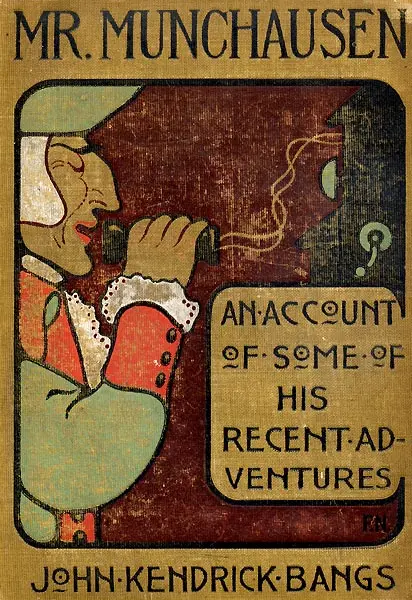
THE CLASSIC COLLECTION · 1901
"Mr. Munchausen" by John Kendrick Bangs is a collection of whimsical and humorous tales written in the early 20th century. This satirical work presents a series of outrageous adventures involving the legendary figure Baron Munchausen, known for his tall tales of bravado and improbable exploits. Through the lens of fantastical storytelling, the book delves into the absurdities of human nature and storytelling itself, offering readers a playful critique of realism and veracity in literature. The opening of the work establishes an intriguing premise: the narrator, an interviewer for the "Gehenna Gazette", receives a mysterious call from the Baron himself, who resides in the afterlife. The Baron claims to have countless astounding stories to tell, agreeing to dictate his recent adventures to the narrator. This whimsical format sets the stage for a blend of humor and fantasy, as the Baron recounts his adventures with extravagant fishing exploits, improbable golfing victories, and encounters with animals, implying that his tall tales serve to elevate the art of storytelling while poking fun at the very nature of truth and lies. The tone is light-hearted and witty, inviting readers to suspend disbelief and enjoy the lavish imagination of Munchausen's world.
Introduction adapted from the source catalogue; source summaries may be automatically generated.
Free to read · English · 34,392 words · No account needed
MAKE TIME FOR A GOOD BOOK
On by default. Untick to stop anonymous reading totals. Each page counts after 10 seconds in view. How this works.
Anonymous counting is on unless you have switched it off.
Note: Project Gutenberg also has an HTML version of this file which includes the original illustrations in color. See 33432-h.htm or 33432-h.zip: (https://www.gutenberg.org/cache/epub/33432/pg33432-images.html) or (https://www.gutenberg.org/files/33432/33432-h.zip)
Being a TRUE ACCOUNT of some of the RECENT ADVENTURES beyond the STYX of the late HIERONYMUS CARL FRIEDRICH, sometime BARON MUNCHAUSEN of BODENWERDER, as originally reported for the SUNDAY EDITION of the GEHENNA GAZETTE by its SPECIAL INTERVIEWER the late Mr. ANANIAS formerly of JERUSALEM and now first transcribed from the columns of that JOURNAL by
Embellished with Drawings by Peter Newell
Boston: Printed for Noyes, Platt & Company and published by them at their offices in the Pierce Building in Copley Square, A.D. 1901
Copyright, 1901, by Noyes, Platt & Company, (Incorporated)
Entered at Stationers' Hall
The lithographed illustrations are printed in eight colours by George H. Walker and Company, Boston
Press of Riggs Printing and Publishing Co. Albany, N. Y., U. S. A.
EDITOR'S APOLOGY and DEDICATION
In order that there may be no misunderstanding as to the why and the wherefore of this collection of tales it appears to me to be desirable that I should at the outset state my reasons for acting as the medium between the spirit of the late Baron Munchausen and the reading public. In common with a large number of other great men in history Baron Munchausen has suffered because he is not understood. I have observed with wondering surprise the steady and constant growth of the idea that Baron Munchausen was not a man of truth; that his statements of fact were untrustworthy, and that as a realist he had no standing whatsoever. Just how this misconception of the man's character has arisen it would be difficult to say. Surely in his published writings he shows that same lofty resolve to be true to life as he has seen it that characterises the work of some of the high Apostles of Realism, who are writing of the things that will teach future generations how we of to-day ordered our goings-on. The note of veracity in Baron Munchausen's early literary venturings rings as clear and as true certainly as the similar note in the charming studies of Manx Realism that have come to us of late years from the pen of Mr. Corridor Walkingstick, of Gloomster Abbey and London. We all remember the glow of satisfaction with which we read Mr. Walkingstick's great story of the love of the clergyman, John Stress, for the charming little heroine, Glory Partridge. Here was something at last that rang true. The picture was painted in the boldest of colours, and, regardless of consequences to himself, Mr. Walkingstick dared to be real when he might have given rein to his imagination. Mr. Walkingstick was, thereupon, lifted up by popular favour to the level of an apostle--nay, he even admitted the soft impeachment--and now as a moral teacher he is without a rival in the world of literature. Yet the same age that accepts this man as a moral teacher, rejects Baron Munchausen, who, in different manner perhaps, presented to the world as true and life-like a picture of the conditions of his day as that given to us by Mr. Walkingstick in his deservedly popular romance, "Episcopalians I have Met." Of course, I do not claim that Baron Munchausen's stories in bulk or in specified instances, have the literary vigour that is so marked a quality of the latter-day writer, but the point I do wish to urge is that to accept the one as a veracious chronicler of his time and to reject the other as one who indulges his pen in all sorts of grotesque vagaries, without proper regard for the facts, is a great injustice to the man of other times. The question arises, why is this? How has this wrong upon the worthy realist of the eighteenth century been perpetrated? Is it an intentional or an unwitting wrong? I prefer to believe that it is based upon ignorance of the Baron's true quality, due to the fact that his works are rarely to be found within the reach of the public: in some cases, because of the failure of librarians to comprehend his real motives, his narratives are excluded from Public and Sunday-School libraries; and because of their extreme age, they are not easily again brought into vogue. I have, therefore, accepted the office of intermediary between the Baron and the readers of the present day, in order that his later work, which, while it shows to a marked degree the decadence of his literary powers, may yet serve to demonstrate to the readers of my own time how favourably he compares with some of the literary idols of to-day, in the simple matter of fidelity to fact. If these stories which follow shall serve to rehabilitate Baron Munchausen as a lover and practitioner of the arts of Truth, I shall not have made the sacrifice of my time in vain. If they fail of this purpose I shall still have the satisfaction of knowing that I have tried to render a service to an honest and defenceless man.
Your reading position is saved on this browser. Take it to another device with a library code. Reading pages adapt to text, rather than matching a printed edition.
John Kendrick Bangs
John Kendrick Bangs
John Kendrick Bangs
John Kendrick Bangs
BEHIND THE BOOK
This eBook is for the use of anyone anywhere in the United States and most other parts of the world at no cost and with almost no restrictions whatsoever. You may copy it, give it away or re-use it under the terms of the Project Gutenberg License included with this eBook or online at www.gutenberg.org. If you are not located in the United States, you will have to check the laws of the country where you are located before using this eBook. Read the source licence.
The original source file, including credits and licence, is retained by this library. Request an original-format copy at no charge. Please include the book title and Project Gutenberg identifier #33432.
KEEP YOUR CURIOSITY GOING
Wilfrid Scawen Blunt
Wilfrid Scawen Blunt

E. W. (Edgar Watson) Howe
Coulson Kernahan

Maurice Baring
Frances Wright