Human Work
Charlotte Perkins Gilman
THE CLASSIC COLLECTION · 1911
"Moving the Mountain" by Charlotte Perkins Gilman is a novel written in the early 20th century, specifically around 1911. The story explores a future society where a man, John Robertson, awakens after thirty years of unconsciousness, discovering a dramatically altered world shaped by the empowerment of women and societal changes. The narrative reflects on themes of gender roles, societal progress, and the potential for a changed human condition. At the start of the novel, we meet John Robertson, who has been found lost and disoriented in Tibet after a long absence. He is reunited with his sister, Nellie, who reveals the wild changes that have taken place while he was gone. As he grapples with the shock of waking up in a time that has progressed greatly beyond his last memories, he learns about the advancements in women's rights and societal transformations that have taken place. Through John's perspective, we are introduced to his bewilderment about the social dynamics, especially regarding the roles of women in this new world, leading to a complex exploration of identity, progress, and the nature of change in human society.
Introduction adapted from the source catalogue; source summaries may be automatically generated.
Free to read · English · 48,306 words · No account needed
MAKE TIME FOR A GOOD BOOK
On by default. Untick to stop anonymous reading totals. Each page counts after 10 seconds in view. How this works.
Anonymous counting is on unless you have switched it off.
"If a man raises, by his own labor, just enough to feed himself--that is working for himself," Mr. Brown explained, "but if he raises more corn than he consumes, he is serving humanity."
"But he does not give it away," I urged; "he is paid for it."
"Well, you paid the doctor who saved your child's life, but the doctor's work was social service none the less--and the teacher's--anybody's."
"But that kind of work benefits humanity--"
"Yes, and does it not benefit humanity to eat--to have shoes and clothes and houses? John, John, wake up!" Nellie for the first time showed impatience with me. But my brother-in-law extended a protecting arm.
"Now, Nellie, don't hurry him. This thing will burst upon him all at once. Of course, it's glaringly plain, but there was a time when you and I did not see it either."
I was a little sulky. "Well, as far as I gather," and I took out my note book, "people all of a sudden changed all their ideas about everything--and your demi-millennium followed."
"I wish we could say that," said Mrs. Allerton. "We are not telling you of our present day problems and difficulties, you see. No, Mr. Robertson, we have merely removed our most obvious and patently unnecessary difficulties, of which poverty was at least the largest.
"What we did, as we have rather confusedly suggested, I'm afraid, was to establish such measures as to insure better births, and vastly better environment and education for every child. That raised the standard of the people, you see, and increased their efficiency. Then we provided employment for everyone, under good conditions, and improved the world in two ways at once."
"And who paid for this universal employment?" I asked.
"Who paid for it before?" she returned promptly.
"The employer, of course."
"Did he? Out of his own private pocket? At a loss to himself."
"Why, of course not," I replied, a little nettled. "Out of the profits
of the business."
"And 'the business' was the work done by the employees?"
"Not at all! He did it himself; they only furnished the labor."
"Could he do it alone--without 'labor?' Did he furnish employment as a piece of beneficence, outside of his business--Ah, Mr. Robertson, surely it is clear that unless a man's labor furnished a profit to his employer, he would not be employed. It was on that profit that 'labor' was paid--they paid themselves. They do now, but at a higher rate."
I was annoyed by this clever juggling with the hard facts of business.
Your reading position is saved on this browser. Take it to another device with a library code. Reading pages adapt to text, rather than matching a printed edition.
Charlotte Perkins Gilman
Charlotte Perkins Gilman
Charlotte Perkins Gilman
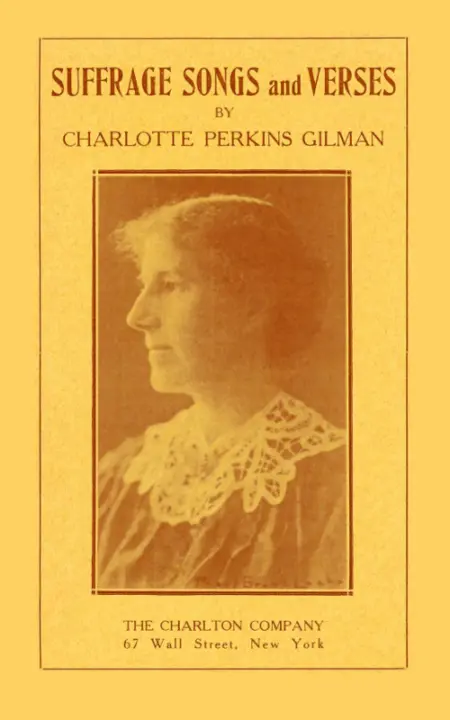
Charlotte Perkins Gilman
BEHIND THE BOOK
This eBook is for the use of anyone anywhere in the United States and most other parts of the world at no cost and with almost no restrictions whatsoever. You may copy it, give it away or re-use it under the terms of the Project Gutenberg License included with this eBook or online at www.gutenberg.org. If you are not located in the United States, you will have to check the laws of the country where you are located before using this eBook. Read the source licence.
The original source file, including credits and licence, is retained by this library. Request an original-format copy at no charge. Please include the book title and Project Gutenberg identifier #66864.
KEEP YOUR CURIOSITY GOING
Coulson Kernahan

Maurice Baring
Frances Wright
Cécile Tormay
Francis Greenleaf Allinson & Anne C. E. (Anne Crosby Emery) Allinson

Frederic Jesup Stimson