
Human Work
Charlotte Perkins Gilman

THE CLASSIC COLLECTION · 1911
"Moving the Mountain" by Charlotte Perkins Gilman is a novel written in the early 20th century, specifically around 1911. The story explores a future society where a man, John Robertson, awakens after thirty years of unconsciousness, discovering a dramatically altered world shaped by the empowerment of women and societal changes. The narrative reflects on themes of gender roles, societal progress, and the potential for a changed human condition. At the start of the novel, we meet John Robertson, who has been found lost and disoriented in Tibet after a long absence. He is reunited with his sister, Nellie, who reveals the wild changes that have taken place while he was gone. As he grapples with the shock of waking up in a time that has progressed greatly beyond his last memories, he learns about the advancements in women's rights and societal transformations that have taken place. Through John's perspective, we are introduced to his bewilderment about the social dynamics, especially regarding the roles of women in this new world, leading to a complex exploration of identity, progress, and the nature of change in human society.
Introduction adapted from the source catalogue; source summaries may be automatically generated.
Free to read · English · 48,306 words · No account needed
MAKE TIME FOR A GOOD BOOK
On by default. Untick to stop anonymous reading totals. Each page counts after 10 seconds in view. How this works.
Anonymous counting is on unless you have switched it off.
"I mean just what I say. They were punished, just as we punish criminals--with confinement at hard labor. The great mass of the people were forced to labor for cruelly long hours at dull, distasteful occupations; is not that punishment?"
"Not at all," I said hotly. "They were free at any time to leave an occupation they did not like."
"Leave it for what alternative?"
"To take up another," said I, perceiving that this, after all, was not
much of an escape.
"Yes, to take up another under the same heavy conditions, if there was any opening; or to starve--that was their freedom."
"Well, what would you have?" I asked. "A man must work for his living
surely."
"Remember your economic platitude, Mr. Robertson," Dr. Harkness suggested. "The whole world's life, comfort, prosperity and progress depends upon the work done, you know. It was not their living they were working for; it was the world's."
"That is very pretty as a sentiment," I was beginning; but his twinkling eye reminded that an economic platitude is not precisely sentimental.
"That's where the change came," Mr. Pike eagerly repeated. "The idea that each man had to do it for himself kept us blinded to the fact that it was all social service; that they worked for the world, and the world treated them shamefully--so shamefully that their product was deteriorated, markedly deteriorated."
"You will be continually surprised, Mr. Robertson, at the improvements of our output," remarked Mr. Brown. "We have standards in every form of manufacture, required standards; and to label an article incorrectly is a misdemeanor."
"That was just starting in the pure-food agitation, you remember," my sister put in--('with apple juice containing one-tenth of one per cent, of benzoate of soda').
"And now," Mr. Brown continued, "'all wool' is all wool; if it isn't, you can have the dealer arrested. Silk is silk, nowadays, and cream is cream."
"And 'caveat emptor' is a dead letter?"
"Yes, it is 'caveat vendor' now. You see, selling goods is public
service."
"You apply that term quite differently from what it stood for in my
memory," said I.
"It used to mean some sort of beneficent statesmanship, at first," Nellie agreed. "Then it spread to various philanthropic efforts and wider grades of government activities. Now it means any kind of world work."
She saw that this description did not carry much weight with me, and added, "Any kind of human work, John; that is, work a man gives his whole time to and does not himself consume, is world work--is social service."
Your reading position is saved on this browser. Take it to another device with a library code. Reading pages adapt to text, rather than matching a printed edition.
Charlotte Perkins Gilman

Charlotte Perkins Gilman

Charlotte Perkins Gilman
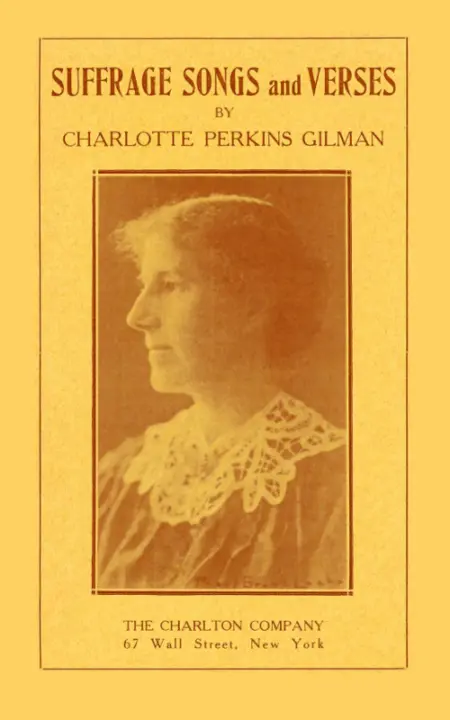
Charlotte Perkins Gilman
BEHIND THE BOOK
This eBook is for the use of anyone anywhere in the United States and most other parts of the world at no cost and with almost no restrictions whatsoever. You may copy it, give it away or re-use it under the terms of the Project Gutenberg License included with this eBook or online at www.gutenberg.org. If you are not located in the United States, you will have to check the laws of the country where you are located before using this eBook. Read the source licence.
The original source file, including credits and licence, is retained by this library. Request an original-format copy at no charge. Please include the book title and Project Gutenberg identifier #66864.
KEEP YOUR CURIOSITY GOING
Coulson Kernahan

Maurice Baring
Frances Wright
Cécile Tormay
Francis Greenleaf Allinson & Anne C. E. (Anne Crosby Emery) Allinson

Frederic Jesup Stimson