Human Work
Charlotte Perkins Gilman
THE CLASSIC COLLECTION · 1911
"Moving the Mountain" by Charlotte Perkins Gilman is a novel written in the early 20th century, specifically around 1911. The story explores a future society where a man, John Robertson, awakens after thirty years of unconsciousness, discovering a dramatically altered world shaped by the empowerment of women and societal changes. The narrative reflects on themes of gender roles, societal progress, and the potential for a changed human condition. At the start of the novel, we meet John Robertson, who has been found lost and disoriented in Tibet after a long absence. He is reunited with his sister, Nellie, who reveals the wild changes that have taken place while he was gone. As he grapples with the shock of waking up in a time that has progressed greatly beyond his last memories, he learns about the advancements in women's rights and societal transformations that have taken place. Through John's perspective, we are introduced to his bewilderment about the social dynamics, especially regarding the roles of women in this new world, leading to a complex exploration of identity, progress, and the nature of change in human society.
Introduction adapted from the source catalogue; source summaries may be automatically generated.
Free to read · English · 48,306 words · No account needed
MAKE TIME FOR A GOOD BOOK
On by default. Untick to stop anonymous reading totals. Each page counts after 10 seconds in view. How this works.
Anonymous counting is on unless you have switched it off.
"Well! well!" said I as genially as I knew how. "That's very different from my young days. Then everybody older than I always complained about all manner of things, and told how much better--and cheaper--things were when they were young."
"Yes, 'twas so," he admitted meditatively. "But 'tain't so now. Shoes is better, most things is better, I guess. Seems like water runnin' up hill, don't it, sir?"
It did. I didn't like it. I got away from the old man, and walked by
myself--like Kipling's cat.
"Of course, of course!" I said to myself impatiently, "I may as well expect to find everything as much improved from what it was in my time as in, say, sixty years before. That sort of progress goes faster and faster. Things change, but people--"
And here is where I got this creepy sense of unreality.
At first everything was so strange to me, and my sister was so kind and thoughtful, so exquisitely considerate of my feelings and condition, that I had failed to notice this remarkable circumstance--so were the other people. It was like being in a--well, in a house-party of very nice persons. Kind, cheerful, polite--here I suddenly realized that I had not seen a grouchy face, heard an unkind remark, felt, as one does feel through silk and broadcloth, the sense of discontent and disapproval.
There was one, the somewhat hard-faced old lady, Mrs. Talbot, of whom I had hopes. I sought her, and laid myself out to please her by those little attentions which are so grateful to an elderly woman from a young man.
Her accepting these as a commonplace, her somewhat too specific
inquiries about my health, suddenly reminded me that I was not a young
man----
She talked on while I made again that effort at readjustment which was so hideously hard. Gone in a night--all my young manhood--gone untasted!
"Do you find it difficult to concentrate your attention?" she was saying, a steely eye fixed upon my face.
"I beg your pardon, madam. I fear I do. You were saying--"
"I was saying that you will find many changes when you get back."
"I find them already, Mrs. Talbot. They rather loom up. It is sudden,
you see."
"Yes, you've been away a long time, I understand. In the far East?"
Mrs. Talbot was the first person who had asked me a question. Evidently hers were the manners of an older generation, and for once I had to admit that the younger generation had improved.
But I recalled the old defensive armor against the old assaults.
Your reading position is saved on this browser. Take it to another device with a library code. Reading pages adapt to text, rather than matching a printed edition.
Charlotte Perkins Gilman

Charlotte Perkins Gilman
Charlotte Perkins Gilman
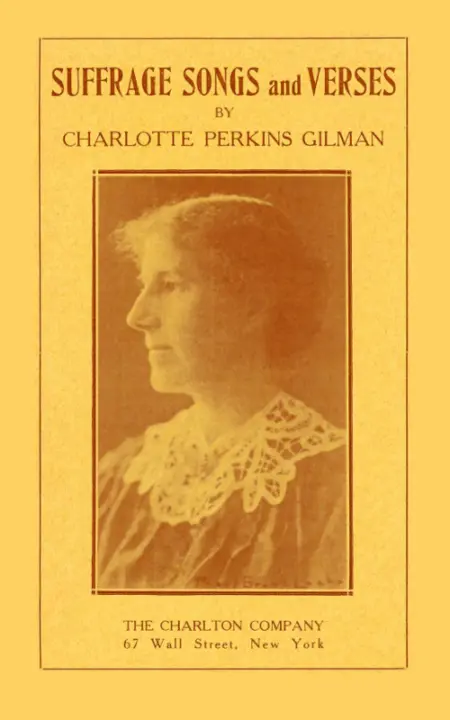
Charlotte Perkins Gilman
BEHIND THE BOOK
This eBook is for the use of anyone anywhere in the United States and most other parts of the world at no cost and with almost no restrictions whatsoever. You may copy it, give it away or re-use it under the terms of the Project Gutenberg License included with this eBook or online at www.gutenberg.org. If you are not located in the United States, you will have to check the laws of the country where you are located before using this eBook. Read the source licence.
The original source file, including credits and licence, is retained by this library. Request an original-format copy at no charge. Please include the book title and Project Gutenberg identifier #66864.
KEEP YOUR CURIOSITY GOING
Coulson Kernahan

Maurice Baring
Frances Wright
Cécile Tormay
Francis Greenleaf Allinson & Anne C. E. (Anne Crosby Emery) Allinson

Frederic Jesup Stimson